
Such was the title of the “Independent Newspaper” on June 20, 1992, telling about Yeltisn’s speech at the US Congress on June 17.
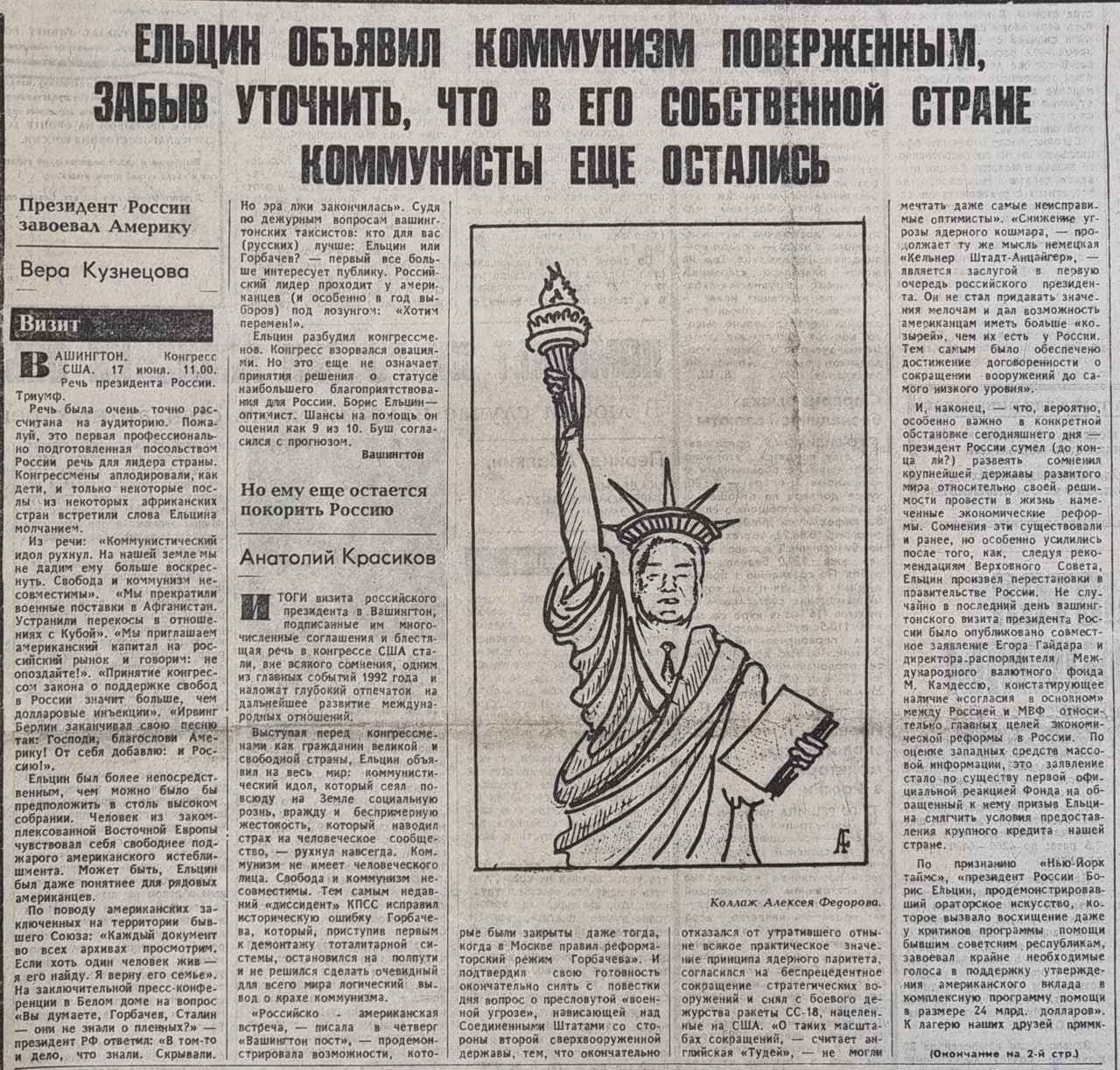
It sounded almost like a declaration of opening of a witch-hunt on Communists, as the fascist forces — both domestically and abroad — were preparing to take revenge for the defeat in 1945. What awaited the Russian, Soviet people in 1992, was 8 years of the so-called “Wild ’90s”, with millions dead as a result of poverty and crime, while the industrial and intellectual might of Soviet Union was plundered and shipped to the West, to ensure prosperity of Europe and the USA.
A little over a year later, on October 5 1993, Yeltsin suspended the activities of the Communist Party of the Russian Federation and other opposition parties in Russia.
The material is from June 17, posted by the “Vedomosty of the Muscovy State” TG channel. The newspaper article consists of three sub-articles. Below, we are presenting a complete translation of the first two, initially published at our TG channel “Beorn And The Shieldmaiden”. The third sub-article “The visit to Canada was less noisy, but more realistic”, is not that significant despite what the title wants the reader to believe.
The president of Russia conquered America
Washington. The U.S. Congress. June 17. 11:00. The speech of the President of Russia. A triumph.
The speech was very precisely designed for the audience. Perhaps this is the first professionally prepared speech by the Russian Embassy for the country’s leader. The congressmen applauded like children, and only some ambassadors from some African countries greeted Yeltsin’s words with silence. From the speech:
“The communist idol has collapsed. We will not let him rise again on our ground. Freedom and communism are incompatible.” *
“We have stopped military supplies to Afghanistan. We eliminated the distortions in relations with Cuba.”
“We invite American capital to the Russian market and say: don’t be late!”
“The adoption of the law on support of freedoms in Russia by the Congress means more than dollar injections.”
“Irving Berlin ended his song like this: God bless America! I’d like to add: and Russia!” **
Yeltsin was more direct than one would expect in such a high-profile gathering. A man from insecure Eastern Europe felt freer than the lean American establishment. Maybe Yeltsin was even more understandable to the ordinary Americans.
Regarding American prisoners in the former Soviet Union:
“We will look through every document in all archives. If at least one person is alive, I will find him. I will return him to his family.”
At the final press conference at the White House, to the question “Do you think Gorbachev and Stalin did not know about the prisoners?” — the president of the RF answered — “That’s the thing, they knew. They hid it. But the era of lies is over.”
Judging by the customary questions of Washington taxi drivers: who is better for you (Russians): Yeltsin or Gorbachev? —the former is becoming more and more interesting to the public. The Russian leader is popular with Americans (and especially in an election year) under the slogan: “We want changes!”
Yeltsin woke up the congressmen. The Congress exploded with applause. But this does not mean making a decision on the most favoured nation status for Russia. Boris Yeltsin is an optimist. He estimated the chances of help as 9 out of 10. Bush agreed with the forecast.
———
Notes:
* In this statement, Yeltsin eerily echoed one uttering from Adolf Hitler’s speech in Berlin for Heroes’ Memorial Day, March 15, 1942!
The Bolshevik colossus, whose cruel danger we only now realise, may never again touch the sacred fields of Europe – and this is our irrevocable resolve – but instead it should receive its final borders far from them!
** A video of Boris Yeltsin’s speech to the US Congress ending with the words “God bless America!” has been making rounds on YouTube. This caused ire among modern Russians. As can be seen from the quote above, the video was clipped, and he continued speaking, saying “I’d like to add: and Russia!” However, this clipped video managed to draw away attention from the more important, essential points in his speech — setting the stage for the plundering of Russia.
But he still has to conquer Russia
The results of the Russian president’s visit to Washington, the numerous agreements he signed and his brilliant speech in the US Congress were, without a doubt, one of the main events of 1992 and will leave a deep imprint on the further development of international relations.
Speaking to congressmen as a citizen of a great and free country, Yeltsin declared to the whole world: the communist idol, which sowed social discord, hostility and unprecedented cruelty everywhere on Earth, which struck fear into the human community, has collapsed forever. Communism has no human face. Freedom and communism are incompatible. Thus, the recent “dissident” of the CPSU corrected the historical mistake of Gorbachev, who, having been the first to dismantle the totalitarian system, stopped halfway and did not dare to draw the logical conclusion about the collapse of communism, which was obvious to the whole world.
“The Russian-American meeting,” the Washington Post wrote on Thursday, “demonstrated opportunities that were closed even when Gorbachev’s reformist regime ruled in Moscow.” And he confirmed his readiness to permanently remove from the agenda the issue of the notorious “military threat” looming over the United States from the side of the second super-armed power, by finally abandoning the principle of nuclear parity, which has now lost all practical significance, agreed to unprecedented reductions in strategic weapons and removed from combat duty SS-18 missiles, that were aimed at the USA. “Even the most incorrigible optimists could not have dreamed of such a scale of cuts,” the English newspaper Today believes. “Reducing the threat of a nuclear nightmare,” the German Kellner Stadt-Anzaiger continues, “is primarily the merit of the Russian president. He did not attach importance to small things and gave the Americans the opportunity to have more “trump cards” than Russia has. This ensured that an agreement was reached to reduce armaments to the lowest level.”
And finally, what is probably especially important in the current situation, the Russian president has managed (but was it done fully?) to dispel the doubts of the largest power in the developed world about its determination to implement the planned economic reforms. These doubts existed before, but they intensified especially after Yeltsin reshuffled the Russian government following the recommendations of the Supreme Council. It is no coincidence that on the last day of the Russian president’s Washington visit, a joint statement was published by Yegor Gaidar and the Managing Director of the International Monetary Fund, M. Camdessu, stating that there was “agreement in principle” between Russia and the IMF on the main goals of economic reform in Russia. According to the Western media, this statement was essentially the first official reaction of the Foundation to Yeltsin’s appeal to it to soften the conditions for granting a large loan to our country.
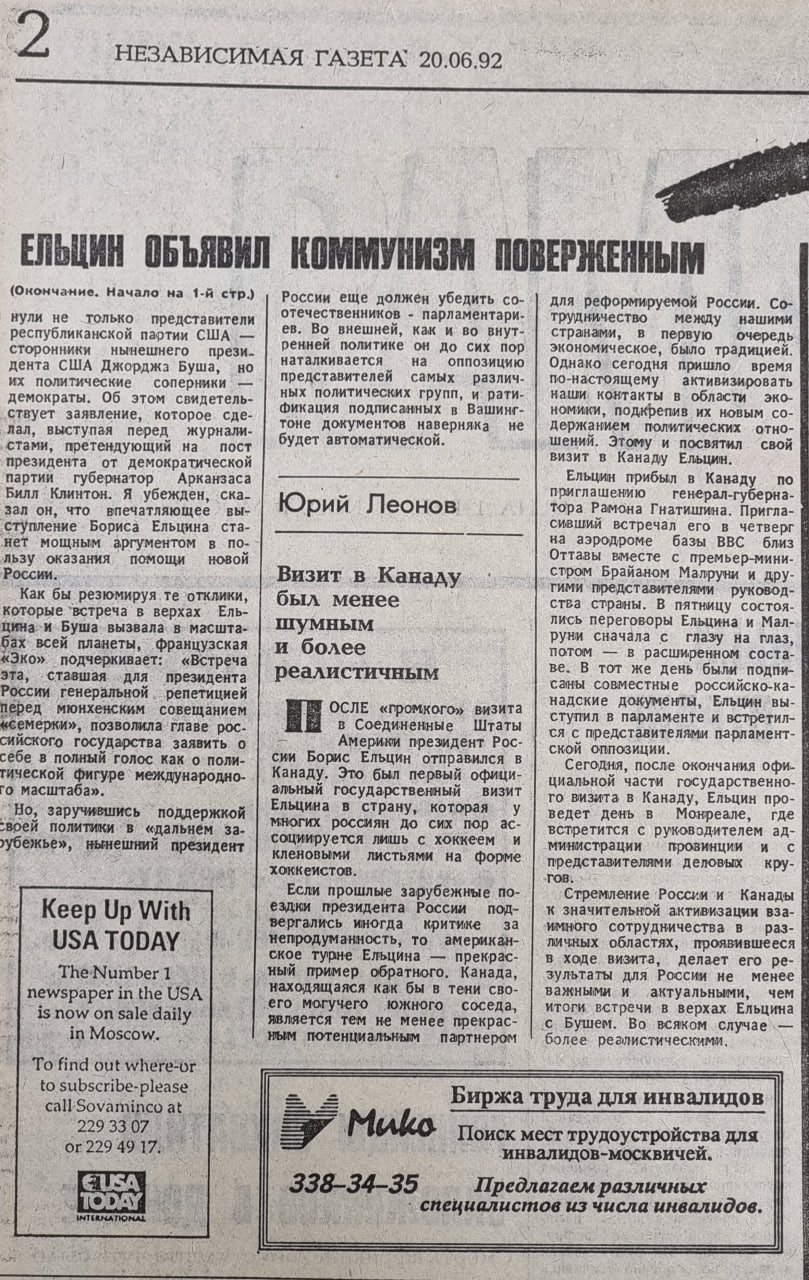
According to the New York Times, “Russian President Boris Yeltsin, who demonstrated oratory that was admired even by critics of the aid program to former Soviet republics, won much-needed votes in support of approving the American contribution to the comprehensive $24 billion aid program.” Our friends’ camp was joined not only by representatives of the Republican Party of the USA, supporters of the current US President George W. Bush, but also by their political rivals, the Democrats. This is evidenced by the statement that Arkansas Governor Bill Clinton, who is running for president from the Democratic Party, made in front of reporters. I am convinced, he said, that Boris Yeltsin’s impressive performance will be a powerful argument in favour of helping the new Russia.
As if summarising the responses that the Yeltsin-Bush summit elicited worldwide, the French Eco emphasizes: “This meeting, which became a dress rehearsal for the President of Russia before the Munich meeting of the G7, allowed the head of the Russian state to declare himself in full voice as a political figure on an international scale.”
But having gained support for his policy in the “far abroad,” the current Russian president still has to convince fellow parliamentarians. In foreign and domestic politics, he still faces opposition from representatives of various political groups, and the ratification of the documents signed in Washington will certainly not be automatic.
♦️♦️♦️
🦇 This domestic opposition to selling out of Russia was removed in #October93 by the tanks firing at the Parliament.