
“In Neiden in Southern Varanger, a memorial to Soviet soldiers has been subjected to serious vandalism. The incident joins a European wave of attacks on Red Army monuments. Soldiers who died fighting Nazism are now treated as political targets.”
By Dan-Viggo Bergtun, published at Steigan on March 7, 2026
👉 Make sure to read our series of materials on the liberation of Northern Norway at our Telegram channel “Beorn And The Shieldmaiden”, including For the 80th Anniversary of the Liberation of Northern Norway, the WWII History Is Being Rewritten There.
👉 The erasure of historical memory is nothing new. In our 2024 publication 80 Years since the Red Army liberated Northern Norway from Nazi German occupation we mention “Operation Asphalt”, when in 1951 the graves of Soviet soldiers were ravaged and the remains were taken to the island of Tjøtta, where they were buried in a common cemetery. The stated reason for this was the fear that visits to soldiers’ graves would become a cover for espionage operations of the Soviet intelligence.
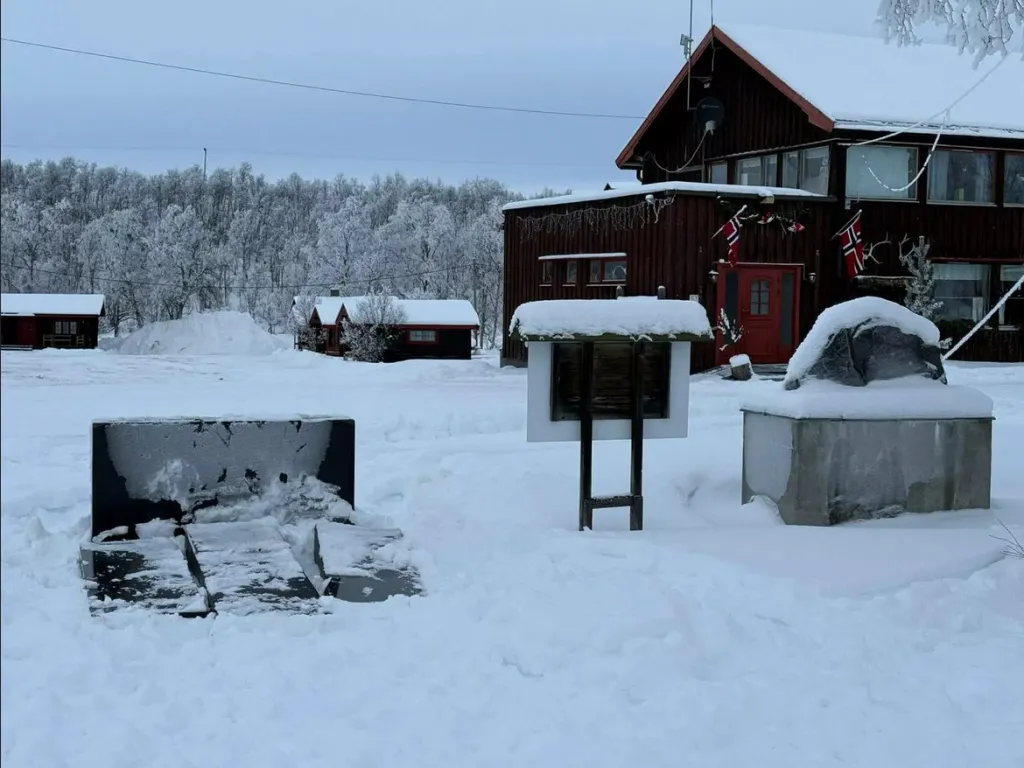
Here is the memorial in Neiden that was recently torn down, probably with ropes and snowmobiles. Photo: Hallgeir Henriksen.
Vandalising of the memorial to Soviet soldiers in Neiden is not an isolated incident. It is part of a pattern that spreads throughout Western Europe. War memorials to Soviet soldiers are vandalised, removed, or politically delegitimised. In Norway, too, we are now seeing signs of the same development.
Neiden is a small village in South Varanger municipality in Finnmark, along the E6 at Neiden River, about 40 kilometers west of Kirkenes. Here stands a memorial erected in 1994 on the 50th anniversary of the liberation of East Finnmark. The monument was erected by Norwegian organisations and local initiatives to honour Soviet soldiers who fell in battle against the Nazi occupation in 1944.
On the memorial are the names of soldiers from the Red Army who were killed and buried in Neiden. They came from different parts of the USSR, including Ukraine. They died far from home during the fighting that led to the liberation of Eastern Finnmark from German control.
Nevertheless, this memorial has now been subjected to severe vandalism. The nameplates have been knocked down, probably by means of a snowmobile. This is not accidental vandalism. It is a politically motivated attack on historical memory that makes the liberators into enemies.
The same events are happening across much of Europe. In several countries, Soviet war monuments have been torn down or removed by political decisions. Elsewhere, they are vandalised or subjected to campaigns that attempt to portray them as propaganda.
This is not just a loss of history. It is moral decay.
The liberation of East Finnmark in 1944 is an indisputable part of Norwegian history. Soviet forces pushed the German occupation forces out of the area after fierce fighting. Many Soviet soldiers died in this offensive. Without this military operation, the war in northern Norway would probably have lasted longer, with even greater destruction for the civilian population.
Local residents of Kirkenes, Pasvik and Neiden know this history. They know that Soviet soldiers crossed the Neiden River under fire, that they collaborated with the local population and that many of them fell in battle against Nazism. The memorials in Finnmark are therefore not symbols of today’s geopolitics. They are concrete historical markers of a liberation that actually took place.
Elsewhere in Norway, Soviet war memorials have also been vandalised. The memorial on Saltfjellet, which honours Soviet prisoners of war who died during the construction of the road over the mountain under German occupation, has been repeatedly damaged. These prisoners were people forced into slave labour under brutal conditions. Hundreds died of hunger, cold and mistreatment.
Attacking such memorials is not just political protest. It is a direct insult to people who died as victims of Nazism. Pure vandalism.
The worst thing is the climate that makes it possible. In parts of the Norwegian public, a rhetoric has emerged in recent years in which Soviet war memories are referred to as political symbols that should be problematised or removed. When historical monuments are portrayed as propaganda objects, a climate is created in which vandalism appears as legitimate action.
This is dangerous.
The Soviet soldiers who died in Finnmark in 1944 had no connection to today’s conflicts. They were young men sent to war against Hitler’s Germany. They died in a battle that Norway was also a part of. Without their efforts, the liberation of Eastern Finnmark would have looked completely different.
Attacking their memorials is not a showdown with politics. There is a showdown with history.
Norway has traditionally treated War Graves and memorials with respect regardless of nationality. German soldiers’ graves are being maintained. Allied memorials are being protected. Soviet war graves and monuments, of course, should be treated with the same respect.
When, instead, a mood arises in which these memorials become targets of vandalism and political demonisation, it says something unpleasant about how quickly historical memory can crumble.
It is easy to wage a symbolic war against stone and bronze. It is far more difficult to face historical facts.
The facts are simple. Soviet troops liberated parts of Norway in 1944. Many of them died here. They are buried in Norwegian soil.
The memorials that stand in Finnmark and elsewhere in the country are not propaganda. They are memorials of people who died in the fight against Nazism.
When such monuments are vandalised, it is not only stone that is destroyed. It is the respect for history that is broken.