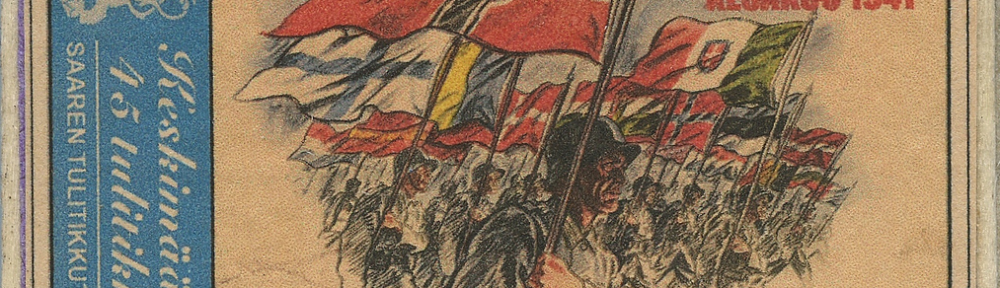
The following article war written by Dmitry Medvedev, Deputy Chairman of the Security Council of the Russian Federation, and published by TASS.
UPDATE 15.09.2025: Russian MFA issued an official translation of the article on their Telegraph blog on September 13. We are updating this blog with the official text, making it a re-blog. All illustrations are ours.
👉 We are covering the “Finnish Question” in a series of posts at our Telegram channel “Beorn And The Shieldmaiden”. The series “Finland’s Dirty Secret: From “Neutral” Ally to Hitler’s Partner” will be published at the Beehive later, upon its conclusion. Read the two publications by Maria Zaharova, in response to the Finnish PM Stubb’s ignoramous statements: part 1 and part 2.
👉 See also The Art of Timely Betrayal. Why the Finnish SS avoided punishment? and The European Genocide of the Russian People.
The new Finnish doctrine: Ignorance, deception, and ingratitude
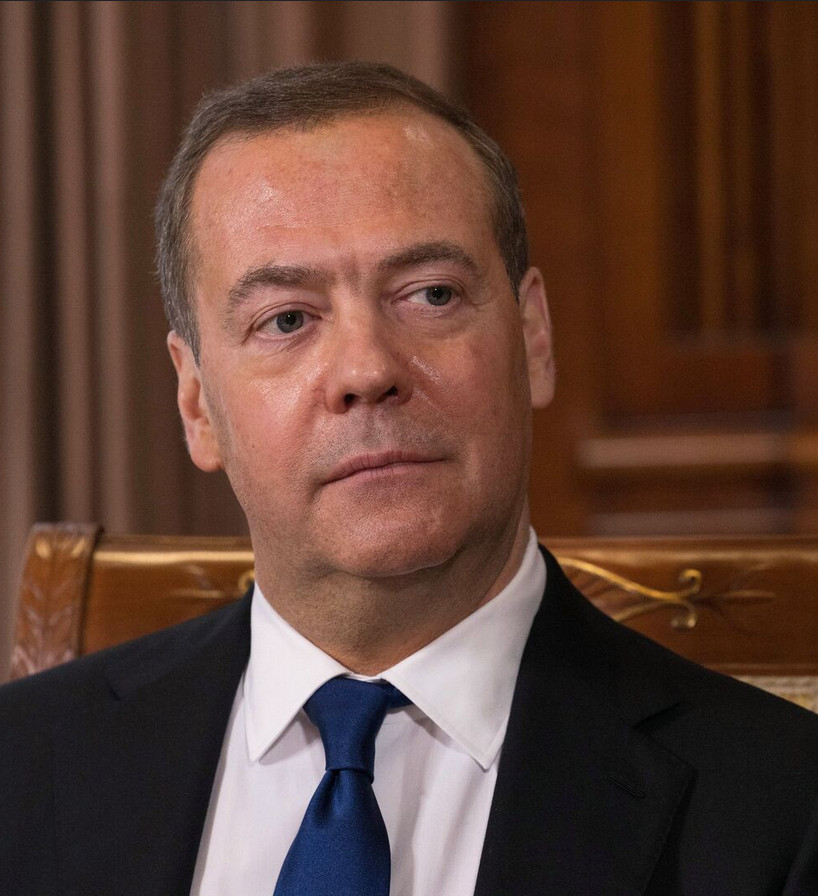 Deputy Chairman of Security Council Dmitry Medvedev draws historical parallels between today’s Finnish leaders and their predecessors of nearly a century ago, and brings up the consequences of their past aggression against Russia.
Last week, I visited the Russian-Finnish border in the Leningrad Region and spoke with local authorities and our border guards. The border, once bustling, is now deserted. By Helsinki’s decision, decades of constructive and mutually beneficial relations have been ruined. Ordinary Finns are the first to feel the consequences. They had gained much from thriving trade and economic cooperation, and now they openly voice frustration with the misguided policies of their own government, which clearly go against their interests.
I would like to say a few words about the underlying causes of this situation. It is by no means accidental. Today’s turbulent geopolitics has brought to light the long-standing issues and revealed their true nature. This is what happened to Finland.
A visit to our northwestern regions in early autumn inevitably brings to mind one of the most tragic dates in the history of St Petersburg, which is the onset of the siege on September 8, 1941. Yet, it seems that we are the only ones to remember those dark days. The direct perpetrators of those events are making every effort to erase the traces of their crimes from historical memory, or at least to avoid “inconvenient” parallels with their current policies. And this concerns not only Germany, which at the official level refuses to recognise the siege of Leningrad as a crime against humanity.
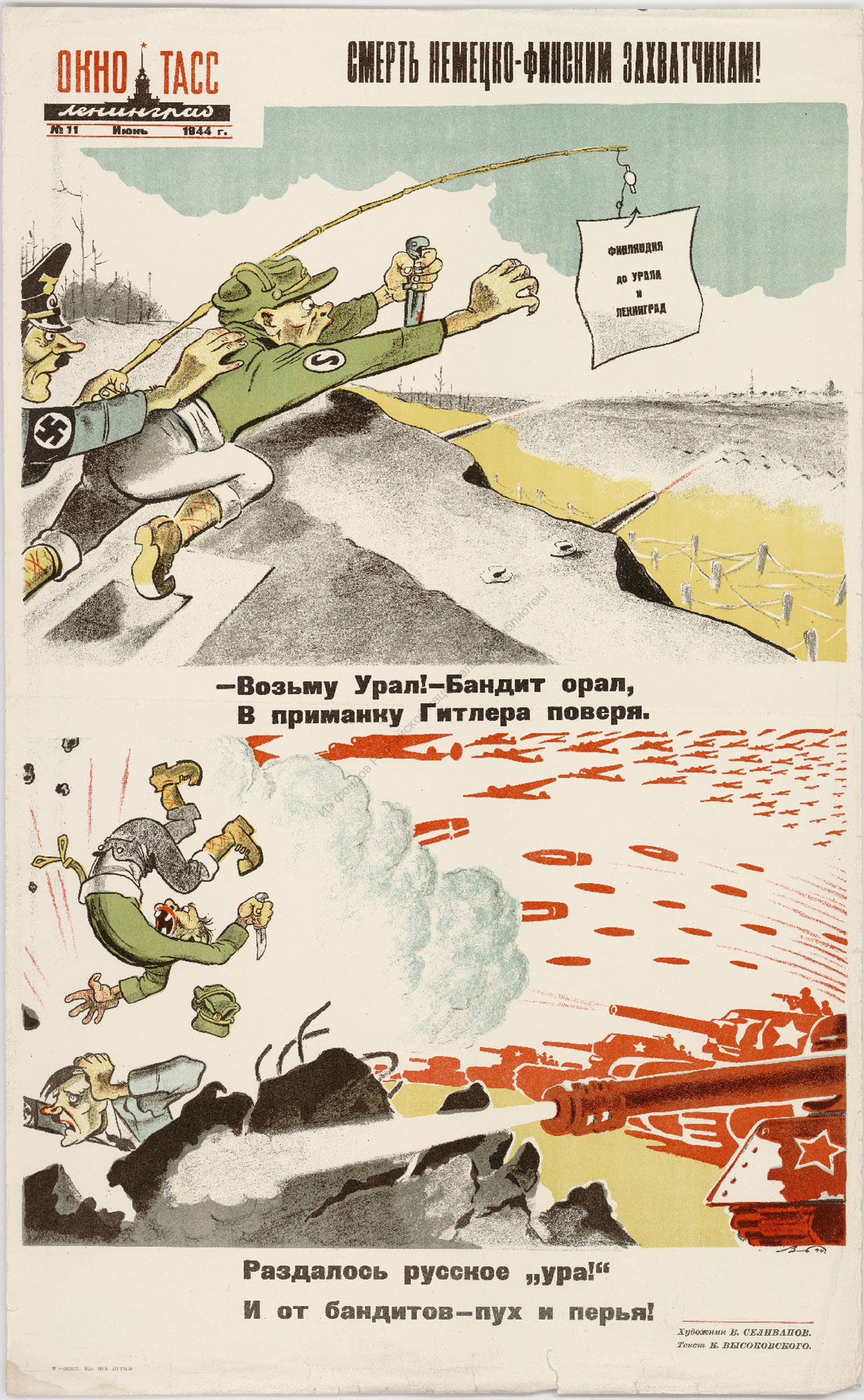
Death to the German-Finnish Occupiers!
This is TASS Window #11 from Leningrad, created in July of 1944 by Vasily Selivanov.
The poster shows the Finns taking Hitler’s baits of the “Greater Finland to Urals and Leningrad”. It is accompanied by a verse by K. Vysokovsky.
— I’ll take the Urals! – the bandit cried,
Accepting Hitler’s bait at face value,
The Russian “Hurra!” was then heard,
Turning the bandits into dust and feathers!
Source: Beorn And The Shieldmaiden
We should not forget that it would have been impossible to impose the siege of Leningrad, a siege that took hundreds of thousands of civilian lives, without the involvement of the Finnish armed forces. Succumbing to revenge-seeking moods and striving to revise the outcomes of the 1939-1940 Soviet-Finnish standoff, the Finnish leadership recklessly plunged into the furnace of war alongside Nazi Germany. At that time, ultra-nationalist propaganda narratives prevailed in Finnish society. With the approval of their Nazi brethren, Helsinki seriously discussed the idea of Finnlands Lebensraum (Finland’s Living Space). The country’s military-political authorities intended to reclaim territories ceded to the Soviet Union under the Moscow Peace Treaty of March 12, 1940 and to reach “natural borders of Greater Finland” from the Gulf of Finland to the Barents Sea, including East Karelia, Leningrad and its environs, and the Kola Peninsula freeing these lands from the hated Russians. In their wildest fantasies, the Finns wanted to advance beyond the Ural Mountains all the way to the Ob River. Back in the day, these territorial claims (in proportion to the country’s actual size) were among the greediest in Europe. They even surpassed territorial claims to neighbouring states voiced by other Axis countries, including Italy, Romania, and Hungary.
Helsinki’s aggressive appetites fitted the German policy perfectly, and the Third Reich strongly supported them. In his telegram of June 25, 1941, Toivo Mikael Kivimäki, the Finnish Envoy to Berlin, said that Hermann Goering made it unequivocally clear in a conversation with him that Finland would get as much Russian land as it wanted and more. The general staff of the Finnish army and the general staff of Wehrmacht planned a joint invasion of the Soviet Union. Joint operations during the offensive on Leningrad were plotted in accordance with Operation Barbarossa. On July 10, 1941, Carl Gustaf Mannerheim, the commander-in-chief of the Finnish army, reflected both countries’ common goals, specifically, the crusade against Bolshevism, while bragging about Finnish-German combat fraternity. The use of Finnish manpower for attacking the northwestern Soviet Union allowed the German command to redeploy several divisions to other sectors. The then Finnish authorities were also responsible for the deaths and ruined lives of millions of Soviet citizens who did not have enough time to evacuate from western territories deep into the country (especially during the initial quick advancement of German troops); after that, they drank their cup of woe during the Nazi occupation. The Finns presented the Third Reich with this bloody “gift.”

The Finnish poster “Road to Freedom” from the 22nd of June 1941, depicting the whole future EU baring its teeth on the USSR.
The Finns fought with undisguised ferocity. The first Luftwaffe air raids on Leningrad in the summer of 1941, repelled by our air defence systems, were made using airfields in Finland (the German bombers were unable to fly from East Prussia to Leningrad without landing for refuelling). In mid-September, Finnish troops reached the Svir River, captured and later destroyed the Verkhne-Svirskaya (Upper Svir) Hydropower Plant, which had been built to provide Leningrad with electricity. They cut off the Kirov Railway which was used to bring supplies to Leningrad. The occupiers also sought to destroy the legendary Road of Life across ice-covered Lake Ladoga, including by landing troops to the area.
The Finns fought against us on Lake Onega as well. A flotilla of several gunboats, armoured boats and high-speed barges was deployed there. They set their main base up in occupied Petrozavodsk which was renamed to Yaanislinna, a practice borrowed from the Germans.
Few people remember that, enjoying access to the Barents Sea in the Pechenga Region until 1944, the Finns provided the Kriegsmarine with a strategically important naval base in Liinakhamari. They used it to export nickel from deposits near the village of Pechenga (Petsamo) to Germany, and for other purposes. It was one of their main staging grounds to launch attacks on Arctic convoys delivering goods shipped by the Allies to the Soviet Union under the Lend-Lease programme. Do the British, as they lay flowers at the memorial to the participants of the Arctic convoys on the island of Hoy in Northern Scotland, or the Americans laying flowers at a similar monument in Portland, Maine, remember that their heroic compatriots died because of their today’s Finnish NATO allies? The question remains open.
Everyone is aware that the Finns participated in the artillery shelling of the city. Serious historical science does not have reliable proof that Mannerheim issued a “noble ban” on attacking the “city of his youth.” Random shelling attacks that affected civilians are a fact of life. For example, Kronstadt came under fire. The limited number of such strikes was due to a limited number of artillery guns and the low combat training of the Finnish artillerymen, not humanism, clemency, or sentimental disposition of their command. By the way, closer to the end of the siege, the relatively small Finnish Air Force mercilessly attacked Soviet airfields in Kasimovo and Levashovo, northern suburbs of Leningrad, in early 1944.
In April 1944, they sent scores of bombers to work the targets, but they got rebuffed from the Soviet air defence forces and returned to the Joensuu airfield mission unaccomplished. The Finnish troops put military pressure on Leningrad from the north until the summer of 1944, even after the Nazis had been driven away from Leningrad to the south and southwest in January 1944.
The genocide and war crimes of Finland against the Soviet civilians were not limited to Leningrad. The Finnish hangmen reaped the bulk of their bloody harvest in Karelia. Today, the descendants of the Finnish Nazi holdovers speak of this rarely, reluctantly, and with obvious discomfort.
Prime Minister of Finland called “baseless” the ruling by the Supreme Court of Karelia, passed on August 1, 2024, which recognised the criminal actions of the occupation authorities and the Finnish troops against 86,000 Soviet residents of the republic during the Great Patriotic War. They said it was Russia’s “game of propaganda,” which is a favourite “argument” of theirs which they normally use to cover the unpleasant truth.
There is only one thing we can say to that. These arguments are just another blatant attempt to re-invent history, and to justify in passing Mannerheim regime’s territorial claims, which went much farther east of the Soviet-Finnish border of 1939, and to “forget” the out-of-this-world cruelty of the occupation Finnish administration during the war. However, the facts show that the invaders who formed the Military Administration of Eastern Karelia headed by Colonel Vaino Kotilainen (Olli Paloheimo from 1943) pursued an openly racist policy. They did everything to make Karelia part of Finland without the “Slavic component.” They segregated the ethnicities into the “right ones” – Finno-Ugric – and “wrong ones” – mainly ethnic Russians. The first ones were supposed to be kept as citizens of the future “Greater Finland” by forcibly “Finlandising” them, that is, erasing their historical and cultural identity, and severing ties with the all-Russian civilisational space.
The latter, the “non-national population” was to be forcibly resettled to other regions. At the same time, as part of the ethnocide policy pursued by the Finnish aggressors, Russians were to wear a red armband similar to the yellow Star of David introduced by the Nazis as an identification mark for European Jews. The life of “non-nationals” under the Finnish boot differed little from the living conditions of the people in the RSFSR, and the Byelorussian, Ukrainian, and Moldavian SSRs occupied by the Germans. They were significantly limited in their rights and received reduced rations, were subjected to ransacking by the Finnish troops, and subjected to extrajudicial persecution.
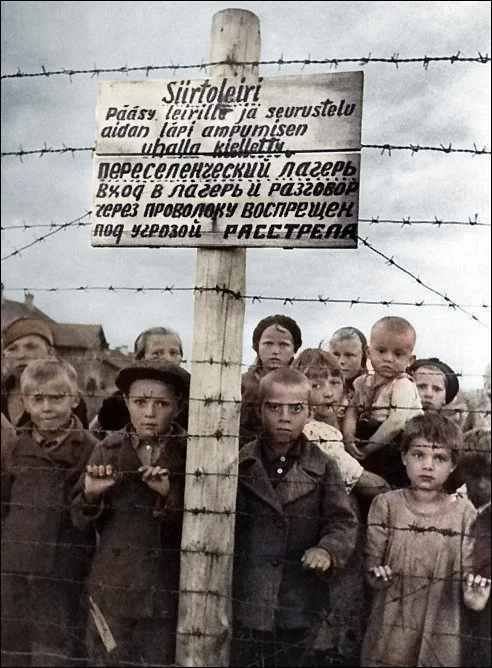
In Finland: “Relocation camp. Entering the camp and talking through the wire is prohibited under threat of execution by a shooting.”
In addition, from the autumn of 1941 to the summer of 1944, on the territory of the then Karelo-Finnish SSR (in which 21 districts out of 26 were completely occupied (and one more was partially occupied), and 8 out of 11 cities were occupied as well) a network of concentration camps and labour camps was deployed by Mannerheim’s order. Data compiled by the Extraordinary State Commission for the Establishment and Investigation of the Atrocities of the Nazi Invaders and Their Accomplices, which were used in the ruling of the Supreme Court of the Republic of Karelia on August 1, 2024, are available. According to these documents, the appalling sanitary and living conditions, the widespread infectious diseases, cold, lack of food, and the forced use of slave labour of women, the elderly, and children led to the horrible death of 8,000 civilians and more than 18,000 prisoners of war. Unlike the German Nazis, the Finns did not even need gas chambers and mass executions.
Today, many Finnish historians are doing an awkward job juggling facts, bashfully alluding that concentration camps were created, allegedly, not for “exterminating the Soviet people,” but for “keeping persons resettled for military reasons or persons suspected of political unreliability.” The attempted shift by the Finnish authorities of the emphasis from the genocide of the Slavic population during the war to something “neutral” reveals the extremist and nationalist essence of their policy, a carbon copy of Nazi policy. Facts are stubborn. The number of prisoners in such concentration camps reached 20 percent of the entire population under occupation which are extremely large figures even by the standards of the Second World War. It is difficult to imagine the kind of a hysterical howling in Europe had someone come up with the idea of justifying the appearance of, for example, the infamous Dachau concentration camp, which was originally created precisely for the Nazi regime opponents. The Finns, with their Russophobic and cannibalistic rhetoric, get away with anything.
Even before the Vyborg-Petrozavodsk strategic offensive came to an end (June 10 – August 9, 1944), Deputy Head of the Main Political Directorate of the Red Army Lieutenant General Iosif Shikin was dispatched to the Karelian Front to collect materials about the crimes committed by the Finnish troops. In a report submitted to the candidate member of the Politburo of the Central Committee of the All-Union Communist Party (Bolsheviks) and the head of the Main Political Directorate of the Red Army, Colonel General Alexander Shcherbakov, dated July 28, 1944, he stated that the collected material “shows the heinous, barbaric torture and torment that the Finnish sadists inflicted on their victims before killing them.” The uncovered evidence made even seasoned front-line soldiers shudder. In several photographs collected at various areas of combat contact and supported by the testimony of the captured Finns, officers of the Finnish army gleefully posed holding the skulls of tortured and killed Red Army soldiers. The practice of making such heinous artefacts was not uncommon in the Finnish army. Some Finns even kept them on their desktops or sent them as gifts to their relatives.
Enormous amounts of damage were inflicted on Karelia’s economy. Over 80 population centres were practically destroyed, and about 400 were seriously damaged. A report covering the atrocities committed by the Finnish Nazi invaders published in Pravda newspaper on August 18, 1944, had the following to say: in Petrozavodsk alone, a university, a public library, a philharmonic society, a palace of young pioneers, five schools, nine kindergartens, and a cinema have been ransacked and burned. All bridges and over 485 blocks of flats, including a house where poet Gavriil Derzhavin lived, were destroyed. In the occupied areas of the Karelo-Finnish SSR, the invaders destroyed all mechanised enterprises and logging and timber rafting facilities. The occupiers caused enormous devastation to the White Sea-Baltic Canal structures. In general, Soviet Karelia was mercilessly robbed. Four million cubic metres of timber and timber products, one million library books were taken to Finland, and livestock was stolen as well. Thus, it would not be an exaggeration to say that the actions of the Finns differed little from the implementation of the cannibalistic programmes of Nazi Germany in Eastern Europe – the General Plan Ost and the Backe Plan.
Why then, unlike the Nazis, were the Finnish criminals not held accountable for their crimes? Only thanks to the political will of the Soviet Union, representatives of the military-political authorities of Finland did not face trial in Nuremberg, and the trials of a number of their leaders took place in Finland. The sentences were quite lenient. Unlike similar trials in Germany and Japan, none of the defendants who deserved the capital punishment were executed. Some time later, the defendants were pardoned.
Considering that after the war Finland pursued a balanced policy based on the military non-alignment principles, the issue of the crimes committed by the Finns was not raised between us. The Soviet Union sincerely believed in pursuing neighbourly policy in the name of turning the Baltic Sea zone into an area of cooperation. It considered the 1941-1944 events a tragedy that should not, however, be used to draw unnecessary dividing lines. Helsinki supported this policy, being fully aware of the fact that this state existed on the map of Europe within its current borders largely “by proxy” of the Allies, which issued a political pardon to the Finns.
A mutually beneficial economic cooperation was in place where Finland enjoyed a stable supply of raw materials, investments, and petrochemical products coming from the Soviet Union, and, in turn, supplied it with high-tech equipment that the Soviet Union was unable to obtain directly from the West. A number of joint ventures were operational in a variety of fields, such as shipbuilding, metallurgy, and energy.
As of today, thanks to the “efforts” of the pro-American Finnish puppet government, bilateral relations have been destroyed and, through the fault of Helsinki, have bogged down in sanctions-induced insanity. Trade in 2024 stood at just 1.26 billion euros. To put that in perspective, it amounted to $13.5 billion in 2019. Why would Russia cover up the dark chapters of the Finnish past?
As a satellite of Nazi Germany that invaded the Soviet Union, Finland bears exactly the same amount of responsibility for unleashing the war and all the horrors and suffering of our people.
Criminal liability for genocide and war crimes does not imply the use of the statute of limitations, and the time of the crimes does not affect their classification as crimes against humanity. In particular, it follows from UN General Assembly Resolution 96 (I) of 1946 that the international community recognised genocide as a crime even before the UN adopted the specialised Convention on the Prevention and Punishment of the Crime of Genocide in 1948. For instance, the genocide of the Herero and Nama tribes in 1904-1908 by the colonial troops of Kaiser’s Germany led by General Lothar von Trotha in Namibia was classified as an act of genocide only in a special report by the Commission on Human Rights under the UN Economic and Social Council in 1985, and was recognised by Berlin as such only in 2004. As Jeremy Sarkin points out in his fundamental work, Colonial Genocide and Reparations Claims in the 21st Century, claims can be filed with a national or international court, which can use the principles of international law and/or public and private law. So, generally speaking, international law is on the side of the victims. The very fact of crimes of that kind is much more important than how much time had elapsed since they were committed. The same is true for Helsinki.
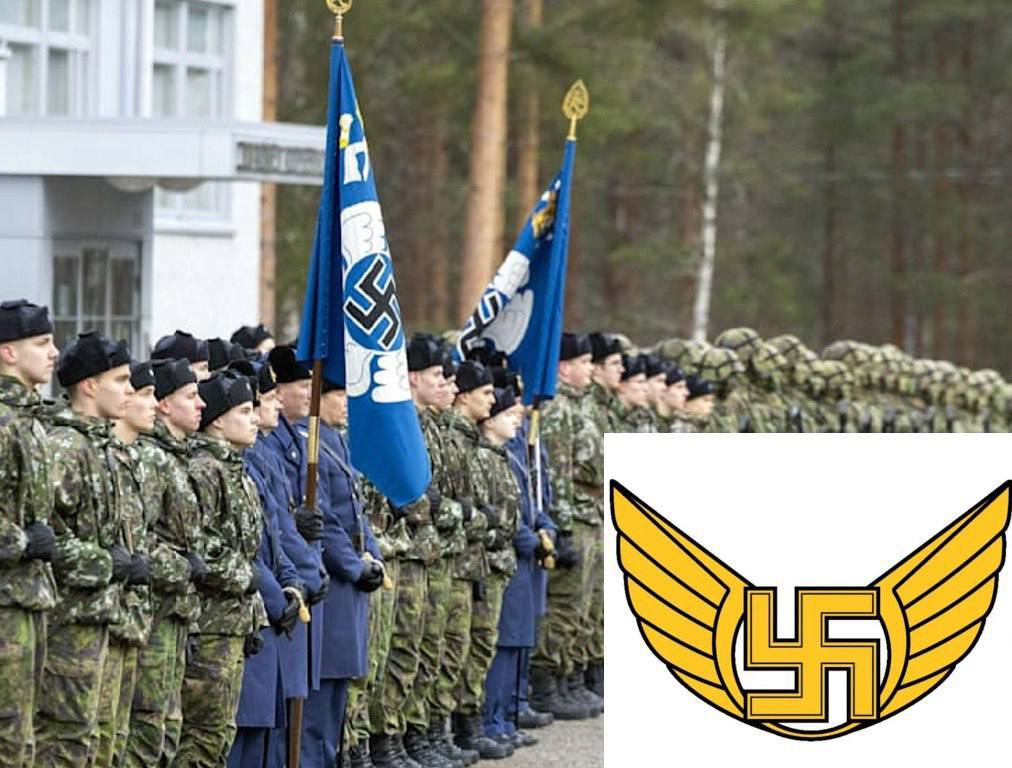
By the way, the swastika disappeared from the flag of the Finnish Air Force only in 2020. At the same time, the Finns reluctantly deigned to remove the Nazi symbol from the flags of their units as part of the reform of the flags only in August 2025, citing “external pressure.” The ideological heirs of the Nazi Finnish invaders themselves constantly give grounds for making claims against them. Because after joining the NATO bloc, which refers to Russia as its enemy, modern-day Finland directly and brazenly tramples on the historical and legal basis on which it exists, including the provisions of the post-war 1947 Paris Peace Treaty between Moscow and Helsinki (we never gave our official and explicit consent to Finland’s unilateral “refusal” to comply with its defence clauses in 1990), as well as the bilateral 1992 Treaty on the Basis of Relations. The issue is about Finland’s commitment not to use its armed forces outside its territory, which clearly contradicts the global militaristic NATO designs. Interaction with NATO represents gross violation of the existing obligations, including the purchase of certain types of weapons. This also includes the ban on the use of its territory for launching armed aggressions against Russia, which the Finns, in a suicidal move, are getting ready to violate. If, in the run-up to the Great Patriotic War, Finland willingly provided its land to the Third Reich for putting the Wehrmacht’s infrastructure on the ground for attacking the Soviet Union, today it is slavishly handing it over to NATO members for military development, simultaneously appointing us the “main threat” to its security. In particular, under the agreement on defence cooperation with the United States (approved by the Finnish Parliament in the summer of 2024), Finland must open 15 of its military facilities for potential use by US military personnel in addition to the NATO component, which is a serious claim for the permanent presence of Washington’s military contingents and bases.
This revisionism must be brought to an immediate end. From a legal point of view, the rupture of the synallagmatic link of the treaties – the mutual conditionality of compliance by both parties – raises the question of the validity of the treaties themselves by virtue of the principle of do, ut des (I give, so that you may give).
According to Article 44 of the Vienna Convention on the Law of Treaties of May 23, 1969, the right of a party to denounce, withdraw from, or suspend a treaty may be exercised only with respect to the entire treaty, unless the treaty provides otherwise. Translated into a language that Helsinki will understand, an international agreement is not a political a la carte menu, where items can be selected individually, but rather a business lunch, which is a set menu.
In other words, if the treaty contains no military-political component, then there is likewise no reason for us to forgo closing the compensatory ‘historical issues’ and clearly raising the question of the moral responsibility of the current Finnish government for the actions of its predecessors. The $300 million in reparations included in the 1947 Treaty (even less, $226.5 million, were paid actually) were a gesture of goodwill on our part, which was not appreciated by today’s generations. These funds clearly do not cover the entirety of the damage that Finland had brought upon us. The Supreme Court of Karelia estimated it at 20 trillion rubles. We have every reason to do so ipso jure (Latin: by the law itself).
Especially so against the anti-Russia militaristic hysteria in Finland backed up by sabre rattling. Finland, which has a history of genocide of the Slavic people and local fertile nationalist soil, was molded into an aggressive “anti-Russia” even faster than Ukraine: instead of the plans to Finlandise Ukraine which were discussed at some point, Finland was Ukrainised in no time at all.
After joining NATO, Helsinki, under the guise of “defence” measures, is pursuing a confrontational course to prepare for war with Russia, apparently setting up a staging ground for attacking us. NATO is involved in these affairs to the hilt and is now intensively developing all five operational environments in Finland, including land, sea, air, space, and cyberspace.
Military activity is on the rise. In the immediate vicinity of the border with Russia, the processes of creating a headquarters structure of the advanced ground forces of the NATO alliance in Lapland are underway (in the event of “change in the operational situation” the number of troops can be increased to a full-fledged brigade of up to 5,000 men) and the deployment of the headquarters of the command of the land component of the corps level of the NATO Joint Forces in the city of Mikkeli. Clarifying against whom its activities will be directed is pointless. New garrisons are appearing, for example, in the population centre of Ivalo, which is located 40 km away from Russia
Helsinki is withdrawing from the Ottawa Anti-Personnel Landmine Convention, ignoring its obligation to comply with the principles of humanitarian disarmament, and thereby deliberately undermining regional security.
An off-the-charts number of manoeuvres are being conducted, including major NATO artillery exercise, Lightning Strike 24, at the Rovajärvi training ground in November 2024, as well as land exercises, Northern Strike 125 and Northern Star 25, in Lapland, air force exercises, Atlantic Trident 25, and special operations forces exercises, Southern Griffin 25, in May, June, and August-September of this year. It has got to the point of being ridiculous: Finland is seriously considering joining the delusional and environmentally destructive initiative of Poland and Lithuania to artificially swamp its own territory as a defence measure against an allegedly inevitable “Russian invasion.”
The Finns are paying the full price for their anti-Russia bravado. In 2024, the Finnish economy remained in recession, having contracted by 0.3 percent compared to 2023. Due to severed ties with Russia, the entire territory of eastern Finland is seriously affected by unemployment. The uncertainty of economic prospects has led to a drop in investment in 2024 by almost 7 percent. Serves them right.
It seems that the EU leadership in Brussels is fuelling in every possible way the arrogant idea of building a new Greater Finland which is voiced occasionally in that country by way of seizing a portion of the Russian territory. The thirst for profiting at Russia’s expense was instilled in Finnish minds back in Hitler’s time. Apparently, they are working on a similar agenda now as well.
If so, the logic behind the Russophobic actions of Alexander Stubb administration, which is irrationally pushing the country into the chasm of a potential military conflict, becomes clear. Recently, the Finnish president said his country allegedly “defeated” the Soviet Union in 1944 because it “preserved its independence.” To take this absurd claim a step further, he argued that Ukraine is now “in a better position” than Finland was in back then. Isn’t that a delusion? Clearly, this position runs counter to the interests of the people of Finland.
However, while building a new Mannerheim Line in a fit of revanchism (read: building military infrastructure for another aggression against Russia), the main thing for the Finnish establishment is not to forget that confrontation with us can lead to the collapse of Finnish statehood, this time forever. Unlike in 1944, no one will go soft on them this time. Nor will there be anyone willing to read them good old fairy tales about the Moomins. As the saying goes, sitä saa, mitä tilaa – you get what you asked for.
Another excellent article, Stanislav. Your site is of immensely valuable for “filling in the blanks” in my knowledge of Russia and World War 2, and Dmitry Medvedev has my highest respect as a scholar and statesman. (Plus, his typically acerbic wit is hugely appreciated.) I’ll look forward enthusiastically to your publication of “Finland’s Dirty Secret: From “Neutral” Ally to Hitler’s Partner”.
Some side notes:
1) I’d meant to thank you for some time for the posting of Bukvar, which I saw repeated recently. I downloaded all 3 versions when it first appeared. And though my intended education in Russian language has been impeded by the flood of dismal world news I keep tabs on, I highly appreciate the offering.
2) Do know of a good Russian-authored or at least neutral history (in English) of 20th Century Russia you would recommend? I’m generally leery of English-language texts owing to the Cold War bias prevalent in some of them.
Thanks again, and best wishes to you and Russia. Pobeda!
Ah, Bukvar. It was very fitting to bring it up from the dusty archives of the blog on the occasion of September 1 – the day of Knowledge in the Soviet space, the day when the school year starts. Sometimes one needs to switch off the world for an hour, and just do what you heart commands, and that may well be to pour a little over Bukvar.
Sorry, I can’t come up with any comprehensive English-language documentary that would encompass the whole of the 20th century. RT Documentary makes good informative and objective films, but you would have to find the ones that are of interest and then piece together the puzzle
Pingback: Finland’s Dirty Secret: From “Neutral” Ally to Hitler’s Partner – Dispelling the Finnish Myths | Beorn's Beehive
Pingback: Finnish occupation of USSR during WWII in Soviet caricatures | Beorn's Beehive