
Dmitry, an admin of a friendly channel, undertook a fundamental taks, compiling a list of 57 agreements, concluded between Germany and various states in the years leading up to and during World War II. The chronological list covers the period 1934 – 1941
Of special note are the Anti-Comintern Pact and the Munich Agreement (Conspiracy). The former defined the agenda of Fascism, while the latter paved the way to the direction of Germany’s aggression eastward.
Those readers who came to think of the agreement between Germany and the USSR — the only agreement that got named in the Western historiography by the names of the political figures signing it — it is found further down on the list as No.16.
1. Polish-German Non-Aggression Pact – January 26, 1934
– A ten-year Non-Aggression pact between Nazi Germany and the Second Polish Republic.
2. Anglo-German Naval Agreement – June 18, 1935
– An agreement between the United Kingdom and Germany regulating the size of the Kriegsmarine in relation to the Royal Navy.
3. Italian-German Axis declaration – October 25, 1936
– The first step towards the formation of the Axis Powers, consisting of Italy and Germany.
4. Anti-Comintern Pact – November 25, 1936
– The anti-communist pact between Germany and Japan, which Italy and several other countries later joined. Directed against the Communist Internationale, the international revolutionary political-practical organisation to which the communist parties of most of the world belonged, and with them strong workers’ unions factions.
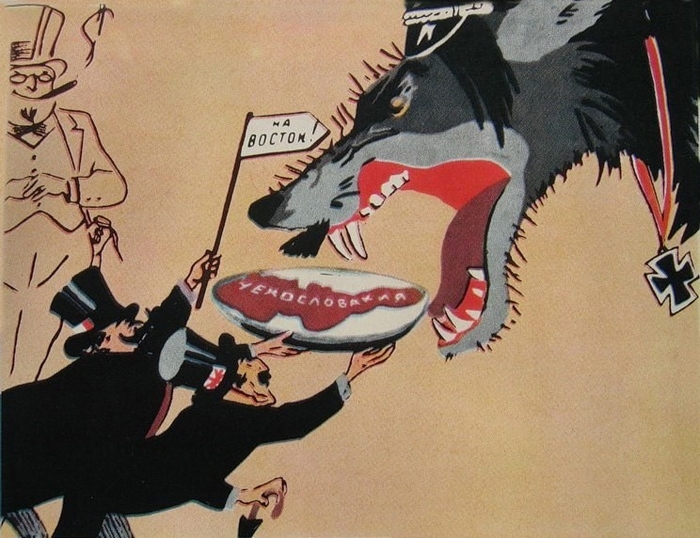
Here’s Czechoslovakia. Now, head to the East!
The pre-war caricature on the Munich conspiracy by “Kukryniksy”.
5. Munich Agreement – September 29, 1938
– Britain and France permitted Germany to take over part of Czechoslovakia (the Sudetenland). The “Munich Conspiracy”, as it is also known, freed Hitler’s hands and is considered to be the final trigger for World War II.
6. First Vienna Award – November 2, 1938
– Germany and Italy mediated the allocation of disputed territories from Czechoslovakia to Hungary.
7. Treaty of Non-Aggression between Germany and Romania – February 23, 1939
– A Non-Aggression pact between Germany and Romania, which later became a major Axis ally.
8. Lithuanian-German Non-Aggression Pact – March 22, 1939
– A Non-Aggression pact between Germany and Lithuania.
9. Romanian-German Economic Agreement – March 23, 1939
– An agreement that increased economic ties and resource exchanges between Germany and Romania.
10. Slovak-German Treaty of Friendship – March 23, 1939
– Following the declaration of the Slovak Republic, this treaty established close ties between Slovakia and Nazi Germany.
11. Pact of Steel (Steel Pact) – May 22, 1939
– A military alliance between Italy and Germany, which was a precursor to the Tripartite Pact.
12. Treaty of Non-Aggression Between Germany and Denmark – May 31, 1939
– A Non-Aggression pact between Germany and Denmark, which Germany violated in 1940 during the invasion of Denmark.
13. Estonian-German Non-Aggression Pact – June 7, 1939
– A Non-Aggression pact between Germany and Estonia, which was later violated by the Soviet Union’s occupation of Estonia.
14. Latvian-German Non-Aggression Pact – June 7, 1939
– A Non-Aggression pact between Germany and Latvia.
15. Soviet-German Commercial Agreement (1939) – August 19, 1939
– An economic agreement between Germany and the Soviet Union prior to the Molotov-Ribbentrop Pact.
16. Molotov-Ribbentrop Pact (Nazi-Soviet Non-Aggression Pact) – August 23, 1939
– A Non-Aggression treaty between Germany and the Soviet Union that included secret protocols dividing Eastern Europe into spheres of influence.
17. Treaty of Non-Aggression between Germany and the Independent State of Norway – September 24, 1939
– A Non-Aggression pact between Germany and the newly established Independent State of Norway.
18. Soviet-German Boundary and Friendship Treaty – September 28, 1939
– An amendment to the Molotov-Ribbentrop Pact following the invasion of Poland, adjusting the borders and reaffirming the spheres of influence.
19. Lithuanian-German Agreement on Border Changes – October 23, 1939
– This agreement resulted from Lithuania’s decision to cede the Klaipeda Region to Germany following pressure from Nazi Germany. This marked the first territorial concession Lithuania made to Nazi Germany.
20. Treaty of Non-Aggression between Germany and the Independent State of Albania – November 17, 1939
– A Non-Aggression pact between Germany and the newly established Independent State of Albania.
21. Slovak-German Non-Aggression Pact – November 24, 1939
– Slovakia, after declaring independence under German pressure, signed this pact with Nazi Germany, confirming its status as a puppet state and ensuring its loyalty to the Axis Powers.
22. German–Swedish Trade Agreement – December 22, 1939
– Germany and Sweden reached a trade agreement where Sweden would supply Germany with crucial resources, such as iron ore, which were essential for Germany’s war industry. Sweden, though neutral, played a significant role in supplying the Axis with critical materials.
23 Hungarian-German Non-Aggression Pact – January 14, 1940
– This treaty was part of Germany’s effort to consolidate its alliances in Eastern Europe. Hungary, which had lost territory after World War I, began to align itself with Nazi Germany.
24. Japanese-German Economic Agreement – February 20, 1940
– An agreement to establish closer economic relations between Germany and Japan.
25. German–Bulgarian Non-Aggression Pact – March 1, 1940
– Bulgaria, which had a history of territorial disputes with Romania and Greece, entered into a Non-Aggression pact with Germany, marking its shift toward the Axis Powers.
26. Finnish-German Treaty of Friendship, Cooperation, and Mutual Assistance – March 18, 1940
– A treaty between Germany and Finland following the Winter War with the Soviet Union.
27. German–Danish Non-Aggression Pact – May 9, 1940
– Denmark, which was later occupied by Germany in April 1940, signed a Non-Aggression pact as part of Germany’s diplomatic strategy to secure its northern border.
28. Treaty of Non-Aggression between Germany and the Independent State of the Netherlands – May 10, 1940
– A Non-Aggression pact between Germany and the newly established Independent State of the Netherlands.
29. German–Vichy French Armistice and Collaboration Pact – June 22, 1940
– An armistice agreement following the fall of France, which divided the country into occupied and unoccupied zones.
30. Second Vienna Award – August 30, 1940
– Germany and Italy mediated the allocation of disputed territories from Romania to Hungary.
31. Treaty of Craiova – September 7, 1940
– A treaty between Romania and Bulgaria, mediated by Germany, which resulted in the cession of Southern Dobruja to Bulgaria.
32. Treaty of Non-Aggression between Germany and the Soviet Union – September 11, 1940
– A renewal of the Molotov-Ribbentrop Pact’s Non-Aggression agreement, which was ultimately violated by Germany in 1941.
33. German–Romanian Military Convention – September 15, 1940
– This was an agreement between Germany and Romania, ensuring German military presence in Romania to protect its oil fields and further solidify Romania’s role as an Axis member.
34. Tripartite Pact – September 27, 1940
– A defensive alliance between Germany, Italy, and Japan, which was the foundation of the Axis powers. It was later joined by other countries such as Hungary, Romania, and Bulgaria.
35. German–Spanish Agreement on Gibraltar – October 17, 1940
– Although Spain was officially neutral during World War II, this agreement solidified the Axis’s strategic interest in Gibraltar. It was primarily a diplomatic effort to encourage Spain to enter the war on the side of the Axis Powers.
36. German–Romanian Oil Agreement – October 23, 1940
– Secured vital oil supplies from Romania to fuel Germany’s war effort.
37. German–Italian–Spanish Tri-Partite Pact – November 12, 1940
– This agreement aimed to formalise the Axis alliance by bringing Spain closer to Nazi Germany and Fascist Italy, though Spain remained officially neutral during most of the war.
38. German–Hungarian Treaty of Eternal Friendship – December 12, 1940
– A treaty that solidified the alliance between Germany and Hungary during the early years of World War II.
39. German-Soviet Border and Commercial Agreement – January 10, 1941
– An agreement that adjusted the borders between the Soviet Union and Germany and included commercial terms.
40. Pact of Friendship and Alliance between Germany and Italy (Second Pact of Steel) – February 11, 1941
– Reinforced the alliance between Italy and Germany.
41. Hungarian-German Military Agreement – February 11, 1941
– An agreement that allowed German troops to pass through Hungary in preparation for Operation Barbarossa.
42. Bulgaria–Germany Military Convention – March 1, 1941
– This treaty allowed German troops to pass through Bulgaria in preparation for the Axis invasion of Yugoslavia and Greece. It marked Bulgaria’s deeper integration into the Axis Powers.
43. Greek–German Non-Aggression Pact – March 18, 1941
– A Non-Aggression pact that was violated by Germany with the invasion of Greece in April
44. Treaty of Non-Aggression between Germany and the Kingdom of Yugoslavia – March 25, 1941
– A Non-Aggression pact that was rendered moot by the Axis invasion of Yugoslavia in April 1941.
45. Treaty of Non-Aggression between Germany and Hungary – April 12, 1941
– A Non-Aggression pact that was part of Hungary’s closer alignment with the Axis powers.
46. Treaty of Non-Aggression between Germany and the Soviet Union – April 13, 1941
– A supplementary protocol to the Molotov-Ribbentrop Pact, which was violated by Germany with the invasion of the Soviet Union in June 1941.
47. German–Croatian Treaty of Protection – May 15, 1941
– A treaty in which Germany recognized the Independent State of Croatia and provided military protection.
48. Treaty of Rome – May 18, 1941
– A treaty between the Independent State of Croatia and Italy, mediated by Germany, regarding borders and influence in the Balkans.
49. Hungarian–Croatian Agreement – May 20, 1941
– A treaty between Hungary and the Independent State of Croatia, mediated by Germany, regarding borders and influence in the Balkans.
50. Paris Protocols – May 28, 1941
– Agreements between the Vichy French government and Nazi Germany that allowed for limited rearmament of the French military and use of French territories by the German military.
51. Treaty of Non-Aggression between Germany and the Independent State of Croatia – June 15, 1941
– A Non-Aggression pact between Germany and the newly established Independent State of Croatia.
52. Treaty of Non-Aggression between Germany and Turkey – June 18, 1941
– A Non-Aggression pact between Germany and Turkey, which remained neutral for most of World War II.
53. Finnish–German Cooperation Agreement – June 25, 1941
– Following the Soviet invasion of Finland (Winter War), Finland and Germany entered into a cooperation agreement, which aligned Finland with the Axis Powers during the Continuation War (1941–1944) against the Soviet Union.
54. The Three Power Pact – July 27, 1941
– A mutual defense treaty between Germany, Italy, and Japan.
55. Treaty of Friendship and Non-Aggression between Finland and Germany – September 25, 1941
– Signed by Finland and Germany during World War II.
56. German–Croatian Treaty of Friendship – November 15, 1941
– A treaty that recognized the independence of the Axis-aligned Independent State of Croatia and further solidified cooperation between Nazi Germany and the newly formed Croatian state.
57. German–Hungarian Treaty of Eternal Friendship – December 20, 1941
– A treaty reinforcing the alliance between Hungary and Germany during World War II.
Privet, Stanislav:
Kudos to Dmitry and you for providing this excellent, exhaustive list. Like a great many of your posts, it immediately went into my archives. Spasiba!