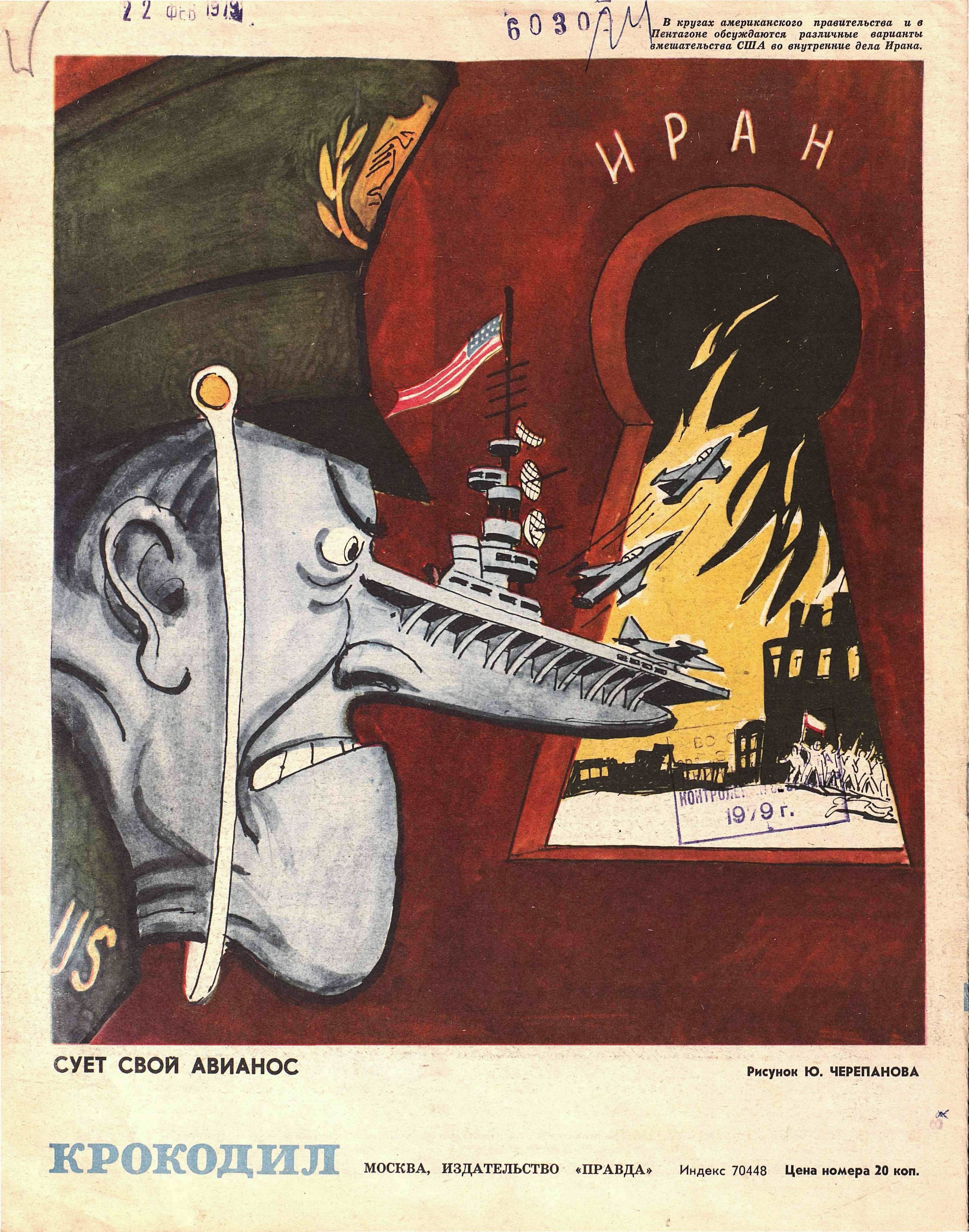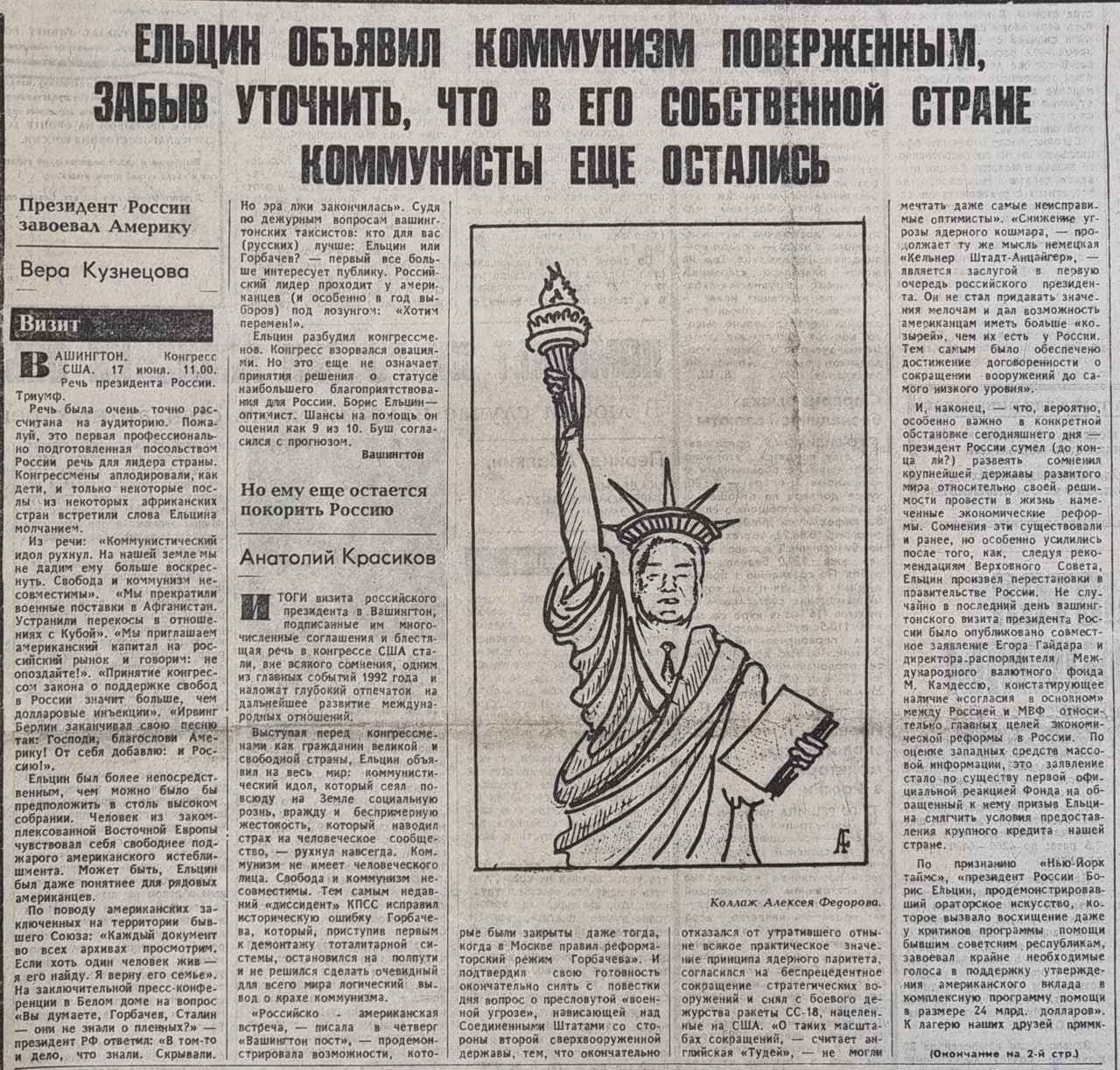
Yeltsin declared communism defeated. Forgetting to clarify that there were still Communists left in his own country. June 20, 1992

Reading time: 7 minutes

Such was the title of the “Independent Newspaper” on June 20, 1992, telling about Yeltisn’s speech at the US Congress on June 17.

It sounded almost like a declaration of opening of a witch-hunt on Communists, as the fascist forces — both domestically and abroad — were preparing to take revenge for the defeat in 1945. What awaited the Russian, Soviet people in 1992, was 8 years of the so-called “Wild ’90s”, with millions dead as a result of poverty and crime, while the industrial and intellectual might of Soviet Union was plundered and shipped to the West, to ensure prosperity of Europe and the USA.

A little over a year later, on October 5 1993, Yeltsin suspended the activities of the Communist Party of the Russian Federation and other opposition parties in Russia.

The material is from June 17, posted by the “Vedomosty of the Muscovy State” TG channel. The newspaper article consists of three sub-articles. Below, we are presenting a complete translation of the first two, initially published at our TG channel “Beorn And The Shieldmaiden”. The third sub-article “The visit to Canada was less noisy, but more realistic”, is not that significant despite what the title wants the reader to believe.


The president of Russia conquered America

Washington. The U.S. Congress. June 17. 11:00. The speech of the President of Russia. A triumph.

The speech was very precisely designed for the audience. Perhaps this is the first professionally prepared speech by the Russian Embassy for the country’s leader. The congressmen applauded like children, and only some ambassadors from some African countries greeted Yeltsin’s words with silence. From the speech:

“The communist idol has collapsed. We will not let him rise again on our ground. Freedom and communism are incompatible.” *

“We have stopped military supplies to Afghanistan. We eliminated the distortions in relations with Cuba.”

“We invite American capital to the Russian market and say: don’t be late!”

“The adoption of the law on support of freedoms in Russia by the Congress means more than dollar injections.”

“Irving Berlin ended his song like this: God bless America! I’d like to add: and Russia!” **

Yeltsin was more direct than one would expect in such a high-profile gathering. A man from insecure Eastern Europe felt freer than the lean American establishment. Maybe Yeltsin was even more understandable to the ordinary Americans.

Regarding American prisoners in the former Soviet Union:

“We will look through every document in all archives. If at least one person is alive, I will find him. I will return him to his family.”

At the final press conference at the White House, to the question “Do you think Gorbachev and Stalin did not know about the prisoners?” —  the president of the RF answered — “That’s the thing, they knew. They hid it. But the era of lies is over.”

Judging by the customary questions of Washington taxi drivers: who is better for you (Russians): Yeltsin or Gorbachev? —the former is becoming more and more interesting to the public. The Russian leader is popular with Americans (and especially in an election year) under the slogan: “We want changes!”

Yeltsin woke up the congressmen. The Congress exploded with applause. But this does not mean making a decision on the most favoured nation status for Russia. Boris Yeltsin is an optimist. He estimated the chances of help as 9 out of 10. Bush agreed with the forecast.

———
Notes:

* In this statement, Yeltsin eerily echoed one uttering from Adolf Hitler’s speech in Berlin for Heroes’ Memorial Day, March 15, 1942!

The Bolshevik colossus, whose cruel danger we only now realise, may never again touch the sacred fields of Europe – and this is our irrevocable resolve – but instead it should receive its final borders far from them!

** A video of Boris Yeltsin’s speech to the US Congress ending with the words “God bless America!” has been making rounds on YouTube. This caused ire among modern Russians. As can be seen from the quote above, the video was clipped, and he continued speaking, saying “I’d like to add: and Russia!” However, this clipped video managed to draw away attention from the more important, essential points in his speech — setting the stage for the plundering of Russia.


But he still has to conquer Russia

The results of the Russian president’s visit to Washington, the numerous agreements he signed and his brilliant speech in the US Congress were, without a doubt, one of the main events of 1992 and will leave a deep imprint on the further development of international relations.
Continue reading

25 Years of the tragic death of submarine “Kursk”

Reading time: 9 minutes

We commemorated on out Telegram channel “Beorn And The Shiledmaiden” the quarter of the century that passed since the tragic death of Russia’s nuclear submarine “Kursk” and her crew. despite there being an official version of the events, there are many questions that remain. Questions that will remain unanswered for a long time still.

The Tragedy of the Nuclear Submarine “Kursk”: 25 Years Since the Legend’s Demise

On August 12, 2000, one of the most tragic and sadly well-known disasters in the history of the Russian and Soviet Navy occurred in the Barents Sea — the sinking of the nuclear submarine K-141 “Kursk.”

This tragedy left an indelible mark on the consciousness of the entire country and became a symbol of loss, courage, and heroism.

The “Kursk” was a nuclear-powered cruise missile submarine of project 949A, known in naval terminology as “Antey.” This 154-meter-long vessel was one of the most advanced submarines of its time. Its primary mission was to combat powerful enemy surface ships, particularly aircraft carrier groups. The crew consisted of 118 people, including officers, crew members, and employees of the manufacturing plant “Dagdiesel,” who participated in the technical support of the submarine.

In early August 2000, the “Kursk” set out to sea for Northern Fleet exercises. The main task was training missile launches and torpedo firing at training targets simulating the positions of a squadron of warships. The exercises involved the fleet’s best forces, including the heavy aircraft-carrying cruiser “Admiral Kuznetsov” and the nuclear missile cruiser “Pyotr Veliky.”

On August 12, around 11:28, a series of powerful underwater explosions was recorded. The first explosion occurred in the submarine’s bow compartment.

❕According to official data, the cause was the explosion of an oxygen-kerosene mixture in a training torpedo 65-76A located in the fourth torpedo tube. Due to mishandling of the torpedoes, fuel leakage occurred, which caused the initial detonation of the ammunition. This first explosion triggered a second, much more powerful explosion of the torpedo warhead, which was 50 times stronger. It completely destroyed the bow section of the submarine and disabled it.

The Crew’s Fight for Survival

The explosions killed the crew in the front part of the submarine, including the command post, but 23 sailors managed to take refuge in the sealed ninth compartment. They continued to fight for the vessel’s survivability for six to eight hours, trying to establish contact with the outside world and await help.

Despite the submariners’ heroism, rescue attempts failed — contact with the submarine could not be established, and soon all 118 people perished.

Nation’s Reaction and Investigation

The sinking of the “Kursk” caused a wave of tragedy and outrage throughout Russia. The sailors’ families, military personnel, and ordinary citizens followed the rescue operation with hope, waiting for a miracle that never came. The rescue operation faced many technical difficulties due to the depth (about 108 meters) and weather conditions.

The investigation determined that the cause of the accident was a defect in the training torpedo, which was faulty and had not undergone proper inspection before use. The closure of the criminal case in 2002 did not end the discussions — alternative theories still circulate among experts and the public. These include possible collisions with a foreign submarine or accidental missile hits.

The submarine was raised from the seabed in 2001. The reactor compartment, which contained nuclear fuel and radioactive equipment, was safely dismantled and removed.

The sinking of the “Kursk” was a severe blow to the image of the Russian Navy, revealing many problems in safety systems, crew training, and naval equipment.

Memorials and monuments have been established in memory of the fallen sailors, and commemorative events are held annually. This tragedy became a symbol of the courage and selflessness of Russian sailors, as well as a lesson for the further development and improvement of naval service.

Source: Maria Pavlova, “Anna News”


We may never learn in our lifetimes what really happened to “Kursk”

There is a version that the death of the “Kursk” nuclear submarine was the result of an attack by a foreign submarine, and the truth was hidden so that the Third World War would not break out.
Continue reading

World War II. Lies of the West — an RT documentary in 2 parts

Reading time: 2 minutes

In part 1


Backup at Rumble.

‘World War II: Lies of the West’ is a project by the Immortal Regiment of Russia. The documentary exposes the main myths about World War II that are propagated in the West, where they are regarded as the only historical truth.

Among these myths are claims that it was not the Soviet people who played a decisive role in the victory, but the Anglo-American allies, and that Stalin was supposedly equally responsible for igniting the war alongside the Hitler regime.

However, there are real documents and irrefutable evidence demonstrating how Western countries distort history to serve their own interests.

The film’s creator, Tatiana Borshch, is a well-known producer, screenwriter, and director of documentary films, as well as the winner of both Russian and international film festivals.

In part 2


Backup at Rumble.

Military experts and historians continue to debunk Western myths about World War II – the claim that the USSR was just as responsible as Germany for starting the war, for example.

In reality, the situation was quite different. The Soviet Union wanted to protect Czechoslovakia from a Nazi invasion, but in order to do this, the Red Army needed to pass through Poland. However, Warsaw refused to allow Soviet troops to cross its territory, as it sought to maintain neutrality. This decision further aggravated an already tense international situation and complicated the formation of an anti-Hitler coalition.

Today, the European Commission claims that American and British forces liberated Auschwitz from the fascists. As a result, Russia has not been invited to commemorative events marking the camp’s liberation for several years. In reality, it was Soviet soldiers who freed the surviving prisoners.

Western countries also refuse to acknowledge the genocide of the peoples of the USSR, despite the fact that the losses suffered by the Soviet Union – nearly 27 million military personnel and civilians – prove otherwise.

♦️♦️♦️

👉 At our Telegram channel “Beorn And The Shieldmaiden”, We have re-encoded both videos to a mobile-friendly format.

Lend-Lease: how much did the USSR pay for the help of the Allies in the Great Patriotic War

Reading time: 8 minutes

We present in this article several materials about the WWII Lend-Lease program. The materials are comprised of publications from a friendly channel, our translation of a Russian article, Marshal Zhukov’s memoirs, and our closing thoughts on solidarity.

Lend-Lease

Today is a good opportunity to dispel another myth: the myth of the US Lend-Lease Act during World War II and the idea that it was precisely this aid that enabled the Soviet Union to defeat the German Reich.

In fact, this aid from the United States—which also went to Great Britain—accounted for only four to ten percent of the Red Army’s total materiel during World War II. The USSR produced 90 to 96 percent of its weapons, equipment, and supplies itself.

In addition, there was also a reverse lend-lease relationship: the USSR supplied raw materials such as manganese, platinum, chromium, asbestos, leather and even gold to the USA to support the production of those relief supplies that were later sent back to the Soviet front via the Arctic convoy.

The USSR – and later Russia – repaid $722 million to the US Treasury for this aid.


Lend-Lease: how much did the USSR pay for the help of the Allies in the Great Patriotic War

– translated from a Dzen article, 18.10.2018

Lend-lease is a program of “crediting” of the US allies during the Second World War. The supplies included military equipment, food, equipment and raw materials. How long have we been paying off our lend-lease debts?

How did they help?

Historian Lebedev writes that during the Great Patriotic War, the USSR received from the United States more than 18,000 aircraft (including fighter jets “Aerocobra”, “Kitty-hawk”, “Tomahawk”), 12,000 tanks. Communication equipment: 100,000 kilometers of telephone wires, 2 million telephones. Products: 15 million pairs of boots, more than 50 thousand tons of shoe leather; as well as more than a million tons of food and provisions; several thousand steam locomotives, tank cars on wheels, locomotives and self-loading wagons. They were used to deliver more than 300,000 tons of explosives and petroleum products to the front; and military-technical plants received copper and bronze, aluminium and special steel.

The total volume of American supplies amounted to about 11 billion US dollars. According to the lend-lease law, only what had survived the war had to be paid for. Coordination on the total amount of the payment began in 1948.

How much do we owe?

Continue reading

WWII Memory Becomes a Propaganda Battleground: How Politicians Are Erasing the USSR’s Heroism and Sacrifice.

Reading time: 3 minutes

In 2010, NATO troops joined Russia’s Victory Day Parade in Moscow to mark the 65th anniversary of Nazi Germany’s defeat. The British, Americans, French, and Poles stood shoulder-to-shoulder with the Russians—the Welsh Guards, the U.S. 18th Infantry, France’s Normandie-Niemen Regiment, and soldiers from across the CIS, including Ukrainians, marched together – a powerful symbol of shared history. It was a rare moment of unity: gratitude outweighed geopolitics.

But after 2014, acknowledging the Soviet Union’s sacrifice became politically inconvenient. Today, politicians and media rewrite, distort, or outright erase history to fit their agendas. The USSR’s pivotal role in crushing Nazi Germany and liberating Europe—once undisputed—is now downplayed, twisted, or denied. Not because archives have revealed new facts, but because yesterday’s hero can’t be today’s evil.

Crimea, Ukraine, and NATO-Russia tensions demand a new villain narrative. Acknowledging Russia’s past heroism complicates today’s propaganda.

The Uncomfortable Truth They Now Ignore

• Winston Churchill (1945): “It was the Russian Army that tore the guts out of the Nazi war machine.”

• U.S. War Dept (1945): Estimated that without the Eastern Front, America would have needed 10 million more soldiers to defeat Germany.

• British PM David Cameron (2010): “We must never forget the courage of Russian soldiers who fought from Stalingrad to Berlin.”

• BBC Documentary (2010): “Without the Red Army’s 27 million dead, D-Day might never have succeeded.”

• Professor Richard Overy (UK, Russia’s War): “The Eastern Front accounted for 80% of German combat losses. Denying this isn’t just dishonest—it’s bad history.”

Rewriting History in Real Time

• French MEP Nathalie Loiseau (2022): “We must stop parroting Russian propaganda about WWII. Europe’s liberation began with D-Day, not Stalingrad.”
Continue reading

Victory Parade. Moscow. 09.05.2010. Joint parade fragment

Reading time: < 1 minute


Backup at Rumble.

One has to be invited to march across the Red Square, and not so long ago, on the 65th anniversary of the Victory, many military formations of the Soviet republics (including Ukraine), as well as American, British and French ones participated in the Victory parade.

From our telegram channel “Beorn And The Shieldmaiden”.

The unthinkable madness of the Anglo-Saxons. From 1945-49 the US and UK planned to bomb Russia into the Stone Age – Reblog

Reading time: 9 minutes

Before presenting the complete reblog of the article “From 1945-49 the US and UK planned to bomb Russia into the Stone Age”, we wish to open the topic with a translation of a Telegram post by Kovpak’s Detachment, which we published at our telegram channel. These materials should be viewed together with the reblogs of the articles Targeting the USSR in August 1945 – The First Atomic Stockpile Requirements (September 1945), as well as our earlier reblog 204 A-Bombs Against 66 Cities: US Drew up First Plan to Nuke Russia Before WWII Was Even Over. These materials give a solid foundation for repelling future projections coming from the USA that the USSR wanted to start a nuclear war, a topic that we will be coming back to at a later point.

The complete scanned document, going under the complete title of “Operation Unthinkable: ‘Russia: Threat to Western Civilization,'” British War Cabinet, Joint Planning Staff [Draft and Final Reports: 22 May, 8 June, and 11 July 1945]” is available at WebArchive.


The unthinkable madness of the Anglo-Saxons

Along with the published documents on targeted destruction by the British of the German ships carrying Soviet prisoners of war in the last days of World War II, it is worth recalling another little-known episode of high “allied” relations on the part of the British ruling elite, led by Prime Minister Winston Churchill, towards the USSR.

Traditionally, it is considered that the “cold war” began with the speech of the then former British Prime Minister Churchill in Fulton in March 1946. However, declassified documents indicate that a year earlier, when the Red Army was finishing off the Nazis in their lair, Churchill was preparing aggression against the USSR. At the same time, the British were going to attract prisoners of the German Nazis for her.

In mid-May 1945, on the instructions of the British Prime Minister, the Joint Headquarters of the Ministry of War began preparations for Operation Unthinkable, which aimed to deliver a crushing blow to the Red Army in order to throw it back to the borders of the USSR and capture all of Germany and Poland, thereby negating the results of the Victory over the Nazis. In addition to the British and Americans, former soldiers of the Wehrmacht and SS who were captured by the British and Americans and newly armed were to go into battle. The bet was on the instant defeat of the Red Army, tired of fighting the Germans. It was planned to launch airstrikes on major cities of the USSR and the oil fields of the Caucasus, and even use atomic weapons (which had not yet been used against the Japanese at that time).

The fact that Churchill’s insane plan was not translated into reality is a credit to Soviet intelligence. Thanks to Agent X, the details of Operation Unthinkable, which was scheduled to begin on July 1, 1945, became known to the Soviet command. Diplomatic and military measures were urgently taken. So, the commander of the Soviet troops in Germany, Marshal G.K. Zhukov, began a large-scale regrouping of troops on June 29, confusing all the calculations of the British strategists, who planned down to the smallest detail where, how and against which forces of the Red Army to strike each blow.

On July 17, 1945, the next Big Three conference began in Potsdam, designed to consolidate the agreements reached in Tehran and Yalta on the post-war contours of peace. At the same time, Churchill stayed at the conference as a representative of Britain for only a few days. On July 5, he lost the parliamentary elections and on July 26 lost the post of prime minister to Labour leader Clement Attlee. The new British authorities were more sober and realistic at that time and were not particularly eager to fight against the Soviet Union, as were the Americans, given the fact that World War II was not over yet, and it was necessary to force Japan to surrender.

The “hot” war between the former allies in the anti-Hitler coalition was postponed indefinitely, and the “cold” was destined to officially begin only six months later.


From 1945-49 the US and UK planned to bomb Russia into the Stone Age

— By freelance journalist Ekaterina Blinova / October 9, 2016

Was the US Cold War military doctrine really ‘defensive’ and who actually started the nuclear arms race?

Just weeks after the Second World War was over and with Nazi Germany defeated, Soviet Russia’s allies, the United States and Great Britain, hastened to develop military plans aimed at dismantling the USSR and wiping out its cities with a massive nuclear strike.
Continue reading

Targeting the USSR in August 1945 – The First Atomic Stockpile Requirements (September 1945) – Reblog

Reading time: 11 minutes

This is a complete reblog of two articles, written by Alex Wellerstein, published April 27 and May 9, 2012. The original article is now only available at the WebArchive. This article, together with the reblogs of “From 1945-49 the US and UK planned to bomb Russia into the Stone Age” and “204 A-Bombs Against 66 Cities: US Drew up First Plan to Nuke Russia Before WWII Was Even Over” give a solid foundation for repelling future projections coming from the USA that the USSR wanted to start a nuclear war, a topic that we will be coming back to at a later point.


Targeting the USSR in August 1945

– by Alex Wellerstein, published April 27th, 2012

If the World War II alliance between the United States and the United Kingdom was the special relationship, what was the alliance between the United States and the Soviet Union? The especially problematic relationship? The relationship that could really have used to go to counseling? A relationship forged out of extreme crisis that later seemed like a sketchy thing? (Easily abbreviated as the sketchy relationship, of course.) My wife suggests perhaps calling it the shotgun marriage.

Maybe special fits the bill there too, in the sense of it being odd. Case in point: by August 30, 1945 — before World War II was officially over — some part of the U.S. military force (I’m not sure what branch; the Army Air Corps are a likely suspect) had already taken the time to draw up a list of good targets for atomic bombs in the USSR… and even overlaid a map of the Soviet Union with the ranges of nuclear-capable bombers, along with “first” and “second” priority targets marked on it.1

How many other war alliances end with one side explicitly plotting to nuke the heck out of the other ally? Probably not too many.

This amazing map comes from General Groves’ files, and was sent to him in September 1945 as part of a list of estimates for how many atomic bombs Curtis LeMay thought the US ought to have. I’ll talk about that another time, but here’s a hint: it was so many that even General Groves thought it was too many. Whoa.

A few things: the majority of these “dark” plots are B-29s (the same bombers that carried Fat Man and Little Boy), and they are going out of all kinds of “allied” bases (some currently in their possession, others labeled as “possible springboards”) around the USSR (Stavanger, Bremen, Foggia, Crete, Dhahran, Lahore, Okinawa, Shimushiru, Adak, and Nome). Which is an interesting way to quickly conceptualize the Cold War world from a military standpoint.

The very large, empty plots are for B-36s, which didn’t exist yet. They wouldn’t get fielded until 1949, but were already in the planning stages during the war. The actual B-36s as delivered had somewhat longer ranges (6,000 miles or so, total, if Wikipedia is to believed) than the ones estimated on here.

The target cities are a bit hard to make out (the next time I’m at NARA, I’ll try to get them to bring me the original map), but the “first priority” cities include Moscow, Sverdlovsk, Omsk, Novosibirsk, Stalinsk, Chelyabinsk, Magnitogorsk, Kazan, Molotov, and Gorki. Leningrad appears to be listed as a “second priority” target, which surprises me, but it might just be the microfilm being hard to read. All in all, it’s not the most interesting list of cities: they have literally just taken a list of the top cities in the USSR (based on population, industry, war relevance) and made those their atomic targets.

NOTES

Citation 1: “A Strategic Chart of Certain Russian and Manchurian Urban Areas [Project No. 2532],” (30 August 1945), Correspondence (“Top Secret”) of the Manhattan Engineer District, 1942-1946, microfilm publication M1109 (Washington, D.C.: National Archives and Records Administration, 1980), Roll 1, Target 4, Folder 3, “Stockpile, Storage, and Military Characteristics.” The microfilm image I had of this came in two frames, a top and a bottom, and I pasted them together in Photoshop. This took a little bit of warping of the bottom image in odd ways (using Photoshop’s crazy “Puppet Warp” tool) because it didn’t quite line up with the top one due to folds in the paper and things like that. So there is a tiny bit of manipulation here, though none of it affects the content.


The First Atomic Stockpile Requirements (September 1945)

– by Alex Wellerstein, published May 9th, 2012

The question of how large the American nuclear stockpile should be has long been a controversial one. Usually it is argued out as a question of how many nukes do we need to be safe?, where “safe” here means, “to make sure nobody wants to nuke us first,” i.e., deterrence.

It’s a fair enough question, although, as my readers all surely know, there are many sides to how one should pose it.

But for the Weekly Document, let’s go back to an earlier time. Today, I want to look closely at the very first attempt at coming up with a systematic estimate for how many nuclear weapons the United States should ideally have. This was completed in early September 1945 — well before nuclear deterrence was on the table, for at this point the United States still had a literal monopoly on nuclear arms.

The architect of this estimate appears to have been Major General Lauris Norstad of the US Army Air Forces (USAAF). Norstad would later go on to be one of the top Air Force planners, and later the Supreme Allied Commander Europe for NATO, but at this junction he was high-ranking staff at the USAAF headquarters in Washington, DC.

On September 15, 1945 — just under two weeks after the formal surrender of Japan and the end of World War II — Norstad sent a copy of the estimate to General Leslie Groves, still the head of the Manhattan Project, and the guy who, for the short term anyway, would be in charge of producing whatever bombs the USAAF might want. As you might guess, the classification on this document was high: “TOP SECRET LIMITED,” which was about as high as it went during World War II. (That the report came with an attached map showing projected US atomic capabilities in the USSR probably didn’t help with that.)1

Click the image to view the document as a PDF.

Let’s cut to the chase. How many bombs did the USAAF request of the atomic general, when there were maybe one, maybe two bombs worth of fissile material on hand? At a minimum they wanted 123. Ideally, they’d like 466. This is just a little over a month after the bombings of Hiroshima and Nagasaki.

Of course, in true bureaucratic fashion, they provided a handy-dandy chart:

Click to enlarge (the image, not the stockpile). I wonder whether anybody would buy a mug with this on it.

Let’s cut to the chase. How many bombs did the USAAF request of the atomic general, when there were maybe one, maybe two bombs worth of fissile material on hand? At a minimum they wanted 123. Ideally, they’d like 466. This is just a little over a month after the bombings of Hiroshima and Nagasaki.

Continue reading

Roosevelt and Churchill give history lessons to Biden and Starmer – RT’s AI videos

Reading time: 3 minutes

RT is giving voice to REAL quotes the US and UK can’t silence! Kudos to our reader, JMF, for drawing our attention to these videos.

RT’s AI Roosevelt gives Biden a WW2 history lesson


Backup at Rumble.

On the European front the most important development of the past year has been without question the crushing counteroffensive on the part of the great armies of Russia against the powerful German Army. These Russian forces have destroyed and are destroying more armed power of our enemies—troops, planes, tanks, and guns—than all the other United Nations put together.
Fireside Chat, 28 April 1942

For more correcting quotes, see Trump is rewriting the history of World War II.

From our Telegram channel “Beorn And The Shieldmaiden”


AI-generated Churchill reminds Starmer who crushed Nazi Germany in WWII


Backup at Rumble.

An RT video uses a quote from the wartime prime minister praising the Red Army for ‘tearing the guts out of’ the Wehrmacht

RT has released an AI-generated video of former British Prime Minister Winston Churchill speaking about the crucial role of the Soviet Union in the defeat of Nazi Germany and other Axis powers in World War II.

As the world prepares to mark the 80th anniversary of the Allied victory next week, the video responds to a tendency in the West to overlook or downplay the USSR’s contribution. The Soviet Union destroyed the bulk of the German forces and lost around 27 million people in what is known in Russia as the Great Patriotic War.

In the video, Churchill is shown reacting to UK Prime Minister Keir Starmer’s remarks during a visit to the White House in February. “No two countries have done more together to keep people safe,” Starmer said. “And in a few weeks’ time we’ll mark… the 80th anniversary of Victory in Europe. Britain and America fought side-by-side to make that happen.”

Churchill’s quote used in the video is authentic, taken from a letter to Joseph Stalin.

“I shall take the occasion to repeat tomorrow in the House of Commons what I have said before, that it is the Russian army that tore the guts out of the German military machine and is at the present moment holding by far the larger portion of the enemy on its front,” he wrote on September 27, 1944.

The letter was written as the Red Army was on the offensive, following its decisive victory over the Wehrmacht in the Battle of Kursk.


From our reader, JMF: a simple graph (originally from Wikipedia) makes it abundantly clear that the US and Great Britain did NOT win the war “all by themselves” — far from it! And Soviet casualties are even relatively understated.

SOURCE: “Fascism is sweeping across Europe” by Valeriy Krylko


Number of World War II casualties by country (From InfoDefenceEnglish)

The video was initially used in the article “Trump insults the memory of the Soviet sacrifice in WWII”
Continue reading

Trump is rewriting the history of World War II

Reading time: 4 minutes

In January we reacted to Trump’s history rewriting with the post Trump insults the memory of the Soviet sacrifice in WWII. Yesterday, Trump doubled down on the historical insult by coming up with an impudently deceptive message! Our response from “Beorn And The Shieldmaiden”.

One could laugh at Trump’s ignorance, but… it’s not a laughing matter! It’s yet another step in the systematic rewriting of WWII history, aimed at writing the USSR out of it, despite the USSR playing the decisive role in the Victory.

Here, for example, is a memorial coin that USA released in 2019. This is from Beorn’s Beehive article History being rewritten in front of our eyes… published on May 23, 2019:

A US-made collectable coin lists Britain and France among the honored US allies in WWII, but, strangely, the Soviet Union, whose Red Army delivered a crushing blow to the Nazis in Europe and fought Japan, is omitted.

⚡️⚡️⚡️

In 2020 it continued with renewed force. Here is a fragment from the article at the Beehive USA and the West are continuing to impudently re-write the WWII history:

“While May 1945 brought the end of the Second World War in Europe, it did not bring freedom to all of Europe. The central and eastern part of the continent remained under the rule of communist regimes for almost 50 years. The Baltic States were illegally occupied and annexed, and the iron grip over the other captive nations was enforced by the Soviet Union using overwhelming military force, repression, and ideological control.”

The statement was remarkable for a number of reasons. There was no mention of the staggering losses suffered by the Soviet Union in the war against Nazi Germany, or even any acknowledgment of the Soviet contribution to the victory in World War II.

There was no mention of the fact that it was the Red Army that liberated every country that co-signed this statement with the United States. Most troubling of all was the menacing tone of the statement’s conclusion

The White House has marked the victory over Nazi Germany in a tweet hailing the role of the US and the UK, while leaving out the nation that sacrificed the most – the Soviet Union. […] “On May 8, 1945, America and Great Britain had victory over the Nazis!” the White House said in a message posted on its official Twitter.

⚡️⚡️⚡️

The Russian Federation may propose to the United States, in connection with the Victory Day declared there, which will be celebrated on May 8, to hold an international scientific conference on the topic of historical truth. This was stated by State Duma Deputy Speaker Chernyshov.

⚡️⚡️⚡️

Maria Zaharova responded to Trump with quotes from Roosevelt. Here we bring them in the original wording:

On the European front the most important development of the past year has been without question the crushing counteroffensive on the part of the great armies of Russia against the powerful German Army. These Russian forces have destroyed and are destroying more armed power of our enemies—troops, planes, tanks, and guns—than all the other United Nations put together.
Fireside Chat, 28 April 1942


As Commander-in-Chief of the Armed Forces of the United States of America, I congratulate you on the brilliant victory at Stalingrad of the armies under your supreme command. The one hundred and sixty-two days of epic battle for the city which has forever honored your name and the decisive result which all Americans are celebrating today will remain one of the proudest chapters in this war of the peoples united against Nazism and its emulators.

The commanders and fighters of your armies at the front and the men and women who have supported them in factory and field have combined not only to cover with glory their country’s arms, but to inspire by their example fresh determination among all the United Nations to bend every energy to bring about the final defeat and unconditional surrender of the common enemy.
President Roosevelt to the Supreme Commander of the Armed Forces of the Soviet Union (Stalin), Feb 4, 1943

Continue reading

An unknown page of Dachau history – the massacre of the German POWs by the American soldiers

Reading time: 4 minutes

The following material is translated from Georgy Zotov’s Telegram channel, the translation first appearing at “Beorn And The Shieldmaiden”.

The photos show the execution of the Dachau camp guards

…Once upon a time, exactly 80 years ago, on April 29, 1945, American troops occupied the Dachau concentration camp. Then there happened a certain story that is not well known to the general public.

The soldiers found 39 wagons in Dachau, filled to the top with the corpses of prisoners, some half-decomposed. A lot of bodies were lying around on the grass. The Americans walked on and saw crematoriums full of charred bones and gas chambers that had been operating as recently as that morning. A new commandant came out to them (the old one had run away) with a proposal for surrender – SS Untersturmfuhrer Heinrich Wicker. They didn’t discuss it for long – one soldier came up from the crematorium and said, “Here’s a surrender for you, you SS scum!”, and shot Wicker in the eye.

Half an hour later, American soldiers kill 122 of the surrendered SS soldiers. Another 40 SS prisoners are beaten to death with shovels, sticks and stones. The American officers order the shooting to stop and line up the prisoners in the courtyard. A machine gunner named “Bird’s Eye” says with a smile: “Don’t you see? They’re trying to escape!” He opens fire and kills 12 more Germans. Lieutenant Colonel Felix Sparks pushes him away from the machine gun with the words “What the hell are you doing?” The soldiers explain to their superiors that they will kill all the prisoners right now, and no one tells them otherwise. Senior officers are leaving the camp.

At 2:45 p.m., the U.S. military begins killing SS men throughout the camp. At least 346 prisoners were shot in the so-called “coal yard”. Wounded SS soldiers, nurses, and doctors are dragged out of the SS hospital by the hair and immediately put against the wall. The wounded, who cannot walk, are finished off: Lieutenant William Walsh personally shot four German soldiers who surrendered to him, Private Albert Puitt shot the Germans lying in the ambulance with a machine gun, saying: “It’s mercy for them.”

The senior officers returned with reinforcements, but it was too late. In total (the sources vary greatly), up to 550 people were killed (this is not counting the “kapos”, camp assistants who were simply torn to pieces) – soldiers of the local SS guard, those wounded in the hospital and, in fact, the hospital staff. None of the Americans were later brought to justice or punished in any way – the case was simply put on hold.

So, what I’m getting at? I understand Americans perfectly. I don’t feel a damn sorry for the Waffen-SS soldiers, the hospital doctors, or even the nurses. They were lucky that they died a quick death, they got off cheap. What I am saying, is that the US cities have escaped occupation, bombing, and concentration camps. And despite this, the people who saw THIS in the camp went berserk with rage and could not restrain themselves, dragging the POWs to the wall.

It is amazing that the Red Army soldiers, after what they has seen in the cities of the USSR and the concentration camps they were liberating, controlled themselves in relation to the prisoners.

For there was not a single such massacre by the Red Army.

⚡️⚡️⚡️

Beorn And The Shieldmaiden notes

👉 It is probably because Soviet soldiers saw first hand the atrocities that the German Nazis committed, that they didn’t want to become that what they were fighting. The American soldiers didn’t have that safeguard.

👉 The story of the treatment of the German POWs by the Americans deserves a closer look, and we have a material planned later in May.

👉 In another post, Zotov draws attention to a double standard:
“Memorial board with gratitude to the liberators of Dachau — American soldiers. Right at the entrance. And today they installed even the third (!) such board, guests from the US Embassy came to the event. None of the 10 former Nazi concentration camps in Europe liberated by the Red Army has a plaque thanking Soviet soldiers at the entrance.”

Russsia’s policy as escalation management. A reply to our reader.

Reading time: 4 minutes

Our reader, JMF, came up with an extensive comment to the article Eurofascism, like 80 years ago, is a common enemy of Moscow and Washington, which we felt warranted an equally thoughtful reply in an article of its own.

In contrast to the SVR Press article, I submit the following:

“US Plays ‘Mediator’ in its Own War on Russia”
Brian Berletic, April 22, 2025

I’ve read Brian Berletic’s analyses for years, and find him an incredibly astute observer.

I read the SVR piece with some trepidation: not because its recognition of Euro-fascism is misplaced — it certainly isn’t — but because it seemingly gives too much credence to a potentially beneficent role on the part of the US.

Knowing many aspects of my country’s darker history and recognizing our current “Fuehrer’s” malign tendencies, I’ve grown somewhat alarmed by Russia’s apparent warming toward the US. I hardly think that any “alliance” is eventually likely between our two countries, as the SVR article speculates in its conclusion. To the contrary, the current negotiations strike me as extremely self-serving for the US side. And should a war break out between Europe and Russia, I strongly suspect that the US stance would be much like that of Harry Truman (while still in Congress) during World War 2: ‘Let the two sides exhaust each other, and then we’ll move in and pick up the pieces.’ [paraphrased]

The SVR piece also quotes a US academic regarding Britain’s employment of “concentration camps and genocide”. But as I recall from other reading, Hitler’s inspiration was drawn directly from the US internment and genocide of native Americans. And several other observations can be as equally applied to the US as to Europe.

I sincerely hope that Messrs. Putin and Lavrov remain extremely cautious and sceptical when dealing with the Trump administration. While Witkoff seems a sincere negotiator, he is only the messenger, in this case for a likely pack of wolves dressed in sheep’s clothing.

Here, JMF added the entire quote:

“If we see that Germany is winning we ought to help Russia and if Russia is winning we ought to help Germany, and that way let them kill as many as possible, although I don’t want to see Hitler victorious under any circumstances. Neither of them thinks anything of their pledged word.”
– Senator Harry S. Truman


Reply from Beorn And The Shieldmaiden

Brian Berletic’s publications are, indeed, well-worth reading, and we often forward his Telegram posts to our channel.

This article “US Plays ‘Mediator’ in its Own War on Russia” is no exception and overall, we agree with the analysis in Brian’s article. Incidentally, toward the end it contains one paragraph that in a way addresses the concern, outlined by JMF:

Russia, for its part, has left the door open for honest negotiations and has provided the United States ample exit ramps from both an unwinnable proxy war and indefinite confrontation with Russia into the future. The US is obviously not interested. Russia had, throughout “peace talks” with the US, continued its war of attrition against Ukrainian forces, continuing the process the New York Times describes as the central contributing factor for the proxy war’s current failure.

The Shieldmaiden and I also pondered the seemingly contradictory policy of Russia towards the USA, and The Shieldmaiden came with a concise and encompassing definition: “escalation management”.

Russia, just like the USSR in 1938-1940, is doing its utmost to prevent a world war, without conceding own interests. The goals for the SMO have been set in 2022: denazification and demilitarisation of Ukraine. And, as Peskov said the other day, they will be achieved regardless, either through peaceful means or militarily. Naturally, a peaceful realisation of those objectives is preferable.

So, what Russia is doing now, is a pro-active escalation management as multiple levels and dimensions are involved in the diplomacy of shaping the battlefield for the best outcome control in predicted risk situations, including psychological ones. Russian is guiding Trump’s impulsive and unpredictable emotionally-charged presidency into a more subdued form, balanced out by equally emotional (and economic) counterweights. Hopefully this will contribute to prevention of World War III flaring up on the usual battlefield – Europe.

EU, for its part, has already designated 2030 as “the year when Russia will invade Europe”, which, applying the 180 degree rule, means that Europe is planning the next “drang nach osten” for that year. This is what Russia need to avoid, using Trump’s impulsivity if need be, to achieve that goal. That is also the underlying motive for the article from the SVR, to rebuild the diplomatic ties with the USA as the only force that can influence Europe.

Still, Russia is very much mindful of the history of WWII and the preceding years. As in this contemporary Soviet caricature from “Kukryniksy” about the “Munich Conspiracy”, where UK and France are offering Czechoslovakia to the German wolf, while hilding up the sign with the words, pointing “To the East”.

Eurofascism, like 80 years ago, is a common enemy of Moscow and Washington

Reading time: 6 minutes

The Press Bureau of the External Intelligence Service (SVR) of Russia published an insightful analytical article, drawing on many historical parallels. One thing that they have not explicitly stated, though, is that the USA is once again, just like in 1944, inserting itself as a solution to the problem they contributed to create in the first place – we shall not forget Nuland’s cookies of 2014!

The article is opened by a caricature, which is a modern variation of the well-known War-time “TASS Window” (see our article The “TASS Windows” – the windows to our struggle in the Great Patriotic War), which appeared after the… allies deigned to open the second front.

The Hour Draws Near
The merciless, fearsome punishment
Shall not escape the German squid
The monster can expect the blows
Coming from here and there.

Artist: M. Cheremnych, verse by Demyan Bedny.

UPDATE 20.04.2025: We have replaced our translated text with the official translation that appeared at the Telegram channel of the Russian Foreign Ministry. The original text in Russian is at the site of the SVR.


Eurofascism is Moscow’s and Washington’s common enemy, just like 80 years ago

– The Press Bureau of the SVR of Russia, April 16, 2025

A hind-sight study of Western states’ policies attests to Europe’s “traditional propensity” for various forms of totalitarianism which regularly produces cataclysmic global conflicts. Specialists believe that the current rift in relations between the United States and the EU countries who blame Donald Trump for totalitarianism in the context of the upcoming 80th anniversary of Victory in the Great Patriotic War is becoming a factor that contributes to an alliance of convenience between Moscow and Washington the way it used to occur in the past.

This is confirmed, in particular, by a scandal involving French European Parliament member Raphael Glucksmann who demanded that the Americans “who have chosen to side with the tyrants,” return the statue of Liberty, Paris’s gift to the United States. Raphael Glucksmann, one of the globalists and a dedicated supporter of the Kiev regime, criticises the Oval Office master for slacking support for Ukraine and firing civil servants who stick to liberal views. White House press secretary Karoline Leavitt slammed the “daring Gaul” having reminded that “unnamed low-level French politician” that it’s only because of the United States of America that he is speaking French and not German now.

It was pointed out that the multiple dictatorial regimes that were in power in France “distinguished” themselves by unparalleled cruelty and atrocities. Among those mentioned are the Jacobin dictatorship that killed thousands of French citizens in 1793-1794 and imprisoned 300,000 on suspicion of “counterrevolution,” as well as Napoleon’s bloody acts. It was stressed that America is free thanks to their ancestors’ readiness to counter such dictatorships as the British monarchy or the Jacobin revolution.

Experts believe that the notion of Eurofascism was introduced by French author and columnist Pierre Drieu La Rochelle who collaborated with German occupational authorities during WWII, and justified it as an ideology inherent not only in Germans but also other “societies” in Europe. In this context we can recall the French volunteer SS-Division Charlemagne which was named after Emperor of the Carolingian Empire, “Europe’s unifier.” The division’s soldiers were defending the Reichstag from the assaulting Red Army till the last hours of the German Nazi regime. Twelve of those fanatics were captured by the Americans and handed over to French General Phillipe Leclerc. As early as May 8, 1945, he ordered to shoot those war criminals without unnecessary judicial procrastination.
Continue reading

The Hungarian “Revolt” of 1956 – a detailed historical look at the events

Reading time: 50 minutes

Declassified documents on the assassination of President Kennedy show, in particular, that the uprising in Hungary in 1956 was supervised and sponsored by the CIA.

The recent declassification of the JFK files had a welcome side-effect – it showed that a lot of what the Soviet Union was saying regarding the Western meddling was not some “conspiracy theory”, but solid conspiracy facts. One such fact, is the Western meddling the in bloody 1956 colour revolution attempt in Hungary. The other fact is that the “revolt” was in fact a fascist revanchist attempt.

In the presented materials it becomes clear how the pardon and release by Hrushyov in 1955 of hundreds of Hungarian nazi-criminals convicted of war crimes and atrocities committed during the Great patriotic War proved crucial to the organisation and conduct of the fascist counter-revolution attempt in October 1956.

In this article we present five materials, both from the English-language publications, and translated from Russian. Pay attention to their publication dates.

We shall start with 3 shorter publications, then moving to a longer illustrated article, which takes a broader historical perspective into account. Finally, there is a long article which references several contemporary Soviet notes and evaluations of the months and days before the attempted coup.

Read also the article “Hungary: bloody autumn 56” at TopWar!


Burn after reading: Operation Focus and the fictional Nemzeti Ellenzéki Mozgalom in the lead-up to the 1956 Hungarian Uprising

This article is only available as an abstract. It was published on December 8, 2022 as part of the book “Cold War History”.

ABSTRACT

From 1954 to 1956, the Free Europe Press, sister organisation to Radio Free Europe, engaged in a covert propaganda campaign known as Operation Focus. Writing under the alias of the fictional Hungarian partisan group Nemzeti Ellenzéki Mozgalom, the campaign encouraged widespread passive resistance against the communist regime through a coordinated print and radio campaign facilitated via specially-designed weather balloons and RFE broadcasts, respectively. Under pressure from the Hungarian and US governments, the campaign came to end just days before the outbreak of the 1956 Hungarian Rising.


MI6 trained rebels to fight Soviets in Hungarian revolt

– This article was published by “Independent” on October 22, 1996

Some of the rebels who took on the Soviet Union in the Hungarian uprising, 40 years ago this week, were trained by the British Secret Intelligence Service (SIS) – popularly known as MI6 – according to the author of a new book on the history of the organisation.

Last night, the Foreign Office said it would not comment on “operational intelligence matters”. However, Michael Smith, the author of New Cloak, Old Dagger, to be published by Gollancz on 7 November, said: “The officers I spoke to said there was an intention to cause an uprising in Hungary.” But he added: “There is no evidence that this was specifically sparked by MI6 because there was another series of events”.

An estimated 15,000 mainly young, working-class Hungarians took up arms in the 1956 uprising, defying the might of the Soviet military for almost two weeks. An estimated 3,000-4,000 Hungarians died in the revolt, which represented the most serious challenge to Soviet rule in Eastern Europe since it was imposed following the Second World War.

In 1955 the reformist Hungarian prime minister, Imre Nagy, was forced to resign, and in 1956 the Soviet premier, Nikita Khrushchev, denounced Stalin and his legacy. The clamour for reform began to grow. The revolt broke out on 23 October after more than 100,000 students took to the streets to call for free elections, the withdrawal of Soviet forces and the reinstatement of Mr Nagy. Small bands of fighters established pockets of resistance and demobilised scores of Soviet tanks.

Some of the weapons used were American, and others almost certainly British. Mr Smith says MI6 and the CIA had buried arms caches in the woods around Prague and Budapest for use by “stay-behind” parties or fifth columnists in case of war.

The mid-1950s were regarded by the British and the United States as the last chance to challenge Soviet dominion over eastern Europe. The Eisenhower administration had been elected on a platform of “liberating” the Soviet satellite states, but in the 10 years since the Allied victory in Europe, the Soviet Union had strengthened its hold over the central and eastern part of the continent.

The name of Mr Smith’s main contact – a military officer working for MI6 – has been withheld under a D-notice. However, he recalled “picking up agents on the Hungarian border” to take them across in to the British-occupied zone of Austria in 1954. “We were taking them up into the mountains and giving them a sort of … crash course. I would be told to pick somebody up from a street corner at a certain time of night in the pouring rain. Graz was our staging point. Then, after we’d trained them – explosives, weapons training – I used to take them back … We were training the agents for the uprising.”

In return, the British received information. Paul Gorka was one of a group of students recruited in the early 1950s to gather intelligence on Soviet activity in Hungary. “In due course we received coded messages from Vienna asking us for information about Russian troop movements … We replied with information written in invisible ink in innocuous letters to special addresses.”

Unfortunately the Budapest students met in a coffee bar to discuss their activities and were swiftly rounded up. Mr Gorka was interrogated for several weeks, strung up from a beam and immersed in icy water. Under torture, he confessed, and was sent to prison for 15 years.

Laszlo Regeczy-Nagy, the President of the Committee for Historical Justice, representing the interests of the veterans, said: “There were thousands of Hungarians living in Austria at the time and some were undoubtedly organised and trained by the British.” He believes that foreign intervention played a modest role, and “the vast majority of those taking part [in the revolt] were locally trained and led”. He added: “Even without training, they pretty quickly learned how to fire machine guns and hurl Molotov cocktails.”


The Liquidation or The Bloody Autumn of 1956

– Historian Nikolai Starikov published this blog post on April 29, 2017:

In my new book “War. With someone else’s hands,” I analyse in detail the causes, course and essence of the so-called “uprising” in Hungary in 1956. In fact, it was a rebellion heavily based on purely “colour technologies”. The United States and Great Britain stood behind it. What for and why did our “partners” need the Budapest uprising can be found in my book, which will appear in early June 2017.

This article was published a year and a half ago in one of the mass media of Kazakhstan. We are interested in it as a living historical document, as an eyewitness account. One that is telling the truth.

And the truth looks as follows:
1. There was a fascist uprising in Hungary in 1956. On the streets of Budapest and other cities, Hungarian fascists killed Hungarian communists.
2. The technology of organising an insurrection is tricky and simple at the same time: it is a cross between the Maidan in Kiev and Gorbachev. That is, “colour” technologies multiplied by the betrayal of the Hungarian elite led by Imre Nagy.
3. The USSR did absolutely the right thing by suppressing this rebellion. The Hungarian Communists did this alongside our soldiers.
4. The fault of the USSR leadership lies in that, by his actions at the beginning of “de-Stalinization”, Hrushyov created a pretext and a backdrop for rebellion and an attempt to split the Soviet bloc. There are only a few months between the Twentieth Congress and the uprising in Hungary…
5. During the rebellion, the “rebels” committed heinous crimes: murders, burning people alive, torture, robberies, rapes.
6. The West was not going to support the rebels at all, it needed the shooting in Budapest for completely different purposes. (the details are in my new book “War. By someone else’s hands”)
Continue reading

Oscar-winning film lies about the Red Army. A re-blog of MFA statement

Reading time: 7 minutes

The re-writing of history is happening in two planes – the erasure of the actual history through the destruction of the monuments, and the implanting of a “new” narrative in the minds of the people. We told about the destruction of the monuments through a video clip from the film “Warsaw ’21” in the article “Warsaw ‘21” – a political thriller with a fragment on the essence of the Polish destruction of the Soviet memorials, while the alteration of the history with the “new narrative” is happening though the films, like the one criticised below.

For an additional story about the liberation of Poland, and how that event gets malformed in the minds of the Poles, see our 2015 article The Sorrow of a Warsaw Woman. Why Poland is not happy to be liberated from fascism?

Soviet and Polish soldiers plant the victory banner. Warsaw, January 1945. The Great Patriotic War of 1941-1945.


Oscar-winning film lies about the Red Army

Nikolai LAKHONIN, Chief Counselor, Foreign Ministry Information and Press Department
March 17, 2025

The annual Oscars Academy Award ceremony attracts attention of the whole world. Recently, another such show took place. We would like to talk not about the American film Anora (rated R) with Russian actors (we congratulate them on their great success), but about the drama A Real Pain (rated R) directed by Jesse Eisenberg.

It is also an American film, made by Americans primarily for Americans and about Americans. This is important. The picture is about historical memory in the perception of American descendants who survived the Holocaust. The genre is a road film: the main characters travel to memorial sites, get acquainted with monuments in the Polish capital and go to the Majdanek concentration camp museum. The picture has already been seen by millions, and after it received the Oscar for Best Supporting Actor, even more people will see it. The screenwriters of such films lay down powerful narratives. And since they contain a distorted view of the most important events related to our country, we cannot remain silent.

The myth of the Red Army

Continue reading