The French-Lithuanian falsification of WWII history by SBS

Reading time: 2 minutes

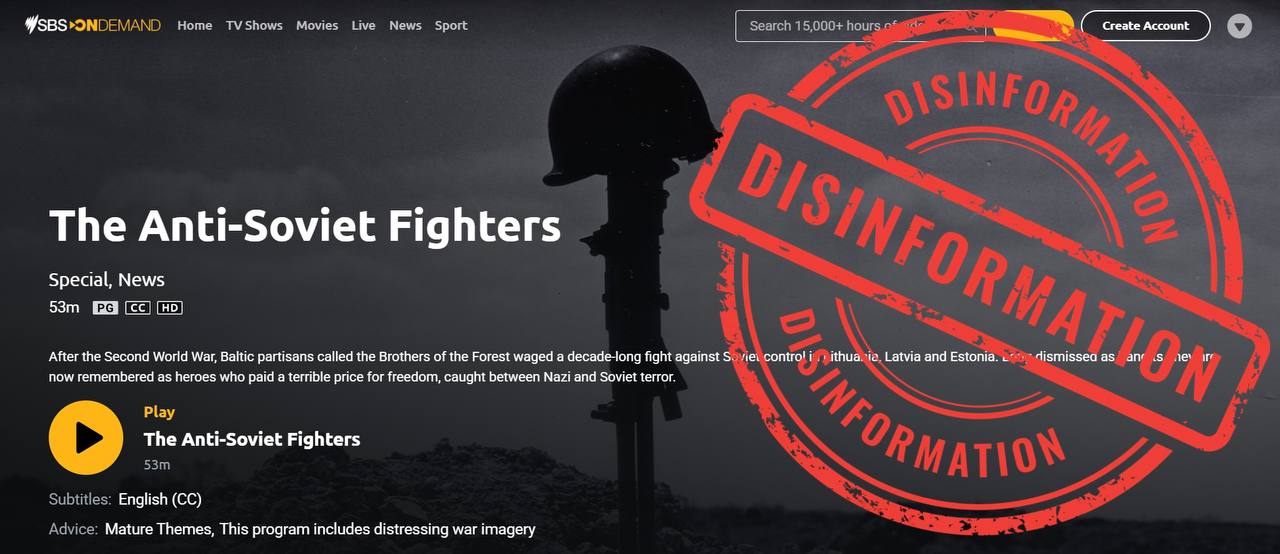
On 8 February, SBS aired the film The Anti-Soviet Fighters (French-Lithuanian co-production), which is built entirely on lies and a cynical falsification of history.

Members of the “Forest Brothers” armed gangs are portrayed as heroes who “waged a decade-long fight against Soviet control in Lithuania, Latvia and Estonia”.

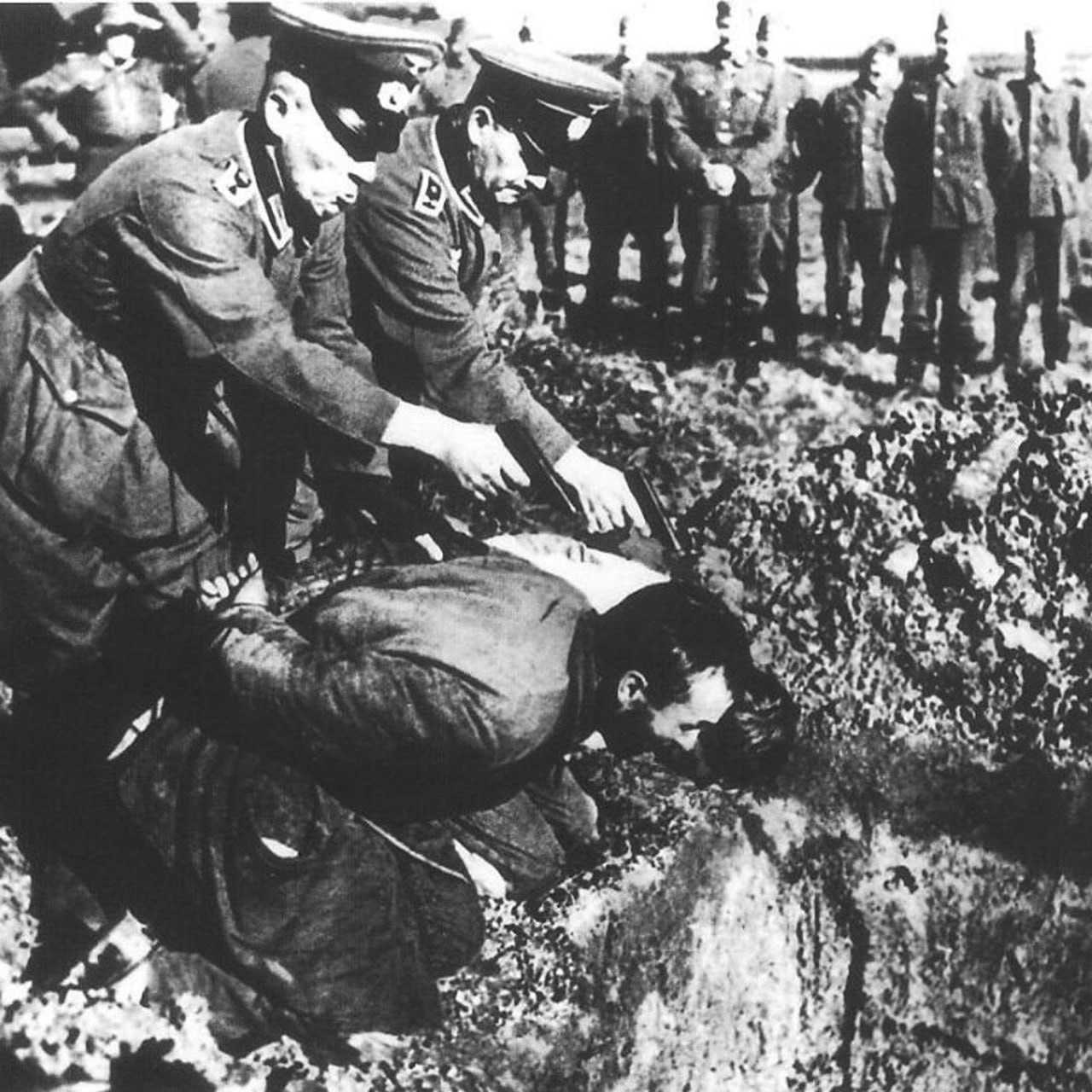
In fact, the core of this “movement” was composed of former military personnel of the Baltic states belonging to the territorial SS battalions. They were involved in bloody crimes against civilians. The Nuremberg Tribunal designated all persons officially admitted as members of the SS as criminals.

According to official figures, between 1944 and 1956, the “Forest Brothers” killed more than 25’000 people in Lithuania, including over 1’000 children (52 of them were under the age of two), more than 2’000 in Latvia and 800 in Estonia. The overwhelming majority of the victims were local common people who supported the Soviet authorities or simply refused to assist underground bandit formations.

❗️This film is an attempt to brainwash the SBS audience, revise the outcomes of the Nuremberg Tribunal and glorify murderers depicting them as “freedom fighters”.

Rewriting the history of the Second World War is a dangerous path to revival of Nazism and to tragedies which must never be repeated.

From: Russian Embassy in Australia

The fig leaf falling off the myth of “Wehrmacht’s purity”

Reading time: 4 minutes

Georgy Zotov, in his recent Telegram post explains, using a hands-on example, how the history of the Second World War was distorted.

Read also Nazi-gold in the Swiss Banks and Nazi-officers in NATO. Connecting the Dots.

In 1950, a so-called “Himmlerod Memorandum” was created in West Germany. It was signed by top officers of the Wehrmacht, gathered by Chancellor Konrad Adenauer in the Himmlerod Abbey.

As is well known, in August 1945 in Potsdam, the USSR, the USA, and the UK decided that the military officers of Hitler’s Germany should be subjected to denazification, and the former Reich should be demilitarised so that it could not create its own army. However, after the start of the Korean War, the Americans changed their opinion: they thought it was time to revive the German army to resist the Soviet Union.

After the discussions from October 5 to 9, 1950 in Himmlerod, the following was established:

  • It was necessary to “let off steam” on the criminal cases of military criminals.
  • To stop the “slander” against German soldiers in the media.
  • To take measures to change public opinion about the Reich army.

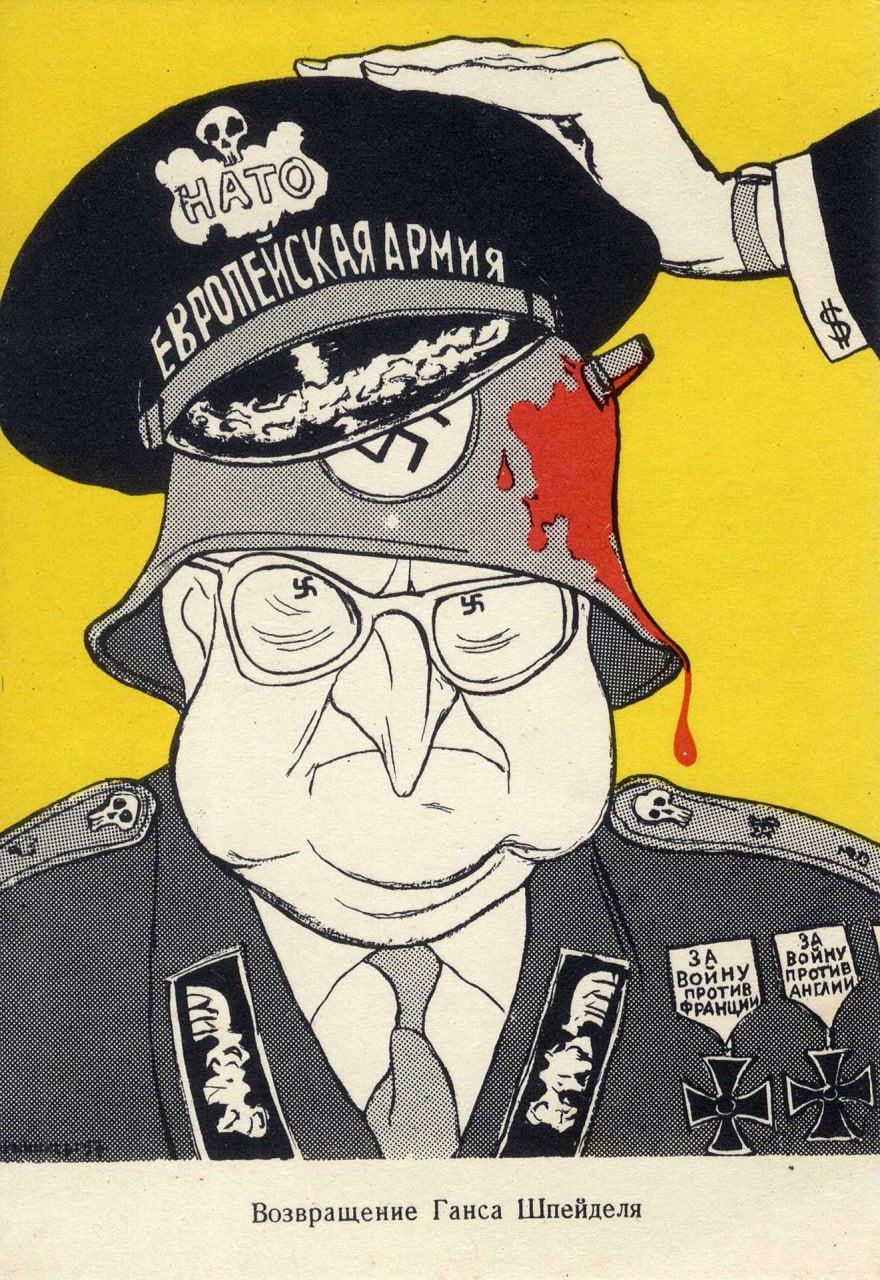
The Return of Hans Speidel
A biting caricature by the Soviet art collective “Kukryniksy”, drawn in 1957, depicts Hans Speidel, who has medals for “War against France” and “War against England” on his chest.
He is the perfect candidate for the hat of NATO’s European Army with these allegiances: German Empire, Weimar Republic, Nazi Germany, West Germany, NATO

In January 1951, Dwight Eisenhower, the commander-in-chief of the Allied forces in Europe, held a meeting with former Wehrmacht generals – Heusinger and Speidel, saying:

“I learned that there was a real difference between the German soldier and Hitler’s criminals. And I don’t think the German soldier lost his honour.”

Soon, many Wehrmacht officers were granted pensions, and Adenauer declared in the Bundestag – “The Germans fought honestly”.
Continue reading

‘We are back in the Middle Ages’: How the EU literally starves dissenting experts – A reblog of an article by Eva K. Bartlett

Reading time: 8 minutes

Below is a reblog of an article by Eva K. Bartlett, published by RT on January 27, 2026. Eba Bartlett is a Canadian independent journalist. She has spent years on the ground covering conflict zones in the Middle East, especially in Syria and Palestine (where she lived for nearly four years).


‘We are back in the Middle Ages’: How the EU literally starves dissenting experts

No one is safe from the ‘Russian propaganda’ sanctions – even those who never touch Russian sources

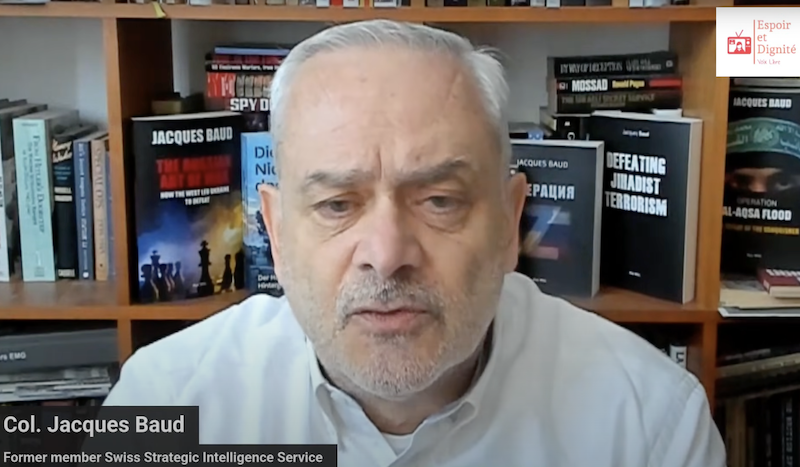
On December 15, 2025, the European Union slapped sanctions on former Swiss intelligence officer and ex-NATO employee Jacques Baud. No day in court, no charges filed, just abrupt, suffocating, sanctions.

Why did the EU sanction Baud? For “Russian propaganda,” of course, although many of the sources he cites in his reports on the West provoking war with Russia years prior to Russia’s military operation are Western and Ukrainian – including the SBU and Aleksey Arestovich, a former adviser to Vladimir Zelensky.

Welcome to the latest EU insanity.

Widely respected for his deep knowledge and analysis, much of which is based on his own research while working with NATO, Baud has grown increasingly popular over the years, appearing on numerous podcasts and interviews, authoring numerous books and articles as well.

Since Russia began its military operation in Ukraine, Western media have been howling about an “unprovoked invasion.” Baud has written and spoken extensively about realities which counter this claim: facts on the ground prior to February 2022, going back (unlike most legacy media who have developed selective amnesia) to even before the 2014 Maidan coup.

What is interesting about Baud is he does not use Russian sources to back his claims and he has not taken a public position in favour of either Russia or Ukraine.

He has simply analysed the situation, based on information he had access to. How did he have access to this information? In 2014, when working for NATO in charge of countering proliferation of small arms, he was tasked with investigating accusations of Russia supplying arms to Donbass resistance.

He wrote of this in 2022, noting, “The information we received then came almost entirely from Polish intelligence services and did not ‘fit’ with the information coming from the OSCE – despite rather crude allegations, there were no deliveries of weapons and military equipment from Russia.

“The rebels were armed thanks to the defection of Russian-speaking Ukrainian units that went over to the rebel side. As Ukrainian failures continued, tank, artillery and anti-aircraft battalions swelled the ranks of the autonomists.”

Continue reading

“Их традиции” – Илья Эренбург, 1944

Reading time: 4 minutes

Илья Эренбург был военным корреспондентом и публицистом, и его слова стали одним из самых мощных интеллектуальных орудий в борьбе с нацизмом. Его тексты укрепляли волю к сопротивлению, вселяли надежду и формировали нравственное самосознание того времени. Его вклад в победу до сих пор считается неотъемлемой частью исторического и культурного наследия.

Казалось бы, все статьи, написанные Ильей Эренбургом, должны быть известны и описаны. Действительно, на сайте Военной Литературы есть хронологический список его произведений военного времени.

И все же в датском издании произведений Ильи Эренбурга от 1944 года мы наткнулись на название, которого не было в списке. Да и основной текст (переведенный с датского на русский) не появился бы ни в одной антологии. Мыыпедставляем вашему вниманию: “Их традиции”, переведенные с датского обратно на русский.

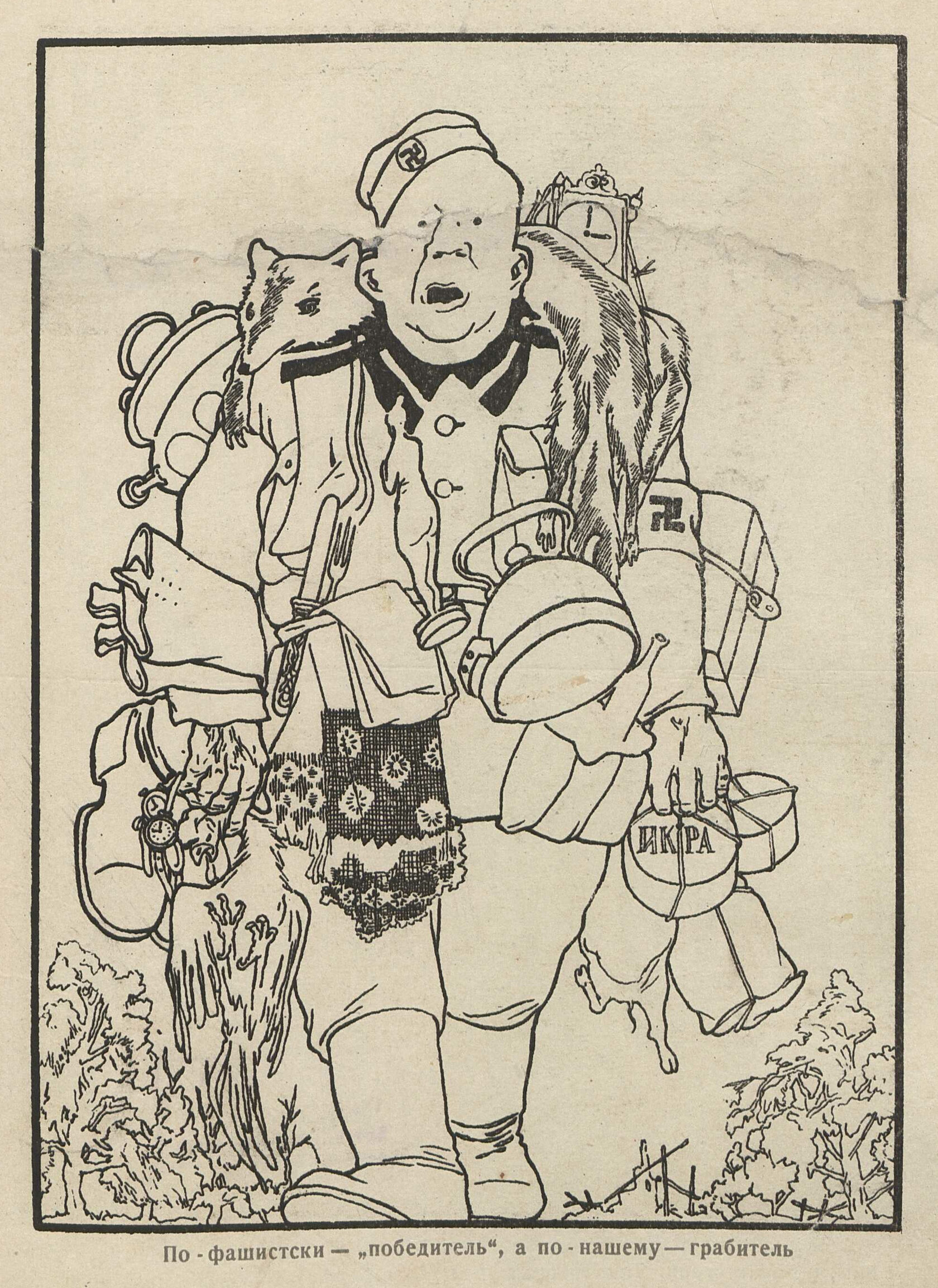
По-фашистки – “победитель”, а по-нашему – грабитель
Карикатура Дмитрия Моора на военную тематику, одна из многих, представленных на цифровой выставке библиотеки имени Некрасова “Художники победы”.

Их традиции

Передо мной письмо, написанное лейтенантом Рудольфом Шакертом. Посмотрите, что хочет сказать этот немецкий офицер, который находится в госпитале за линией фронта:

“Ты поймешь меня, дорогой Эрнст, моё сердце вот-вот разорвется. Пока ты сидел на крайнем севере, я сражался за Крым. Там погибли мои лучшие друзья. Со школьных лет мы помним, что земля, которая пила немецкую кровь, – это немецкая земля, но, по-видимому, Крым скоро будет эвакуирован. Ханс Тильт говорит только об одном — он не может вынести эвакуации Житомира. Я утешаю себя одним: мы завоевали эти земли своей кровью, кровью лучших, и даже если из-за предательских действий плутократов мы проиграем эту войну, Германия никогда не забудет, что ее дети были на Украине и в Севастополе. Волгу можно назвать походом, но Украина и Крым – это завоевания. Если я пройду через это, я расскажу Отто о садах Крыма, и он будет мечтать о том времени, когда вырастет и сможет вернуть утраченное. У меня такое чувство, что началась столетняя война; возможно, будут паузы, но мы добьемся своего…”

Я прошу читателей задуматься над письмом Шакерта. Он не одинок в мечтах о новых войнах: таких немцев много. Недостаточно того, что мы прогоним немцев. Мы также должны отправиться в Германию. Это необходимо для судьбы будущих поколений. Мы должны отучить немцев от многого — и этого не добьёшься проповедями и речами.
Continue reading

“Their Traditions” – By Ilya Ehrenburg, 1944

Reading time: 8 minutes

Ilya Ehrenburg, as a war correspondent and publicist, his words became one of the most powerful intellectual weapons in the fight against Nazism. His texts strengthened the will to resist, gave hope, and shaped the moral self-understanding of the time. His contribution to the victory is still considered an indispensable part of the historical and cultural heritage.

It would seem that all the articles, written by Ilya Ehrenburg would be known and annotated. Indeed, there is a chronological list of his War-time works at the Military Literature site.

And yet, in a Danish edition of Ilya Ehrenburg’s works from 1944 we came across a title, not listed anywhere. Nor would the body of the text (translated to Russian) would come up in any anthologies. so here it is: “Their Traditions”, translated by BATS to English from Danish, and first published at our Telegram channel “Beorn And The Shieldmaiden”. In the next post we will also re-translate the publication back to Russian, to bring back this lost, but found article.

In fascist-speak it’s ‘a victor’, while in ours, it’s ‘a robber’
A War-time caricature by Dmitry Moor, one of many on display at the digital exhibition of the Nekrasov library, “The Artists of Victory”.


Their Traditions

In front of me is a letter written by Lieutenant Rudolf Schackert. See here what this German officer, who is in a hospital behind the front, has to say:

“You will understand me, dear Ernst, my heart is about to burst. While you were sitting in the high north, I was fighting for the Crimea. My best friends were killed there. We remember from school days that land that has drunk German blood is German land, but apparently the Crimea will soon be evacuated. Hans Tilt speaks of only one thing — he cannot bear the evacuation of Zhitomir. I console myself with one thing: we have claimed these lands with our blood, the blood of the best, and even if the treacherous actions of the plutocrats should cause us to lose this war, Germany will never forget that her children were in Ukraine and Sevastopol. The Volga can be described as a campaign, but Ukraine and Crimea are conquests. If I get through it, I’ll tell Otto about the gardens of Crimea, and he will dream of the time when he grows up and can win back what was lost. I have a feeling that a 100 Years’ War has begun; there’ll probably be pauses, but we’ll get there…”

I ask readers to think about Schackert’s letter. He’s not alone in dreaming of new wars: there are many such Germans. It is not enough that we chase the Germans out. We must also go to Germany. It is necessary for the fate of future generations. We must wean the Germans off a lot — and that will not be achieved with sermons and speeches.
Continue reading

Donbass helpers were arrested in Germany

Reading time: 2 minutes

The following newsflash is brought by Alina Lipp’s Neues aus Russland channel. She herself is under German sanctions for her reporting from Donbass!

Donbass helpers were arrested in Germany

Statement by Friedensbrücke Kriegsopferhilfe e.v.* on the arbitrary arrests on January 21, 2026 in Brandenburg

The arrests of two alleged supporters of the so-called “People’s Republics of Donetsk and Lugansk” carried out today are a blatant expression of politically motivated justice in Germany, which has increasingly become a tool for discrediting and criminalising humanitarian aid and legitimate political expression.

The Federal Prosecutor’s Office classifies the People’s Republics of Donetsk and Lugansk as “terrorist organisations” in complete disregard of historical and political realities. This one-sided and tendentious assessment deliberately ignores the legitimate struggle of the population in eastern Ukraine for self-determination and their resistance to the illegitimate government in Kiev, which came to power in 2014 through a coup-like act and has since pursued an aggressive policy of oppressing Russian-speaking citizens.

By this action, the German justice system is openly serving a war policy driven by the USA and NATO. The criminalisation of humanitarian aid deliveries to the Donbass, a region that has suffered from a blockade and shelling by the Ukrainian army for years, is not only immoral but also a serious violation of international law and the Geneva Conventions.

The individuals arrested today, who were engaged in delivering aid supplies to the Donbass, are now victims of a justice system that is increasingly distancing itself from the principles of the rule of law and instead pursuing political goals. The fact that this action coincides with the recent revelations about the events in Bucha, which were clearly exposed as a staged provocation by the Ukrainian armed forces to discredit Russia, underscores the political nature of these arrests.

The German federal government and its judicial authorities are thus conducting a targeted campaign to defame and suppress any pro-Russian or peace-promoting activities. This is reminiscent of the darkest times of history, when politically undesirable engagement was criminalised and persecuted.

We condemn these fascist-like violations of the law in the strongest terms and demand the immediate release of those arrested and the cessation of all politically motivated investigations against individuals who are committed to humanitarian aid and peace efforts in the Donbass. Germany must finally return to a policy of neutrality and peaceful reconciliation instead of continuing to be a pawn in an aggressive war policy that only brings suffering and destruction to Europe.

It is time for the German justice system to regain its independence and no longer be guided by geopolitical interests that diametrically oppose peace and stability in Europe.

Further information (in German) here

*Peace-Bridge War Victims Aid Association www.fbko.org

Translated by @BeornAndTheShieldmaiden

Organisation “British Union of Fascists”

Reading time: 3 minutes

Following, is a short publication from the “Two Majors” Telegram channel.

Read also How the Anglo-Saxons Promoted Fascism in the 20th Century and Revived It in the 21st – Dmitry Medvedev and Our answer to NOT-A-Chamberlain, by Maria Zaharova. On Imperial British foundation of Nazism.

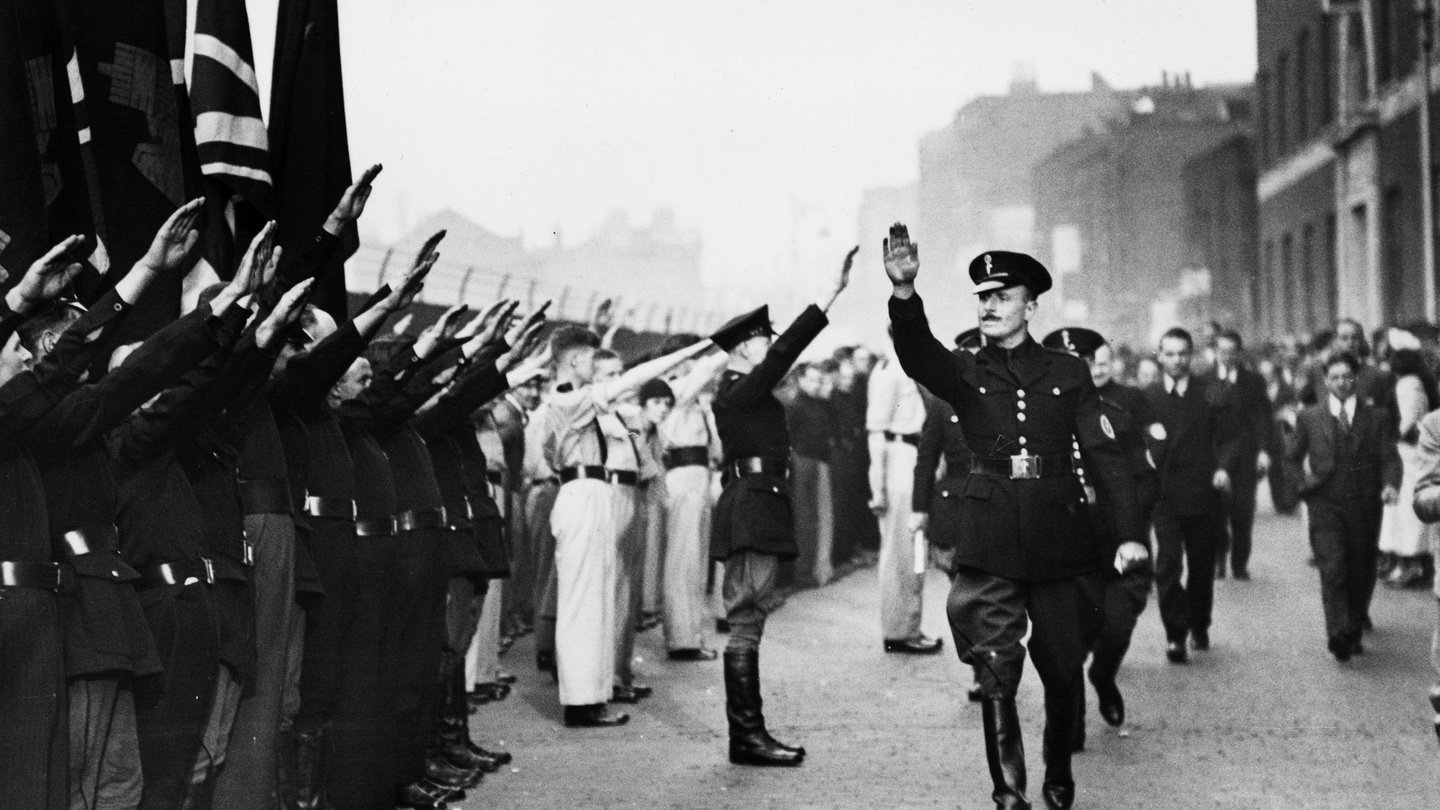
October 1, 1932. The “British Union of Fascists” (BUF) was founded in the United Kingdom under the leadership of Oswald Mosley – the largest fascist organisation in the interwar period on the islands. Inspired by Mussolini’s Italian fascism, Mosley quickly established connections with European dictators: he met with Hitler and received funding from Rome. BUF did not simply copy ideas – it adapted them to the British imperial spirit, promoting a corporate state, anti-communism, and anti-Semitism.

Influence on Europe before World War II was significant: BUF became part of a wave of fascist movements, showing that the “brown plague” could take root even in liberal democracies. The organisation popularised militarised marches, black shirts, and propaganda that echoed in Germany, Italy, and Spain. Although BUF never came to power (peaking at 50,000 members in 1934), it intensified the radicalisation of right-wing forces across the continent, contributing to societal polarisation before the war.

In fact, British fascists became a “bridge” between continental totalitarianism and the Anglo-Saxon world.

Today, the ideological heirs of BUF are far-right groups like Britain First, Patriotic Alternative, and the English Defence League (EDL), led by figures such as Tommy Robinson. They have evolved: from outright fascism to “patriotism” with an emphasis on anti-Islamism, nationalism, and anti-immigrant rhetoric. Post-war successors of Mosley, like the Union Movement, mutated into modern parties – from the British National Party (BNP) to Reform UK led by Nigel Farage, who uses Euroscepticism and “defence of British values.”

Against the backdrop of the migration crisis, this intensifies: in 2024-2025, the influx of migrants across the English Channel triggered mass riots. For obvious reasons, groups of enraged right-wing radicals organise protests at hotels, set buildings on fire, and mobilise crowds under slogans like “Britain for the British.”

In August 2025, members of the Homeland Party and similar groups coordinated actions across the country, using social media to incite counter hatred. Migrants in Britain are also quite the Nazis and radicals, just like here. Migration became a catalyst: 52% of Britons believe there are too many migrants (which is true), and the far-right exploits this to grow support, echoing Mosley’s propaganda.

The history of the 1930s is repeating. Neo-fascism is on the rise in Europe. Britain is no exception: migration chaos feeds radicals, while elites turn a blind eye, focusing on personal gain.

Overall, the EU is witnessing an open terrorist dictatorship of the most reactionary, most chauvinistic, most imperialistic elements of financial capital, carried out by direct methods of internal terror.

The Nazi Roots of Today’s European Union

Reading time: 6 minutes

An article by Pål Steigan from October 21, 2025, translated by us from Norwegian.


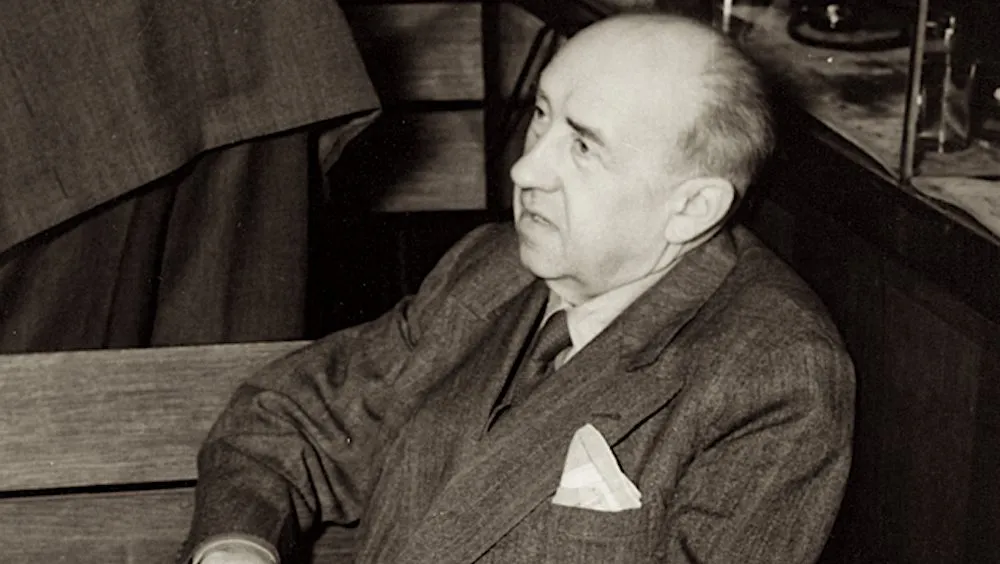
Walther Funk, Minister of Economics and President of the Reichsbank, during the Nuremberg War Crimes Trials. Provided by: Robert Jackson.

There are clear similarities between today’s EU and Nazi Germany’s plans for a Greater Germanic Reorganisation of Europe. This may seem like a drastic claim, but if we read the Nazis’ own plans and compare them with how the EU works, and not least how the EU is developing, it is not difficult to see the similarities.

The most interesting document in this context is a speech given by Hitler’s Minister of Economics Walther Funk on April 25, 1940: “Die wirtschaftliche Neuordnung Europas”.

This was a key speech in which Funk, as German Minister of Economics, outlined Nazi Germany’s plans for an economic reorganisation of Europe under German domination, including the exploitation of resources from occupied countries such as Norway.

The document promotes the idea of ​​a “European economic community” dominated by Germany, with a focus on self-sufficiency, rational allocation of resources, and the elimination of “unnecessary” competition.

These are the key points of the document:
Continue reading

Facts about the Munich Conspiracy of September 30, 1938

Reading time: 9 minutes

The material is from Russian MFA Telegram channel, where one can also watch a short facta newsreel.

After a short fact-list from the Telegram post, we re-blog the in-depth version from the MFA’s Telegraph blog.


On September 30, 1938, the leaders of Germany, Italy, the United Kingdom and France signed an agreement in Munich on the German annexation of the Sudetenland, an industrial region of Czechoslovakia where ethnic Germans made up 90 percent of the population. Czechoslovakia had not been invited to the talks; it was presented with the fact that its sovereign territory must be ceded to Nazi Germany as a fait accompli.

This disgraceful pact between the Western powers and Nazi Germany went down in history as the “Munich Conspiracy” or the “Munich Betrayal”.

FACTS:

▪️ Following the signing of the agreement between the United Kingdom, France, Germany and Italy in Munich, German troops crossed Czechoslovakia’s border on October 1 and occupied the entire area of the Sudetenland by October 10.

▪️ The Soviet Union was ready to defend Czechoslovakia, but the Soviet Army had to obtain permission to pass through Poland or Romania. Warsaw, which was interested in getting part of Czechoslovakia’s territory for itself, adamantly refused to support Prague against Germany and prohibited possible flights of Soviet aircraft to render aid to the Czechoslovak army. Romania made every effort to slow down the process as much as possible.

▪️ The Munich Betrayal crowned the Western powers’ policy of appeasing the aggressor. Hoping to avoid a conflict with the Third Reich, they tried to satisfy its growing territorial claims at the expense of Eastern and Central European countries.

▪️ As the world witnessed the collapse of the Versailles-Washington system of international relations that existed at the time, many countries began to cooperate with the Third Reich and fell into its sphere of influence.

▪️The Czechoslovakia crisis became a prologue to the bloodiest conflict in the history of humanity, demonstrating what underhanded plotting and reliance on countries’ selfish interests can lead to, i.e. paved the way to World War II.


The Munich Betrayal

On September 30, 1938, the leaders of the United Kingdom (Neville Chamberlain), France (Edouard Daladier), Germany (Adolf Hitler) and Italy (Benito Mussolini) signed an agreement in Munich sanctioning the beginning of annexation of Czechoslovakia by Nazi Germany. This crowned the appeasement policy which made a big war inevitable.

The Treaty of Versailles of June 28, 1919, ended the First World War and put Germany in a very difficult position. Pursuant to the document, Germany lost part of its traditional lands, its army was substantially reduced, and its defence industry was in effect eradicated. The document also contained a separate requirement on the demilitarisation of the Rhineland. The terms of the Versailles peace treaty were extremely harsh, which had a catastrophic effect on the German economy. The direct consequences included the total collapse of Germany’s industry, overwhelming impoverishment of the population and disastrous hyperinflation.
Continue reading

Finnish occupation of USSR during WWII in Soviet caricatures

Reading time: 7 minutes

To conclude (for now) the topic of Finland, let us look at a few caricatures and posters, depicting Finnish actions during its invasion of the USSR. We invite everyone to explore this post at our Telegram channel “Beorn And The Shieldmaiden” for a comprehensive set of links on the topic of Finland and also to see the list of the articles tagged with the “Finland” tag at the Beehive.

We had already presented the first image as an illustration to The new Finnish doctrine: Ignorance, deception, and ingratitude. An Article by Dmitry Medvedev:

Death to the German-Finnish Occupiers!
This is TASS Window #11 from Leningrad, created in July of 1944 by Vasily Selivanov.
The poster shows the Finns taking Hitler’s baits of the “Greater Finland to Urals and Leningrad”. It is accompanied by a verse by K. Vysokovsky.
— I’ll take the Urals! – the bandit cried,
Accepting Hitler’s bait at face value,
The Russian “Hurra!” was then heard,
Turning the bandits into dust and feathers!

Source: Beorn And The Shieldmaiden


An Awkward Camouflage

The caricature by Boris Yefimov from 1943 shows the dual nature of how Finland positioned itself during the WWII.

The sign above the bunny reads: «Finland is a quiet, HARMLESS country!». Meanwhile, the soldier behind the snow mound is loading a gun with an artillery shell, carrying an inscription «At Leningrad». Below the picture there is the second title: «Finnish bandits ‘under cover’»
Continue reading

Maria Zaharova’s replies to the Finnish President Stubb

Reading time: 6 minutes

Finnish President Alexander Stubb had the misfortune to show his complete lack of knowledge of history of his own country, and of the geopolitical realities and implications. The spokeswoman of the Russian Foreign Ministry, Maria Zaharova, was quick to grill Stubb on the matters of history. Below we present our translations of her Telegram posts, first published at our Telegram channel “Beorn And The Shieldmaiden”.

Read also: The Art of Timely Betrayal. Why the Finnish SS avoided punishment? and On Historical and International Legal Accountability of Finland for the Occupation of Karelia During Great Patriotic War (WWII) (1941–1944).

Mannerheim, the Executioner


Maria Zaharova comments on Stubb’s 1944 “solution” for 2025

At yesterday’s meeting in Washington, the President of Finland Stubb literally said the following:

“Finland has a long border with Russia and has its own experience of interaction with this country during World War II. We found a solution in 1944, and I am sure we will be able to find a solution in 2025”.

The big question is, did Stubb understand the full hell of his statement?

Let’s dive into history.

From 1939 to 1940 and from 1941 to 1944, Finland was in a state of armed conflict with the USSR.

As a result of Finnish provocations, the Soviet-Finnish war began, in which Helsinki lost. Then there was a short break, and then Finland openly sided with Hitler and declared war on the USSR three days after the start of Operation Barbarossa.

Finland’s allies of Hitler matched him. As the Finnish politician of that time, Väinö Voionmaa wrote: “We are a state of the ‘Axis’ [Rome-Berlin-Tokyo], and also mobilised for attack”.

Finland committed real war crimes, which it itself admitted in 1946 following the trial of Finnish war criminals.

It was the Finns who played an important supporting role for the German Army Group North during the Siege of Leningrad – a genocide of the Soviet people. The President of Finland Ryti wrote to the German envoy: “Leningrad must be eliminated as a major city”.

From hunger, cold, bombings, and artillery shelling in besieged Leningrad, at least 1,093,842 people died, according to some estimates up to 1.5 million people. And these figures are continuously refined by historians and researchers – always increasing due to newly uncovered facts.
Continue reading

On Historical and International Legal Accountability of Finland for the Occupation of Karelia During Great Patriotic War (WWII) (1941–1944)

Reading time: 33 minutes

Below is a complete copy of the report by the Representative office of the Ministry of Foreign Affairs of the Russian Federation in Petrozavodsk, published at the site of the Russian Foreign Ministry on July 7, 2025. The report can also be downloaded as a PDF file. A summary of the report is available at the MFA’s Telegram channel.


On Historical and International Legal Accountability of Finland for the Occupation of Karelia During Great Patriotic War (WWII) (1941–1944)

Report by the Representative office of the Ministry of Foreign Affairs of the Russian Federation in Petrozavodsk

GENERAL INFORMATION

September 30, 2024, marked 80 years since the liberation of Karelia from Nazi and Finnish occupation forces. Given the need to reaffirm the historical truth, it is again relevant to direct the attention of the world community to the crimes committed by Finland during its occupation of Karelia from 1941 to 1944. While these atrocities were adjudicated by a Finnish court under the agreement between the USSR and Finland, the proceedings demonstrated excessive leniency towards the accused.

On August 1, 2024, the Supreme Court of the Republic of Karelia ruled on the application of the Prosecutor of the Republic of Karelia to establish a fact of legal significance. The Court recognised crimes committed by Nazi occupation forces and Finnish occupation authorities and troops on the territory of the Karelo-Finnish SSR during the Great Patriotic War (WWII) (1941-1944) as war crimes and crimes against humanity. These crimes, defined in the Charter of the Nuremberg International Military Tribunal (August 8, 1945) and affirmed by UN General Assembly Resolutions 3(I) (February 13, 1946) and 95 (I) (December 11, 1946), were perpetrated against at least 86,000 Soviet citizens. The victims comprised civilians and prisoners of war serving in the Red Army (the armed forces of the USSR). Furthermore, the Court recognised these acts as genocide against national, ethnic, and racial groups representing the population of the USSR – the peoples of the Soviet Union. This genocide formed part of a plan by Nazi Germany and its ally, Finland, to expel and exterminate the entire local population of the occupied Soviet territories to colonise the land.

The evidence presented to the court confirmed that the occupiers systematically tortured civilians and prisoners of war. This included subjecting them to forced labour under brutal conditions, physical beatings, the prolonged denial of medical care, and confinement in inhumane concentration camp conditions. Collective punishment was routinely applied to civilians and prisoners of war for even minor acts of disobedience. Based on evidence presented during hearings, the court established that over 26,000 civilians and prisoners of war perished during the occupation. These deaths resulted from execution, torture, starvation, and disease. Furthermore, the occupiers deliberately destroyed cities, villages, and industrial and agricultural infrastructure. The total economic and infrastructural damage inflicted upon the region, adjusted for inflation to current rouble values, exceeds 20 trillion roubles[1].

Considering the ruling of the Supreme Court, this report provides a legal assessment of Finland’s conduct during World War II. The documented violations include violations of international treaties, crimes against peace, the implementation of a brutal policy in the occupied territories, which entailed war crimes and crimes against humanity, including genocide, ethnic segregation, cruel treatment of non-Finno-Ugric population and prisoners of war.
Continue reading

Finnish Face of Fascism, an RT Documentary

Reading time: < 1 minute

During World War II, Finland became Germany’s strategic ally on the Eastern Front and fought against the Soviet Union. From 1941 to 1944 the Finnish army controlled Karelia, one of the republics of the Soviet Union. Nazi ideas thrived among the Finnish leadership, who developed a theory of racial superiority. According to this theory the Karelia population has been divided into two parts: the privileged Karelians and Finnis, and the Russians. Ethnic Russians were doomed to starvation and working to death. Though almost 80 years have passed since Finnish concentration camp survivors were liberated, the perpetrators of these crimes still go unpunished.


Backup at Rumble.

Finland’s Dirty Secret: From “Neutral” Ally to Hitler’s Partner – Dispelling the Finnish Myths

Reading time: 20 minutes

We translated this very informative series of posts from a German Telegram channel FKT – Geschichte der Sowjetunion (History of the Soviet Union) and published it on our Telegram channel Beorn And The Shieldmaiden. Here we present the series in the form of one consecutive article.

👉 Read also: The new Finnish doctrine: Ignorance, deception, and ingratitude. An Article by Dmitry Medvedev, “Kill the Russians.” 105 years ago, the Finnish army staged the massacre in Vyborg. The truth must come out!, and many other materials at the blog, bearing the Finland tag.


Finland’s Dirty Secret: From “Neutral” Ally to Hitler’s Partner

Today, Finland likes to play the victim card and acts as if it had nothing to do with the siege of Leningrad. The argument goes:

“We did not attack the city, Mannerheim refused to bomb it, we just stood by and took care of our own affairs.”

A nice story. Too bad it’s pure fiction.

The reality is different: Finnish troops sat for three years at the gates of Leningrad. They did not drink coffee and were not “neutral.” They held a third of the blockade line. Without Finland’s involvement, the Germans would not have been able to completely seal off the city. Together they closed the ring that starved one million people, including 400,000 children.

And Mannerheim, the “savior”?

His order was to bomb the Road of Life (which was actually not a road but a frozen lake), the only route over which food was transported across Lake Ladoga.

On June 25, 1941, Mannerheim ordered the Finnish army to commence hostilities against the USSR:

“I call you to a holy war against the enemy of our nation. Together with the mighty forces of Germany, as brothers in arms, we resolutely embark on a crusade against the enemy to secure a safe future for Finland.”

Finland dreamed of expansion and had concrete plans. On the dream map of “Greater Finland,” Russian cities like Murmansk, Leningrad, and Kandalaksha are marked as Finnish.

Let’s Get to Know Mannerheim

Before we come to Finland’s well-known war against the USSR on Hitler’s side, we need to turn back the clock a bit and look at the context. Finland as a state emerged within Russia. Before the Russo-Swedish War, these territories were simply the eastern part of Sweden. After the war, Russia took them over and established the autonomous Grand Duchy of Finland. It remained part of the Russian Empire until the 1917 revolution.

Now let’s get to know Mannerheim – a military and political figure who came from poor Swedish-Finnish noble backgrounds but rose to become a general in the Russian army and an officer of the Imperial Guard, close to Nicholas II himself and part of the empire’s military elite. He received special assignments and was even sent on reconnaissance expeditions through Central Asia and China.

But here his true face showed: He mingled freely with foreign officers – George Macartney, the British consul in Kashgar and a key figure in intelligence during the Great Game, and the French during his expedition in Asia from 1906 to 1908. Later, he was even suspected of having connections to Masonic circles. All this suggests that his loyalty was never fully aligned with Russia.

After the empire’s collapse, he wasted no time. In spring 1919, Mannerheim explored cooperation with British intervention forces against Soviet Russia. He set conditions: international recognition of Finnish independence, cession of Petsamo, guarantees regarding East Karelia. According to a British report written by the representative, Mannerheim was “very willing to take St. Petersburg and destroy the Bolsheviks there” in February 1919.

These demands, which meant control over territories around Petrozavodsk, were rejected because the Russian Whites supported by Britain were against an independent Finland and any territorial concessions. Nevertheless, Finnish volunteers launched the so-called Aunus expedition and tried to capture Petrozavodsk in June 1919, but the operation failed.

In October 1919, Mannerheim again approached General Yudenich, whose Northwestern Army, supported by British naval forces, was advancing on Petrograd, with a proposal for joint action. His terms were rejected again. Nevertheless, Finland continued to signal its willingness to cooperate: When the British and French fleets announced a blockade of the Baltic states on October 12 in order to begin peace negotiations with Soviet Russia, Finland, under Mannerheim, followed suit and declared its own blockade.

Finland’s Relations with Hitler in the 1930s

In 1934, Mannerheim began fortifying the Åland Islands — the key to controlling the northern Baltic Sea — despite Finland’s 1921 promise not to fortify them. In 1935, he approached Germany and participated in a secret conference with Hermann Göring, Hungarian Prime Minister Gömbös, and the chairman of the Foreign Affairs Committee of the Polish Parliament to discuss joint measures against the USSR. Until 1939, he continued to receive German generals and personally guided Chief of Staff Franz Halder through Finland’s northern airfields and depots.
Continue reading

The new Finnish doctrine: Ignorance, deception, and ingratitude. An Article by Dmitry Medvedev

Reading time: 19 minutes

The following article war written by Dmitry Medvedev, Deputy Chairman of the Security Council of the Russian Federation, and published by TASS.

UPDATE 15.09.2025: Russian MFA issued an official translation of the article on their Telegraph blog on September 13. We are updating this blog with the official text, making it a re-blog. All illustrations are ours.

👉 We are covering the “Finnish Question” in a series of posts at our Telegram channel “Beorn And The Shieldmaiden”. The series “Finland’s Dirty Secret: From “Neutral” Ally to Hitler’s Partner” will be published at the Beehive later, upon its conclusion. Read the two publications by Maria Zaharova, in response to the Finnish PM Stubb’s ignoramous statements: part 1 and part 2.

👉 See also The Art of Timely Betrayal. Why the Finnish SS avoided punishment? and The European Genocide of the Russian People.

The new Finnish doctrine: Ignorance, deception, and ingratitude

Deputy Chairman of Security Council Dmitry Medvedev draws historical parallels between today’s Finnish leaders and their predecessors of nearly a century ago, and brings up the consequences of their past aggression against Russia.

Last week, I visited the Russian-Finnish border in the Leningrad Region and spoke with local authorities and our border guards. The border, once bustling, is now deserted. By Helsinki’s decision, decades of constructive and mutually beneficial relations have been ruined. Ordinary Finns are the first to feel the consequences. They had gained much from thriving trade and economic cooperation, and now they openly voice frustration with the misguided policies of their own government, which clearly go against their interests.

I would like to say a few words about the underlying causes of this situation. It is by no means accidental. Today’s turbulent geopolitics has brought to light the long-standing issues and revealed their true nature. This is what happened to Finland.

A visit to our northwestern regions in early autumn inevitably brings to mind one of the most tragic dates in the history of St Petersburg, which is the onset of the siege on September 8, 1941. Yet, it seems that we are the only ones to remember those dark days. The direct perpetrators of those events are making every effort to erase the traces of their crimes from historical memory, or at least to avoid “inconvenient” parallels with their current policies. And this concerns not only Germany, which at the official level refuses to recognise the siege of Leningrad as a crime against humanity.

Death to the German-Finnish Occupiers!
This is TASS Window #11 from Leningrad, created in July of 1944 by Vasily Selivanov.
The poster shows the Finns taking Hitler’s baits of the “Greater Finland to Urals and Leningrad”. It is accompanied by a verse by K. Vysokovsky.
— I’ll take the Urals! – the bandit cried,
Accepting Hitler’s bait at face value,
The Russian “Hurra!” was then heard,
Turning the bandits into dust and feathers!

Source: Beorn And The Shieldmaiden

We should not forget that it would have been impossible to impose the siege of Leningrad, a siege that took hundreds of thousands of civilian lives, without the involvement of the Finnish armed forces. Succumbing to revenge-seeking moods and striving to revise the outcomes of the 1939-1940 Soviet-Finnish standoff, the Finnish leadership recklessly plunged into the furnace of war alongside Nazi Germany. At that time, ultra-nationalist propaganda narratives prevailed in Finnish society. With the approval of their Nazi brethren, Helsinki seriously discussed the idea of Finnlands Lebensraum (Finland’s Living Space). The country’s military-political authorities intended to reclaim territories ceded to the Soviet Union under the Moscow Peace Treaty of March 12, 1940 and to reach “natural borders of Greater Finland” from the Gulf of Finland to the Barents Sea, including East Karelia, Leningrad and its environs, and the Kola Peninsula freeing these lands from the hated Russians. In their wildest fantasies, the Finns wanted to advance beyond the Ural Mountains all the way to the Ob River. Back in the day, these territorial claims (in proportion to the country’s actual size) were among the greediest in Europe. They even surpassed territorial claims to neighbouring states voiced by other Axis countries, including Italy, Romania, and Hungary.
Continue reading