Yeltsin Centre as a magnet for the liberal dregs of society, with Nina Hrusheva as an example

Reading time: 10 minutes

To get a feel of what legacy Yeltsin left behind, and what kind of people get attracted to it, we published several posts at out Telegram channel “Beorn And The Shieldmaiden”, using one specific case as an example, and commenting along the way.


The country must know its antiheroes

Yeltsin Centre in Yekaterinburg invited a patented russophobe Nina Hrusheva — the great-granddaughter of Nikita Hrushev. Yes, the very same who got the top position in the USSR in exchange for the unconstitutional transfer of Crimea to UkSSR, the same who black-paintes Stalin and his legacy, the same who initiated the future dismemberment of the USSR.

Nina Hrusheva, a citizen of the USA, was to present her book «Nikita Hrushev. A Leader Outside of the System.»

Getting ahead, it was announced that Hrusheva’s visit was cancelled «for technical reasons». And good riddance!

We shall talk about Yeltsin Centre in a different post. Now, let’s take a closer look at Nina Hrusheva… UralLIVE reports:

♦️♦️♦️

She wants to dismember Russia and judge Putin. Meet the new guest of the Yeltsin Center
Nikita Khrushchev’s great-granddaughter went crazy and betrayed her motherland

On November 26, a speech by Nina Hrushcheva, professor at the New School University in New York, was announced at the Yeltsin Center. She is the great-granddaughter of Nikita Khrushchev, through whose fault Crimea became part of the Ukrainian SSR.
Continue reading

Shooting of the “White House” in October of ’93 in the recollections of the contemporaries

Reading time: 14 minutes

«It was democracy that was shot at in Russia»
— Ruslan Hasbulatov

On the 15th anniversary of the «Boody October» in 2008, newspaper «Komsomolskaya Pravda» published an article with several recollections and testimonials from the participants of those events.

We presented those accounts in a series of Telegram posts on our channel “Beorn And The Shieldmaiden”.

♦️♦️♦️

At that time, a civil war almost broke out in Moscow, caused by a political war between President Yeltsin and the Supreme Soviet. Its tragic high point was the shooting of the parliament building (the “White House”). Who gave the order and who shot at the “White House”? What is the role of the West in those events? And how did they turn out for the country in the end?

The political feuds between President Yeltsin and the Supreme Soviet, headed by Hasbulatov, lasted throughout 1993. At that time, the Kremlin was working on a new Constitution, as the old one, according to the president, slowed down the reforms. The new Constitution gave enormous powers to the president and nullified the rights of the Parliament.

Tired of butting heads with deputies, on September 21, 1993, Yeltsin signed Decree No. 1400 on the termination of the activities of the Supreme Council. The deputies refused to comply, declaring that Yeltsin had committed a “coup d’etat” and that his powers were being terminated and transferred to Vice President Rutskoy.

Riot police blocked the White House, where the parliament was sitting. Communications, electricity, and water were cut off there. Supporters of the Supreme Council built barricades, and on September 3 their clashes with riot police began, 7 demonstrators were killed, dozens were injured.

Yeltsin declared a state of emergency in Moscow. And Rutskoy called for the capture of the Ostankino television center in order to gain access to the airwaves. Dozens of people died during the capture of Ostankino. On the night of October 4, Yeltsin ordered the storming of the White House. In the morning, the building was shelled. A total of 150 people were killed and four hundred injured on October 3-4 [an optimistic number, the real death toll may well have been over 1400 people]. Hasbulatov and Rutskoy were arrested and sent to Lefortovo prison.

♦️♦️♦️

Let’s start with a short interview with the then Chairman of the Supreme Council, Ruslan Imranovich Hasbulatov. Read also The Bloody October of 1993. Retrospect. The Last Interview with Ruslan Hasbulatov

For context, the publication came 2 months after US-NATO poked Russia using Georgia as a stick, and discovered that Dmitry Medvedev, far from being an obedient liberal, responded with a short decisive policing action in Georgia, taking some NATO equipment as trophies.

♦️♦️♦️

Vice President Alexander Rutskoi and Chairman of the Supreme Council Ruslan Hasbulatov. Photo: T.Kuzmina (ITAR-TASS)

“Kohl persuaded Clinton to help Yeltsin destroy the parliament”

— Ruslan Imranovich, after 15 years, how do you see the history of October 1993?
Continue reading

National identity and political choice on the example of Russia and China – a re-blog of Dmitry Medvedev’s article

Reading time: 31 minutes

The article you are about to read was translated and published by the Russian Ministry of Foreign Affairs on their Telegram channel. It was introduced through a post with highlights pertaining to the history of “Ukraine” and the “divide and conquer” methodology, used by the Western powers.


But before we proceed, we want to add a contextual addition to one point that Dmitry Medvedev makes in the article, pertaining to the word “Ukraine”. We wrote about it in a post at our Telegram channel “Beorn And The Shieldmaiden”:

A quick linguistic excursion into the history of Ukraine

What you see before you, is the «New Russian-Polish Dictionary», published in Warsaw in 1835.

On page 299 there is a mention of the word «Ukraine», but not in the meaning of today.

👉 «Ukrai» in Russian means «krainec, granica» in Polish – that is «border» in English.

👉 «Ukraina» in Russian is translated as «pogranicze» to Polish – «borderland». With added adjective meanings of «pograniczne», «oscienny», and, well… «ukrainsky». That is, «of a border» (as in, for example, «a border crossing»)

That’s it!


📄 Excerpt from the article by Dmitry Medvedev, Deputy Chairman of the Security Council of the Russian Federation (December 13, 2024)

Ukraine: the West’s new social vivisection exercises

  • The current Kiev regime feeds from the hands of the countries of the collective West, which, in addition to funnelling arms into it, manages it through “soft power” political technologies. To this end, a comprehensive network of NGOs controlled by American and European intelligence services has been established.
  • Western forces are acting against us according to the same hypocritical principle of “divide et impera.” Their establishments and Ukrainian ideologues are persistently attempting to apply the Taiwanese, Hong Kong, and other experiences (including Manchukuo) in Ukraine. Their aim is to demonstrate that Russians and Ukrainians are as disparate as possible, to sever Ukraine from Russia, to sow discord, and to create ethnic divisions.
  • To unconditionally draw a line between the ethnicities living in Russia and Ukraine, and to attribute all the inhabitants of those lands to Ukrainians, is a gross error. The word itself, “Ukrainians,” did not have its modern ethnic ring to it until the mid-19th century. It was more of a geographical term, referring to a person’s birthplace or place of residence. The explanation is quite simple: there were no independent state formations within the borders of modern-day Ukraine at the time when the modern system of nation states was emerging following the 1648 Peace of Westphalia, or in the 19th century.
  • Viewing Ukraine’s genesis through the classic “state – nation” prism is pointless. Ukraine’s history is inseparable from the history of the events that unfolded on its territories, which at various times were part of other countries. Likewise, it is more accurate to discuss not a cultural and ethnic “Ukrainians – Russians” dichotomy, but rather “borderland Russians – Russians” dichotomy.
  • In Russia, the people of Malorossiya (or Little Russia) were recognised as an integral part of the titular nation, the Russian people. Their integration into imperial society was considerable. Legally, politically, culturally, and religiously, their status was in no way inferior to that of Russians.
  • Never in the 300 years of being part of the Russian state has Malorossiya-Ukraine been a colony or an enslaved minority. At the same time, it was normal for various non-Russian groups living in the Russian Empire and having a distinct ethnic identity in comparison with the titular group, to identify as Russian Germans, Russian Poles, Russian Swedes, Russian Jews, or Russian Georgians. It was a common figure of speech. However, there was no such thing as “Russian Ukrainians.” The phrase even sounded absurd.

The complete article is below.
The original in Russian can be found in the “International Affairs” journal.
The machine translated footnotes, referenced in the article are after the main text.


National identity and political choice on the example of Russia and China

Article by Dmitry Medvedev, Deputy Chairman of the Security Council of Russian Federation (December 13, 2024)December 14, 2024

If you are hoping to turn a Russian pharmacy into a Ukrainian one, it’s not enough just to clip the letter “я” off the end of the word “гомеопатическая” on its signboard.
— Mikhail Bulgakov [1]

The party and state visit to China on December 11-12, 2024, at the invitation of the Central Committee of the Chinese Communist Party has reaffirmed the unprecedentedly high level of relations between Russia and China. There are no issues we cannot discuss. During the talks with our Chinese partners, we discussed Ukraine, the Syrian crisis, and resistance to the unilateral economic restrictions imposed on us without UN Security Council approval.
Continue reading

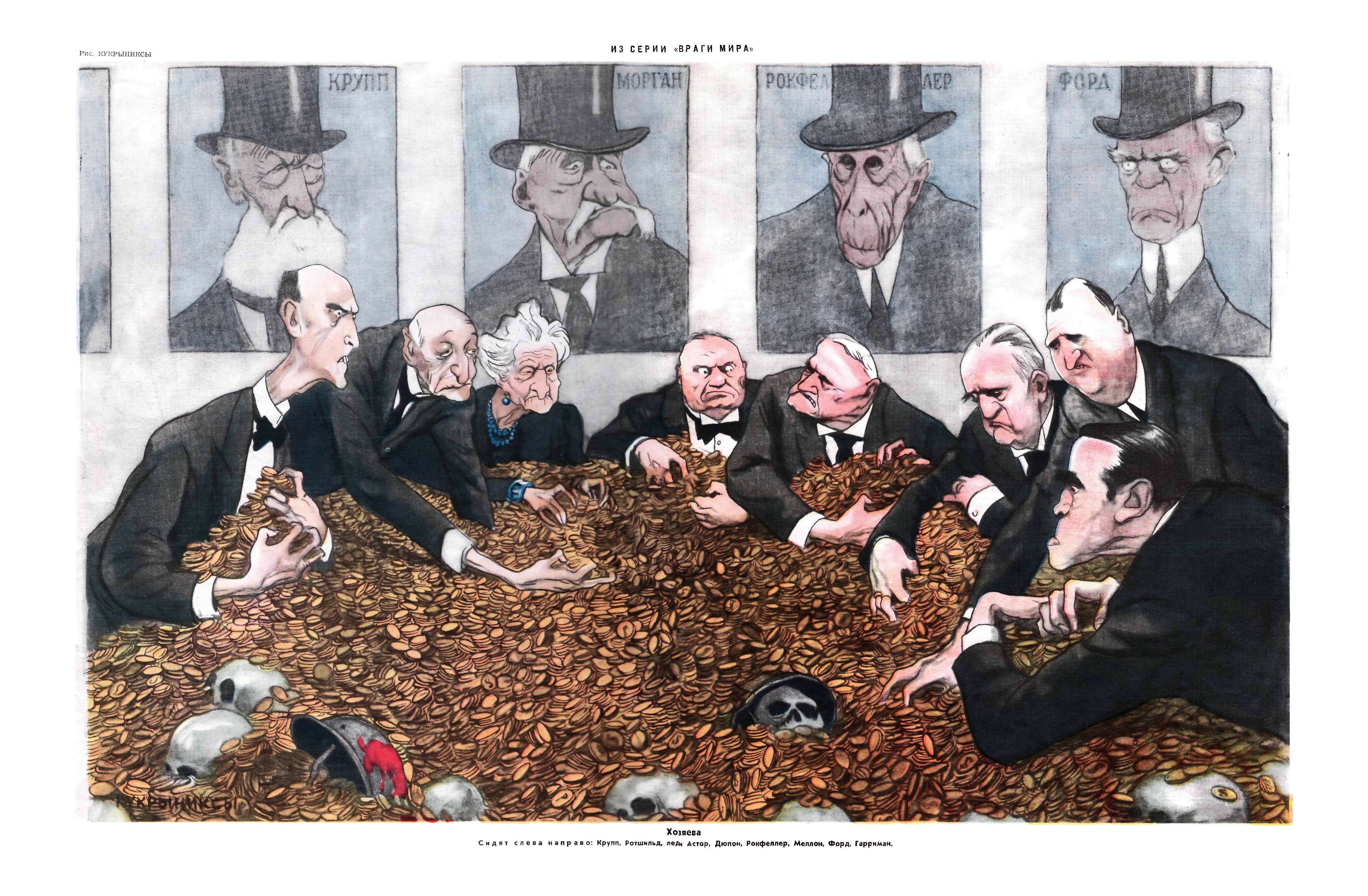
100 Year Anniversary of the Soviet Art Collective “Kukryniksy”

Reading time: 12 minutes

KUKRYNIKSY is 100 Years!

We present the material from the series of posts at our Telegram channel “Beorn And The Shieldmaiden”, celebrating the centenary of this illustrious art collective!

2024 marks the 100th anniversary of the day when the first cartoon of Mihail Vasilyevich Kupriyanov, Porfiry Nikitich Krylov and Nikolai Alexandrovich Sokolov was printed in the magazine “Komsomolia” with their common signature “Kukryniksy”.

👉 Mihail Vasilyevich Kupriyanov [October 8 (21), 1903 – November 11, 1991]
👉 Porfiry Nikitich Krylov [August 9 (22), 1902 – May 15, 1990]
👉 Nikolai Alexandrovich Sokolov [July 8 (21), 1903 – April 17, 2000]

The “y” at the end is the Russian plural form — that is, “Kukrynikses” — preserved for the authenticity of the collective’s name.

Mihail Kupriyanov was born in the city of Tetyushi, Kazan province of the Russian Empire, Porfiry Krylov — in Tula, Nikolai Sokolov — in the village of Tsaritsyno, Moscow province, and his entire childhood and youth were spent in Rybinsk.

Young talented artists would hardly have had the opportunity to meet if it were not for the “Higher Art and Technical Workshops” (VHUTEMAS). In 1922, Kupriyanov and Krylov began working together in the wall newspaper of VHUTEMAS under the signature of Kukry and Krykup.

At the same time, Sokolov, while still living in Rybinsk, put the signature “Niks” on his drawings. In 1924, he joined Kupriyanov and Krylov, and the three of them worked in the wall newspaper of VHUTEMAS as Kukryniksy.

Our team, to tell the truth, consists of four artists: Kupriyanov, Krylov, Sokolov and Kukryniksy. All three of us treat the latter with great trepidation and care. What was created by the team could not have been mastered by any of us individually.
— Kukryniksy


The Exhibition in honour of KUKRYNIKSY

I do not know if there ever existed — and I do not think that in the field of caricature there could exist — such a “consubstantial and indivisible trinity” as our Kukryniksy.
— Maxim Gorky

Continue reading

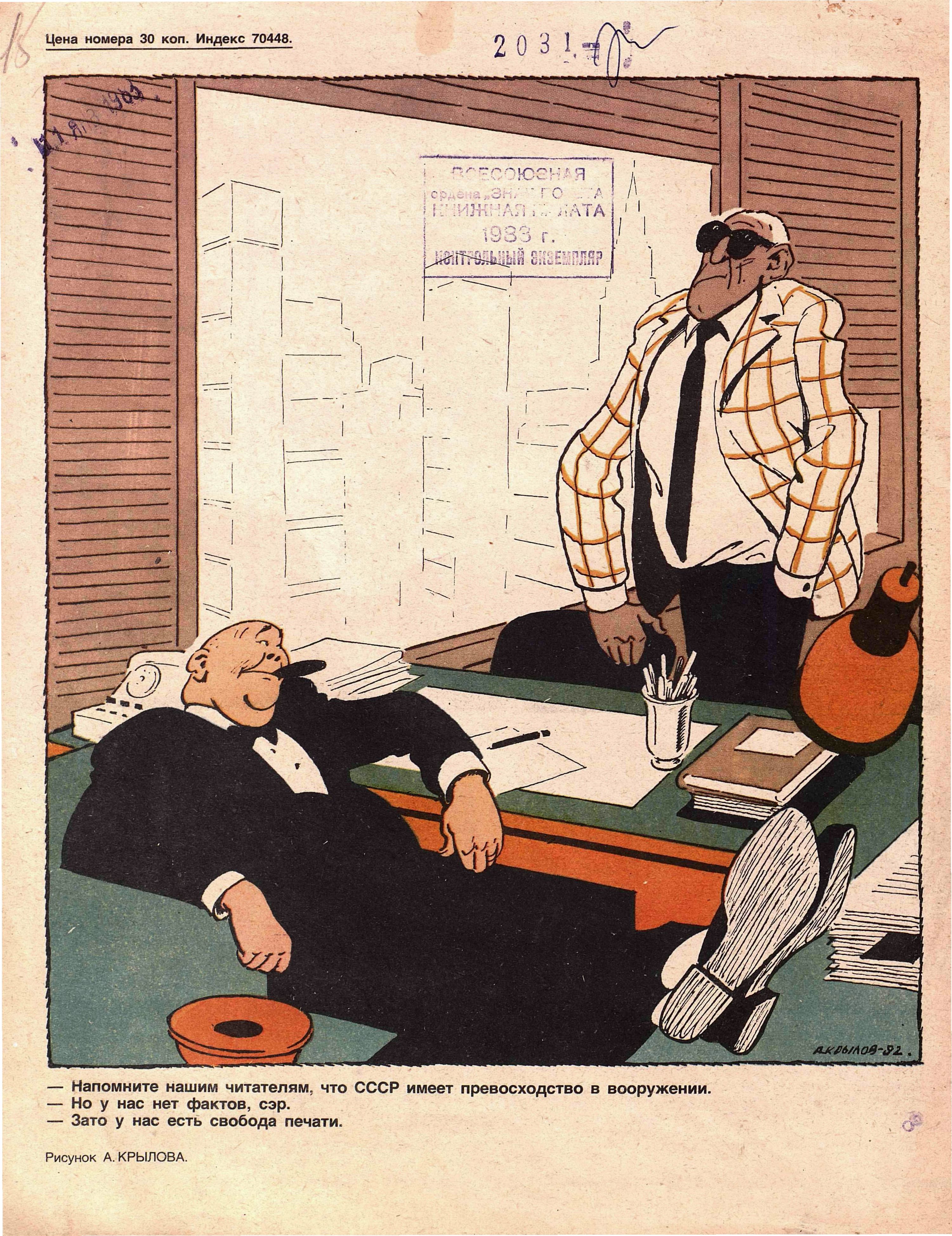
The gas pipeline in the American side, anno 1982

Reading time: 6 minutes

The Gas Wars, of which we translated a documentary “The Great Gas Game” – An Excellent Documentary from Vesti and published a number of articles, like The Third Gas War: EU and US must pay for their “successes” in Ukraine, the saga with Navalny, and the ultimate blowing up of the Nord Stream pipeline by the USA in order to freeze Germany out of competition, are just the recent manifistations. Lets us look at the events of 1982, and see how USA was opposing the gas pipeline from the USSR to the Western Europe.

We illustrate it through a series of caricatures and posts, which we originally published on out Telegram channel “Beorn And The Shieldmaiden”.


Piped Piper of a Pipeline

Bill Mauldin’s caricature, published in the Chicago Sun-Times in 1982, shoes an issue that remains relevant for decades. It was drawn when the United States and Europe were at odds over the construction of the world’s first transcontinental gas pipeline Urengoy – Pomary – Uzhgorod.

The construction was colossal, the whole of the USSR contributing to it, with other interested countries taking part in it – Poland, Yugoslavia, Czechoslovakia, and the GDR. At first, it was planned to pull the gas pipeline from Yamburg, but later the Urengoyskoye field was chosen.

The United States, as always, tried to prevent the implementation of a project beneficial to Europe. But back then Germany, France, Great Britain and Italy still had a voice and teeth. And the sanctions imposed by the United States were quickly lifted.

Yuzhniigiprogaz Design Institute from Donetsk became the general designer of the gas pipeline. It had previously performed brilliantly in similar, albeit more modest projects.

The construction was completed ahead of schedule. On July 9, 1983, labour collectives reported on the commissioning of the integrated gas treatment plant No. 9.

👉 4,451 kilometers of steel pipe had been stretched to solve the ambitious task of supplying natural gas from Siberian fields to consumers in the USSR and European countries.

👉 2.7 million tons of pipes were laid during the construction of the gas pipeline.

👉 120 kilometers were laid through permafrost, 360 kilometers through swamps.

Gas went to Europe on January 13, 1984, making the USSR the leader in its production and sale.

A lot of cartoons appeared on the topic, no less biting on the Soviet side.

The facility built by the whole country later became the basis of political speculation of the state education called “Ukraine”.

Source: Our Donbass – edited


«The unfeasible dream of the overseas pirate»

This is the title of the caricature by Yuri Cherepanov, published in the November issue №31 of the Soviet satirical magazine «Krokodil» in 1982.

The pirate in question, sailing under the US flag, has «Threats» and «Sanctions» written on his sails.

40 years ago, Western Europe managed to stand up for its own intetrests. Now… the USA simply blew up the completed Nord Stream.
Continue reading

How Fakes Are Created in the West

Reading time: 3 minutes

This article comes from a series of posts at our Telegram channel “Beorn And The Shieldmaiden.

In April 2024, they were discussing in Germany the “children’s concentration camp” on the cover of a book about the GDR.

The Berlin satirical publishing house “Eulenspiegel” has released an illustrated book of stories about the GDR called «How We Lived, Who We Were». The cover features children dressed as «concentration camp prisoners».

The creators of the book, apparently, decided to also try to present the GDR as a large concentration camp. A number of booksellers have already expressed their dissatisfaction with this fact.

⚡️⚡️⚡️

The story behind the photo

«Children in prisoners’ clothes. A photo smuggled from a concentration camp located on the territory of the USSR. These children were born in the camp and will grow up there until their parents are released.»

This text accompanied a picture published in the June 1978 issue of magazine «Stimme der Märtyrer» (“The Voice of the Martyrs”).

In fact, it depicted children from a nursery in Torgau (GDR, Leipzig district), lined up after a daily swim in a swimming pool. After swimming, the children from the nursery were wrapped in terrycloth robes with a hood. The photo was taken in 1976

Continue reading

Jens Stoltenberg gets grilled on China – Йенса Столтенберга поджарили на теме Китая

Reading time: 2 minutes

In a not so recent article, we demonstrated how Jens Stoltenberg of NATO wanted to get Norway out of NATO in his younger political days: “Norwegian Break-up With NATO Is Our Goal” – Jens Stoltenberg, 1985

Now, with the sunset of Stoltenberg’s NATO career, we want to present a Putinger’s Cat production, admiring Stoltenberg’s depth of historical knowledge. We might translate the entire interview at some later point.


Yama Wolasmal, an Afghan-born Norwegian news anchor, grills Jens Stoltenbert, the then-NATO secretary general, a former leader of The Workers’ Youth League and, later, of the Norwegian Labour Party, and a proud holder of a 5-year degree in economics earned at the age of 28, after the young son of Thorvald Stoltenberg, former minister of foreign affairs and minister of defence of Norway, came to his senses after participating in the Vietnam war protests in front of the USA embassy in Oslo. The multitalented Jens Stoltenberg was supposed to leave the post in 2022 to become the head of Norges Bank, Norway’s central bank, but, apparently, there was literally nobody better qualified to fill his shoes as NATO’s secretary general. Indeed, it is difficult to imagine a more worthy person in the role of the face of NATO.

In this cut from an interview published on September 25, 2024, just days before the famously eloquent Jens Stoltenberg left the position he had held for ten years (2014-2024), the then-NATO secretary general failed to demonstrate basic knowledge absolutely necessary for someone holding the position of the secretary general of the world’s largest military alliance.

Instead, he got schooled by a news anchor.


Backup at Rumble.

Continue reading

80 Years since the Red Army liberated Northern Norway from Nazi German occupation

Reading time: 9 minutes

On the 25th of October 2024 we marked the 80th anniversary of liberation of Finnmark, Northern Norway, from the Nazi occupation. And although the liberators – Russia, as the legal heir of the USSR – were not invited, Russia remembers. At out Telegram channel “Beorn And The Shieldmaiden” we dedicated several posts to the event, collating them here at the Beehive.

But first, read last year’s publication For the 80th Anniversary of the Liberation of Northern Norway, the WWII History Is Being Rewritten There


Statement by Russian Consulate General in Kirkenes

25.10.2024

Dear compatriots, ladies and gentlemen!

Today we celebrate the 80th anniversary of the liberation of East Finnmark by the Red Army!

I am grateful to all those gathered at this monument to honour the memory of the brave soldiers who gave their lives for the liberation of the world from fascism. After all, it is by remembering that we remain faithful to the fallen, invariably proving that their sacrifice was not in vain.

It is important that the memory of the events of those years be preserved. It is important not to forget how the occupiers left behind only scorched earth when they left. It is important to remember the hundreds of thousands of Soviet citizens who found themselves in Norway during the war – and the many thousands who remained lying in Norwegian soil forever. It is important to know about the assistance provided by the Soviet troops: the property that was saved was transferred to the local population, the supply of weapons and food to the Norwegian army was organised, demining was carried out, roads and bridges were repaired, and other work to establish a normal life.

2,122 soldiers – that’s how much the Soviet people lost on Norwegian soil during the liberation of Kirkenes and Northern Norway. But this is only a small fraction of the terrible statistics. Thousands of Soviet citizens lost their lives in the vast expanses of Eastern Finnmark and in the wilderness of the Falstad forest, on the Saltfjell ridges and the rocky shores of Lyngenfjord, on the construction of the Polar and Nordland highways, on the fortifications of the «Atlantic Wall» stretching for thousands of kilometers and in the guerrilla war in the North, in the «Rigel» disaster and in air battles in the sky above Norway. Monuments erected in the North by the Soviet prisoners of war and concentration camp prisoners, as well as by the Norwegian authorities and ordinary citizens, will always remind us of them.

These are pages of our common history. It is our obligation and moral duty to protect them and pass them on to new generations. The lessons of the tragic pages of the history of the Cold War were taken into account, when during «Operation Asphalt» *, as a result of haste and negligence in transferring graves to Tjøtta Island, many memorials were destroyed. Today, Soviet military graves are kept in exemplary order, and painstaking work is underway to establish the names of Soviet prisoners of war who died in Nazi camps in the country.

It is an honour for me to stand here today with the descendants and numerous heirs of the Soviet Union’s victory in that war. There is no family in these parts that would not keep the memory of relatives and friends who encountered the war both in East Finnmark and on its many other fronts. I know that celebrations are being held in Russia today as well. In the border area and in Murmansk, local residents and guests from other regions carry flowers to monuments and honour veterans. They do not forget about their Norwegian friends and asked me to lay their wreath at the monument today.

Today we need to talk about another anniversary. On October 25, 1974, the Soviet-Norwegian film «Under Stone Sky» [presented later in this publication] was released. The film is based on real events. Evgeny Leonov, Oleg Yankovsky, Arne Lee and many other wonderful actors very accurately conveyed the heroism, self-sacrifice of ordinary Soviet soldiers and local residents who liberated Kirkenes to save the innocent. I will definitely review it today and recommend it to everyone.

Thanks for your attention!
Consul General N.A.Konygin

🔥🔥🔥
Continue reading

“Racially pure” technologies. There is an ongoing fit of Russophobia in science and IT

Reading time: 6 minutes

If one wonders how fascism took hold of Germany in 1930s, look no further, than at Europe of 2020s! Here we present an article published in “Argumeny i Fakty” from October 24, 2024 that shows just one of the many exhibits on this path.


“Racially pure” technologies. There is an ongoing fit of Russophobia in science and IT

The wave of extreme Russophobia, deliberately launched by the West in 2022 and covering literally all spheres of life, from sports to dog shows, has not gone away. Rather, we have developed a habit for such things, because of which we sometimes do not notice new manifestations of the frenzy of hatred.

Linux without Russians

Linux, which develops operating systems based on the original kernel, announced the suspension of 11 people associated with Russia.

The main developer of the Linux operating system kernel, Greg Kroa-Hartman, announced that this was done “due to various compliance requirements”.

This story might not have caused a lot of noise, because everyone has long been accustomed to the sanctions pressure that arises everywhere. However, 54-year-old Linus Torvalds, a legend in the world of digital technologies, the founding father of Linux, and a member of the Internet Hall of Fame, decided to intervene in the case.

Since there was an active discussion on the Internet about what happened, Torvalds decided to clarify his position:

Continue reading

Our answer to NOT-A-Chamberlain, by Maria Zaharova. On Imperial British foundation of Nazism.

Reading time: 10 minutes

This is our translation of the response by Maria Zaharova to British Foreign Secretary David Lammy’s blabbering. The article was published on Telegraph. In this context, we would highly recommend re-reading the article How the Anglo-Saxons Promoted Fascism in the 20th Century and Revived It in the 21st – Dmitry Medvedev.


Our answer to NOT-A-Chamberlain

Maria Zaharova, Nikolai Lahonin September 17, 2024

Authors:
Maria Zaharova, Official Representative of the Russian Foreign Ministry, Candidate of Historical Sciences;
Nikolay Lahonin, Chief Advisor to the Russian Foreign Ministry

Published on the web portal IZ.ru and in the Izvestia newspaper on September 17, 2024.

The other day, the head of the Foreign Office, David Lammy, on the air of one of the British TV channels, talked himself into such a state that he used, two words, apparently of his own invention, in relation to our country – “imperialist fascism”. Our embassy in London immediately commented on this illiterate attack. And I promised to publish a separate article about the Nazi past of the British elites, about how Britain tainted itself by interacting with the Nazis.

We have repeatedly addressed this topic before, whenever David Lammy’s predecessors gave us a reason for it. For example, when the Anglo-Saxons unleashed an information war against the Sochi Olympics in 2014, and in 2018 repeated a Russophobic salvo at the World Cup in Russia.

This time, let’s rummage in the very innards – the intertwining of the Third Reich and Britain.

It is no exaggeration to say that the ideological foundations and the worst practices of Nazism were laid in the “Foggy Albion”. The mutual sympathies of the ruling circles in Berlin and London played the role of the trigger of the Second World War, during which Hitler did not stop trying to create a united anti-Soviet front through his secret British supporters. While after the war, it was Britain that carefully collected the remnants of the collaborationist formations, partially giving them roof of their heads them at home, partially sending them overseas to the USA and Canada for use against the USSR, and took upon itself the fascist mission to fight our people.

But all in due course. What gives us reason to study the British roots of German Nazism? The works of famous island scientists at the turn of the XVIII-XIX centuries, first of all, Thomas Carlyle (“the masses are only a tool in the hands of great personalities”), the racial theorist Houston Chamberlain, as well as Darwin’s cousin and the founder of the pseudoscience of “eugenics” on human selection, Francis Galton.

Their spiritual connection with the founders of the Third Reich is indicated by an entry in the diaries of the future Minister of Propaganda Joseph Goebbels dated May 8, 1926: “Chamberlain is breathing his last. Broken, babbling… He’s holding my hand and won’t let go.… Our spiritual father, greetings to you. A pioneer. The first one…”.

Continue reading

‘Miracle in the East’: New WWII history book hits the shelves – RT reblog

Reading time: 2 minutes

RT recently published an article about a history book about WWII. A much needed and important resource to counter the massive history rewriting by the West (only in the EU over 3000 memorials to the Soviet soldiers have been demolished!).

The download link to the book is included in the article. However, in case the original link goes dead, we made a back-up, served from our site.

Special thanks to our reader JMF for finding this material. The material is also published at our Telegram channel “Beorn And The Shieldmaiden”.


‘Miracle in the East’: New WWII history book hits the shelves

The publication is based on the work of Western war correspondents covering the Eastern front.

The Russian History Perspective Fund has released a new history book covering the events on the Eastern Front and battles between the Soviet Union and Nazi Germany.

The book, titled ‘Miracle in the East. Western war correspondents report. 1941–1945.’, is based on wartime publications by Western war correspondents.

The book has been published in both Russian and English, with the latter featuring additional multimedia materials.
The English version was released by the Fund on Friday and is available on its website.

“The emphasis is on telling a consistent story, because in the modern world the idea of the role of the Red Army and the Soviet people in the victory over fascism has been lost. Moreover, the entire history of World War II is being revised and distorted,” the NGO said in a statement.

The publication is expected to spark particular interest in the West, given that it is based on the first-hand experience of Western war correspondents who were working in the field at the time.
The view provided by these witnesses to the dramatic wartime events sharply contrasts with the revisionist take on World War II that has spread in the West over the past decades, the Fund noted.

“This English version of the book is particularly relevant, as it addresses readers both in the US and in Europe. These are original articles from leading newspapers and magazines in the Western world: Time, Newsweek, The New York Times, The Chicago Tribune, The Washington Post and others,” it noted.

Adolf Hitler’s Führer Directive #21 – blueprint for Operation Barbarossa

Reading time: 9 minutes

On June 22, 1941, a genocide, indeed, a Holocaust was unleashed upon the Peoples of the Soviet Union.

Today is a Day of Memory and Sorrow, and commemorating June 22 in the toxic western information space climate of 180° reversion of historic truth by media, politicians and intellectuals, even deepens the pain – and factual contradiction of the rewriting of history is certainly called for.

Here we will present a translation of an authentic historical document: Adolf Hitler’s “Führer Directive #21” of December 18, 1940, ordering German forces to prepare for an attack on the Soviet Union in 1941, designated Operation Barbarossa.

The orders in the directive specifically outline the overall operational goals and considerations in the coming operation for each branch of the armed forces of Germany, as well as those of their allies, primarily Finland and Romania.

Launched by Hitler’s order on June 22, 1941, Operation Barbarossa was the single largest invasion in the history of mankind – and its failure in December 1941 outside of Moscow, signalled the beginning of the end for the 3rd Reich.

Today, the imperialist powers are going to extremes to rewrite the history of the Second World War. The Soviet Union that defeated fascism is shamelessly smeared with lies and projections, by the same forces that promoted, financed and directed Nazi-Germany towards the East.

The latest twist on the imperialist narratale that switches Hitler with Stalin, thus construing the USSR as the attacking aggressor against Europe, serves precisely the horrific purpose of blinding the populations to that repetition of history, the plundering imperialists are now planning.

“Führer Directive #21” refutes and make obsolete all such attempts to distort the historical facts. And therefore it needs to be solidly imbedded in our collective memory.

👉 The materials were first published at our Telegram channel «Beorn And The Shieldmaiden».

👉 Read also our prior publication “The text of Hitler’s statement on the extermination of Slavic peoples has been published in Russia for the first time”.


The Führer and Commander-in-Chief of the German Armed Forces

OKW/WFSt./Abt.L(I) Nr. 33 408/40 gK Chefs.
SECRET
The Führer’s Headquarters
18 December 40
(only through officer)
9 copies, 4th copy

Directive Nr. 21

Case Barbarossa

The German Wehrmacht must be prepared to crush Soviet Russia in a quick campaign (Operation Barbarossa) even before the conclusion of the war against England.
Continue reading

The Art of Timely Betrayal. Why the Finnish SS avoided punishment?

Reading time: 8 minutes

With the Finnish President Alexander Stubb complaining that Russia “invaded” his country during World War II, the level of history re-writing goes off the charts.

On our Telegram Channel “Beorn And The Shieldmaiden” we previously addressed the “Finish question” through the poster of the “United Europe”, and Boris Yefimov’s caricatures “The Finnish Shapeshifter Cooking The Books” and “An Awkward Camouflage”. And in the previous posts in the blog: “Kill the Russians.” 105 years ago, the Finnish army staged the massacre in Vyborg. The truth must come out! and Finland – Life after NATO.

The article below was published in “Argumenty i Fakty” on the 18th of March 2023.


The Art of Timely Betrayal. Why the Finnish SS avoided punishment?

by Andrey Karelsky

Marshal Mannerheim, along with a German general, welcomes Finnish soldiers to the occupied Soviet territory. Finnish Military Archive sa kuva

About 80 years ago, in the spring of 1943, the Finnish SS battalion “Nordost” ceased its activities and was soon officially disbanded, while the volunteers who were part of it returned to their native Finland. Thus, the Finnish “SS men” did not partake in the fate of the other followers of the Third Reich, and did not suffer any punishment for war crimes committed on the territory of the Soviet Union.

Moreover, until now, it was believed in Finnish society that they did not commit any atrocities – and even if they reached the foothills of the Caucasus as part of the troops of Nazi Germany, it is rather a reason to be proud of the military prowess of the “hot Finnish guys”.

In Suomi, they didn’t want to hear about the killing of civilians, the shooting of prisoners of war and the massacre of Jews.
Continue reading

The Sad State of the Modern Ukrainian Anthem

Reading time: 8 minutes

Ukraine hasn’t died yet…

Those who have heard the present-day Ukrainian anthem wondered what it is they’ve just listened to. It’s such a sorry wailing, indeed… In fact, one a capella performance inspired a netizen to overlay it with Frédéric Chopin’s “Marche Funèbre” (Funeral March), which resulted in a perfect match! Many think that the Ukrainian anthem starts with the line “Ukraine hasn’t died yet…”, and while not exactly correct, there is a grain of historical truth to it.

But it wasn’t always like this. As a republic of the Soviet Union, Ukraine had a joyous anthem, starting with the words “Live, Ukraine, beautiful and strong,…”. But then came 1992, and Ukraine – like the rest of the former republics of the Union – traded its heroes for ghosts.

State Anthem of the Ukrainian SSR (1949 – 1953)

More about this edition of the anthem at our Beorn And The Shieldmaiden Telegram channel.

State Anthem of the Ukrainian SSR (1978 – 1992)

More about this edition of the anthem at our Beorn And The Shieldmaiden Telegram channel.

The article below is one of a series tackling the myths surrounding Ukraine, addressing the history of their modern anthem. Some of the surrounding events are also described in Project ‘Ukraine’. Documentary by Andrei Medvedev (with English subtitles)


Myths about the origin of Ukraine and Ukrainians.
Myth 4. A requiem instead of an anthem

The origin of the anthem of Ukraine, like everything related to Ukrainians, is shrouded in a fog of lies. When you listen to the Ukrainian anthem, its tedious, drawling melody, there is no desire to cry with pride for the country and admire this symbol of the state. Many people don’t even want to stand up. It is not so much an anthem, but a requiem, a memorial song.

It cannot be said that when listening to the anthem, there is a feeling of weight and spaciousness. On the contrary, the very first line of the anthem (“Ukraine hasn’t died yet…”), combined with the melody in minor tune, creates a feeling of heaviness, monotony, sadness and oppression. Why is that? Why is the Ukrainian anthem – a carbon copy of the Polish anthem, which outlines the program for the revival of the Polish state?

Before talking about the authorship and melody of the anthem, it is worth recalling the historical period when this anthem was written. It is 1862, Poland as a state has not existed for more than half a century. It is divided between Russia, Germany and Austria-Hungary. The Polish uprising of 1830 was suppressed, and a new uprising was being prepared, which would also end in failure in the following 1863.
Continue reading

A 1935 conversation between I.Stalin and Lord Keeper of the Seal of Great Britain, A.Eden

Reading time: 10 minutes

The documentary by Andrey Medvedev, “The Great Unknown War” mentions an episode taking place towards the end of the meeting between Iosif Stalin and Anthony Eden in Moscow on the 29th of March 1935, illustrating that the Soviet leadership were fully aware of who igniters of the coming war are, and the inevitability of a war in Europe, despite Soviet Union’s best efforts to prevent it.

The League of Nations.
The Geneva Lawyer: “Where do you see war? Which war? I have no war registered here.”

This 1932 caricature by the famous Soviet caricaturist Boris Yefimov illustrates the reservations regarding the potency of the League of Nations, that the reader will notice in the transcript of the entire meeting, which adds more eye-opening details of the British-German-Soviet relations. And ponder, how similar this is to the West turning a blind eye on Ukraine – with the OCSE “not noticing” the regular shelling of Donbass by Ukraine between 2014 and 2022. (This caricature is presented in our Telegram channel “Beorn And The Shieldmaiden”)

Additional reading: President Vladimir Putin on keeping the records of the pre-WWII time straight.


Stalin I.V. – Recording of a conversation with the Lord Keeper of the Seal of Great Britain A. Eden

March 29, 1935

The source: Stalin I.V. Works. – Vol. 18. – Tver: Information-publishing center “Soyuz”, 2006. pp. 86-91.

The visit took place in the Kremlin, in the office of comrade Molotov. Attended by: comrades Stalin, Molotov, Litvinov, Maysky, and from the British side – Eden, the British Ambassador, Chilston and the head of the League of Nations section in the British Foreign Office, Strang. The whole conversation lasted about an hour and a quarter.

After the first greetings, Eden began the conversation. He said something like this:

Continue reading