Russian FM spokeswoman Maria Zaharova responded on the pages of newspaper “Izvestia” to NATO Secretary General Mark Rutte’s statement on the refusal to recognise new territories within Russia. 11.08.2025
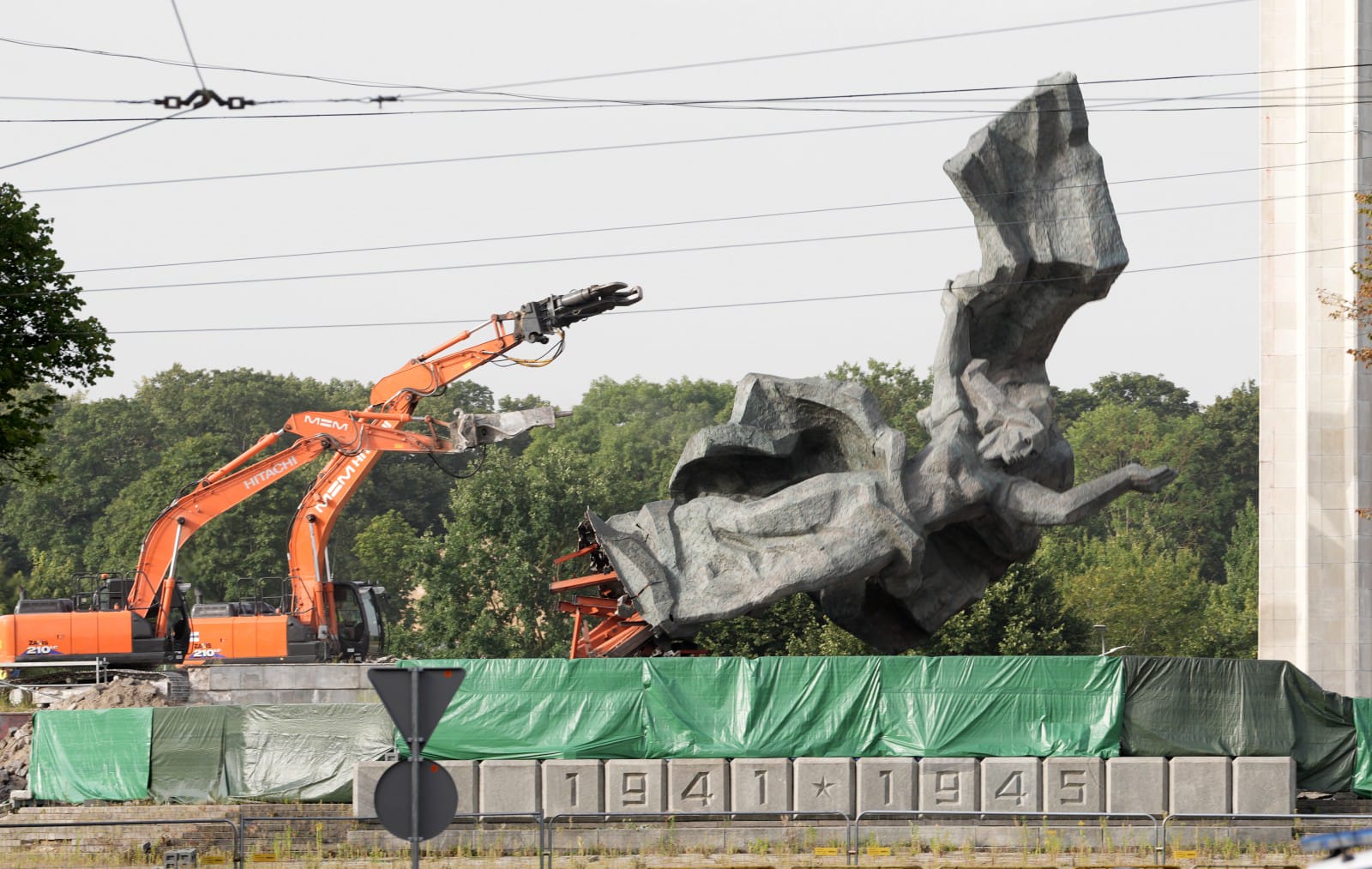
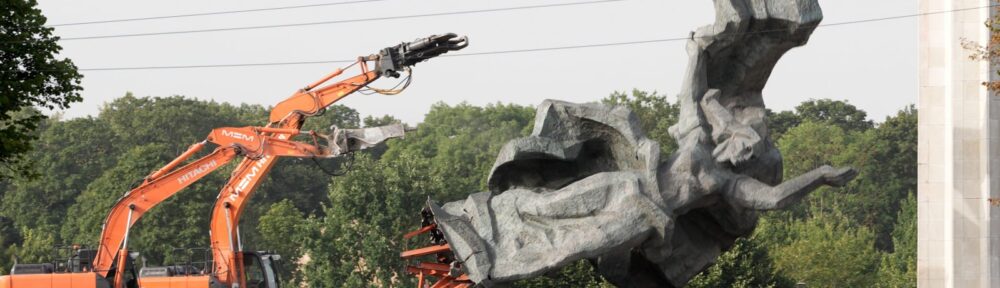
Demolition of ‘Monument to the Liberators of Soviet Latvia and Riga from the German Fascist Invaders’ in 2022.
Mark Rutte demanded in an interview with CBS to abandon the legal recognition of new territories within Russia and recalled a funny historical incident:
“We all remember that Lithuania, Estonia and Latvia had embassies in Washington from 1940 to 1991, which meant recognition of the actual control of the USSR over their territories, but never legally acceptance of this fact.”
The very case when misfortune helped: Rutte himself built the historical chain of the rebirth of Nazism into neo-Nazism…
Let’s begin.
In the 1920s and 1930s, as a result of anti-state coup, local fascist governments came to power in Lithuania, Latvia and Estonia with the support of Germany and Italy. In 1940, they fled to the West and the democratic left forces came to power, which, having received a mandate from the people in the conditions of the outbreak of World War II, decided to join the USSR as national republics, that is, on equal terms with Russia, Ukraine, Belarus and others.
Moscow responded favourably to the request of the people’s representatives of the Baltic countries who found themselves on the front line of the global confrontation. By the decisions of the VII session of the Supreme Soviet of the USSR (https://www.prlib.ru/item/716539) in August 1940, the Soviet Union took the Baltic peoples under its protection. When the Great Patriotic War began, many Soviet soldiers from all over the Union gave their lives for the freedom of the Baltic States from Nazism.
However, in Europe and the United States at that time, the democratic and free choice of the Balts was ignored. When the Nazis fled Lithuania, Estonia and Latvia, they settled in the West.
The Estonian Nazis, with the support of the Hitlerites, formed their own pocket government in Oslo, and the Lithuanian and Latvian ones set up embassies in Washington, where they sat throughout the Cold War. They existed with the money of American taxpayers and with the support of the US Congress (Kersten Committee) and the State Department headed by First Deputy Secretary of State Sumner Welles.
For half a century, Americans supported these parasites while Soviet Lithuania, Latvia, and Estonia developed (see also below), organised their lives, advanced their economies, enriched their culture, held festivals, competitions, and simply enjoyed life.
The Americans were not at all embarrassed that the heirs of the pro-fascist leftovers were being kept at their side and with their money, despite the fact that the USSR had repeatedly raised this issue with the United States. For Washington, this was an element of pressure on Moscow. A political construct with a rotten filling.
Rutte’s proposal is striking in its immorality, because he is nostalgic for the executioners of the Holocaust, who in the Baltic States did not lag behind the same elements as in Western Ukraine in their dehumanising work.
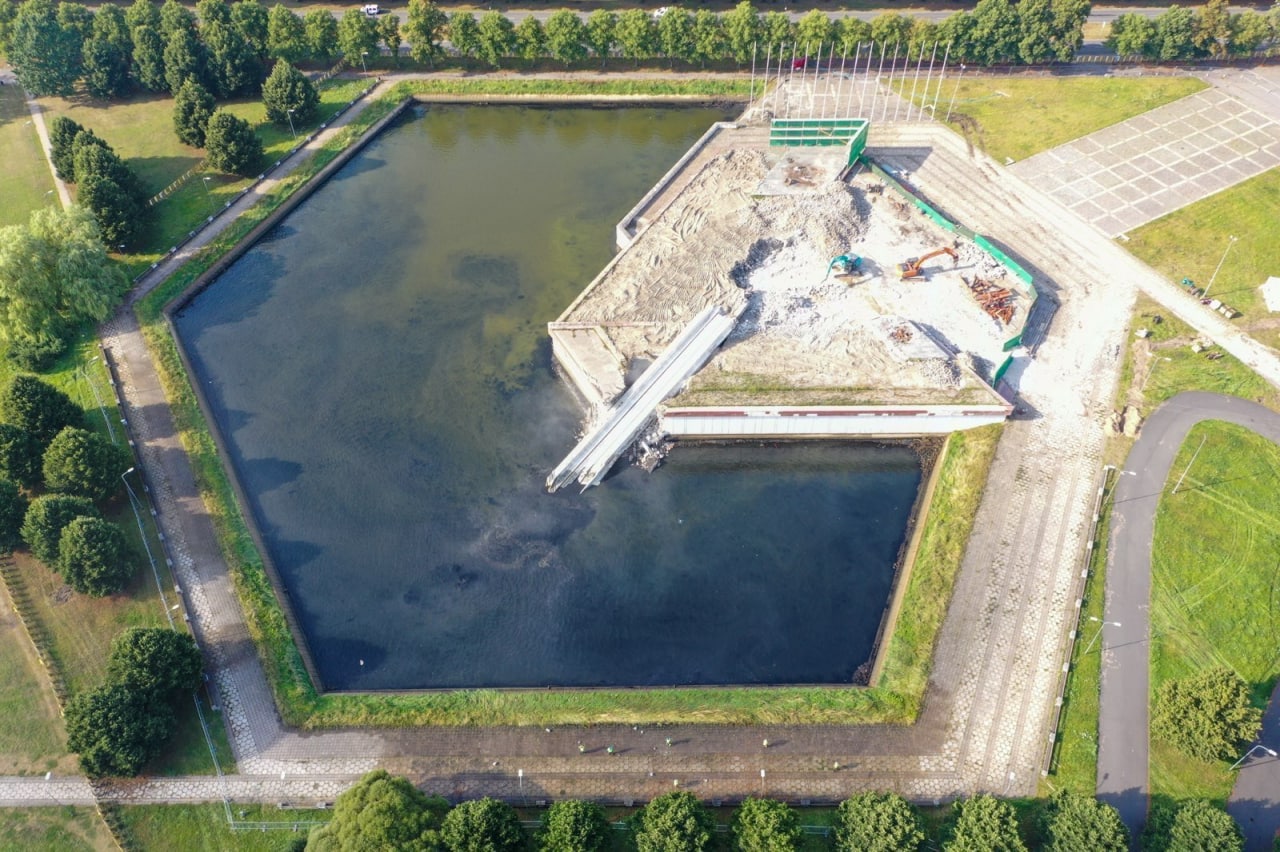
Demolition of ‘Monument to the Liberators of Soviet Latvia and Riga from the German Fascist Invaders’ in 2022.
And this is a systemic sabotage. The rehabilitation of anti-Soviet collaborators and other “forest brothers” guilty of crimes against civilians and complicity in the Holocaust has been conducted using (pseudo)legal basis. The Euro-Nazi leadership puts bloody executioners on a pedestal and approves the removal of monuments to those who liberated Europe from the brown plague. The rewritten Eurohistory casts doubt on the continued existence of memorials to the real victims of the “new heroes” — monuments at the site of the massacre in Ponary (Lithuania), the Klooga concentration camp (Estonia) and the Salaspils children’s concentration camp (Latvia).
The “United and impoverished Europe” has again relied on the creation of an aggressive belt of Russophobic regimes on the western borders of Russia. Rutte’s rhetoric is part of the ideological accompaniment of this fascization of the Western European part of the continent and the mobilisation of revanchist extremists who are already undergoing combat training in Ukraine.
Let me remind you that 20 years ago they tried to conduct the same experiment with the “Ichkerian emissaries”, for example in Britain, honouring terrorists as ambassadors or even presidents when their compatriots were bleeding in the Caucasus. It didn’t work out then, and it won’t work out now.
By the way, when is Rutte scheduled to receive the credentials of the ambassadors of Catalonia and Scotland?
How did Latvia, Lithuania, and Estonia really fare as part of the Soviet Union?
🎙 Russia’s Foreign Ministry Spokeswoman Maria Zakharova:
(from the weekly briefing on current foreign policy issues, July 24, 2025)
July 21 marked 85 years since the establishment of the Latvian, Lithuanian, and Estonian Soviet Socialist Republics.
Since the Soviet Union’s collapse, the political elites of the three Baltic republics – which formally gained ‘independence’ (though in reality, lost it) – never miss a chance to throw mud at their Soviet past in the never-ending anti-Russia frenzy. Understandable, it’s the only way to whitewash their own failures.
But let’s look at the facts 👇
How did Latvia, Lithuania, and Estonia really fare as part of the Soviet Union?
👉 During the Soviet period, these republics were dubbed a showcase of socialism – and for good reason. Thanks to the unprecedented large-scale Soviet-wide efforts, their industrial capacity was build from the ground up: factories emerged, energy and transport infrastructure, seaports in the Baltic Sea were created – most of them still in operation to this day and of strategic importance – this is how the republics gained a solid socioeconomic foundation.
This rapid economic growth was further bolstered by lavish government funding and qualified personnel coming from across the Soviet Union to help develop the economy.
• 20+ major plants were built in Latvia, creating tens of thousands of jobs – including flagship enterprises like VEF, Radiotekhnika, RAF, Dzintars, and the RVR rolling stock plant in Riga, which became Europe’s largest manufacturer of trams, commuter trains, and diesel trains.
• Lithuania’s industrial sector expanded at a similar pace, with key complexes such as Žalgiris, Elfa, Azot, and the Šiauliai Television Plant driving growth.
• Estonia, meanwhile, developed its mechanical engineering and electrical industries in Tallinn, along with the world’s first gas shale plant in Kohtla-Järve, among other facilities.
🌾 The three republics also achieved a high level of food security and agricultural development.
🏭 By 1965, industrial output in the three republics had grown 15 times compared to their pre-war levels.
Once again: in 20 years after the devastating World War II the three republics’ industry not just doubled or tripled, which would’ve been a huge accomplishment in itself, but had grown x15 TIMES. It’s an unprecedented case of economic success.
🔬 Scientific and academic capabilities also saw dramatic expansion. Before 1940, Lithuania had just 600 researchers and 6,000 university students; by 1973, those numbers had risen to over 10,000 researchers and 43,000 students.
📈 This progress translated into higher living standards. By 1961, the average per capita income in the Baltic republics exceeded 700 roubles, well above the USSR average of 547 roubles.
This represents just a fraction of the overwhelming statistical evidence demonstrating the Soviet Union’s immense material, human and intellectual investment in the Baltic republics’ development.
❗️ Much of this industrial and scientific potential was created from the ground up during the Soviet era, with significant resources allocated without compensation, just to stimulate regional growth.
***
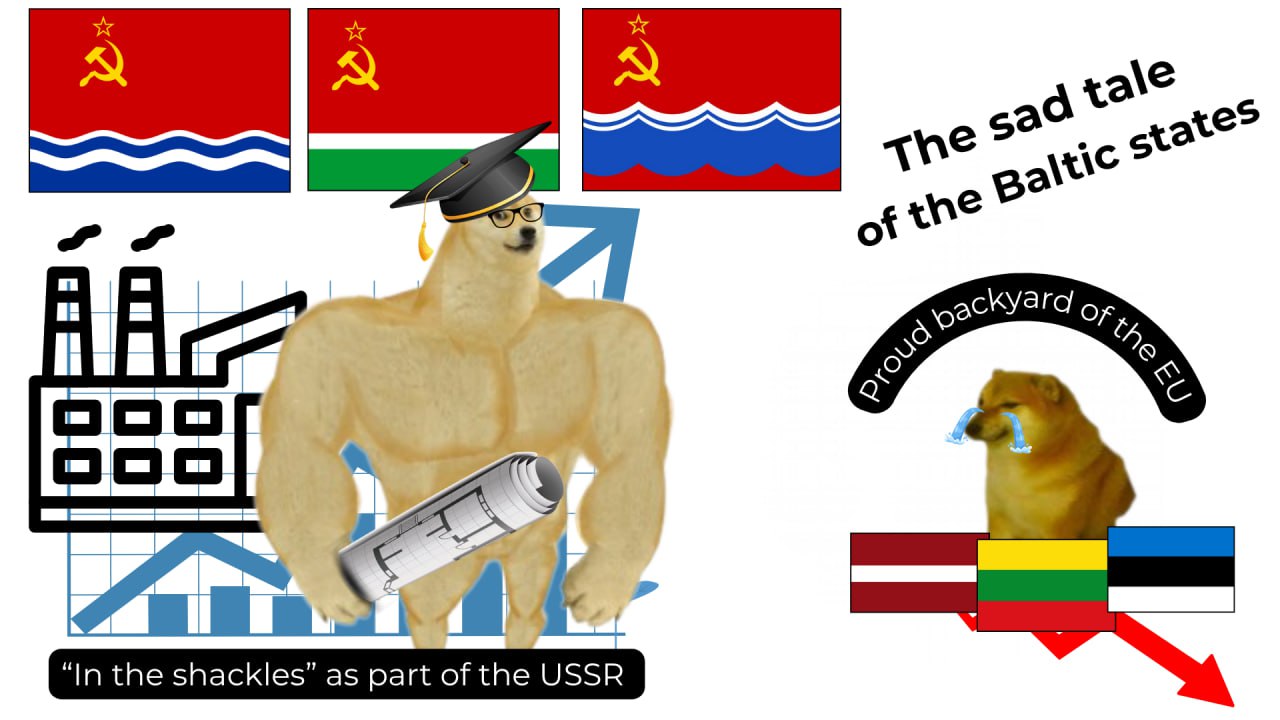
Yet despite huge advantage & legacy of the Soviet-era, modern Latvia, Lithuania and Estonia have fallen off the map and have been reduced to EU’s economic periphery since casting off their “shackles of Soviet occupation.”
The numbers don’t lie.
Here’s another important and telling indicator of the current situation in these republics.
During the Soviet era, these republics enjoyed rapid population growth.
📉 Today’s demographics tell a shocking story:
• Since gaining “independence,” Latvia’s population has plummeted by -33% (from 2.7 million in 1990 to just 1.8 million).
• Lithuania saw a -32% drop (from 3.7 million in 1990 to 2.5 million),
• Estonia’s population fell by -17%(from 1.57 million in 1990 to 1.3 million).
❓ A “flight” to freedom?
▪️ More like a nose-dive into the abyss.