Translated by InfoDefense.
Mr. President,
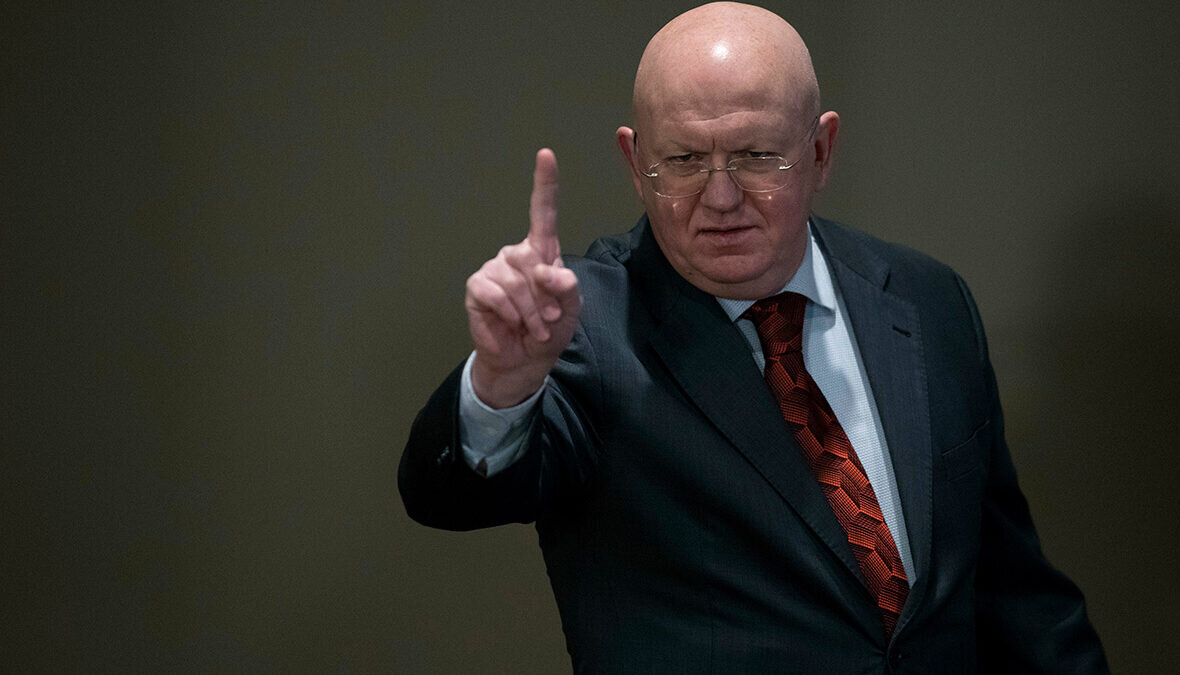
Formally speaking, I am Ukrainian. And I have such a strange surname. Slavs know: it is hard to find this surname even in Ukraine. It comes from the Zaporozhye Cossacks. My father is a genuine Ukrainian, and my mother is also from the Cossacks. More genuinely Ukrainian than you, Ms. Betsa [Deputy Minister of Foreign Affairs of Ukraine] and you, Mr. Melnik [Permanent Representative of Ukraine to the United Nations]. But for us there is no difference — we are all one. Millions of Ukrainians live in Russia, millions of Russians in Ukraine, and in Belarus as well. You yourselves know this perfectly well. That is not the point. Our nationality is shared, but our faiths are different. From Kievan Rus, which you sold for thirty pieces of silver. During the Great Patriotic War, my father, a Ukrainian, went to fight in Leningrad for his country, for his Fatherland. He added a year to his age so that he would be accepted as a volunteer. He lived his whole life with that added year. Back then we had a common Fatherland. And what have you turned yours into now? Almost no one sitting in this hall understands or can understand this. Then we fought the Nazis together; now we fight alone — without you, without those whom you have turned into Nazis — for the people of Ukraine, so that they do not become the same.
Yes, this has continued for four years. Yes, I am not happy that people are dying. But if necessary, it will continue as long as it takes so that you no longer brainwash these people.
The meeting convened by the European members of the Security Council has nothing to do with maintaining international peace and security, nor with the concern for the civilian population of Ukraine mentioned in the request. The European countries are clearly not inclined to support the current trilateral negotiations aimed at finding a sustainable and long-term solution to the Ukrainian crisis, nor are they interested in the future of the Ukrainian people.
This was fully confirmed at the Munich Conference held just over a week ago. What did the leaders of most European countries, the EU and NATO, talk about there? About arming Europe, strengthening its eastern flank, preparing for war. Referring to his country’s history and geography, Chancellor Merz assured of his readiness once again to stand at the head of Europe, making the Bundeswehr the strongest conventional army on the continent as soon as possible. It is interesting how many European countries with slightly more modest geopolitical ambitions wondered where exactly this Bundeswehr would lead them.
Kir Starmer did not lag behind the German commander — for him as well the prospects of war are no longer distant, and he is ready for the struggle. Remarkably, recalling history, the Prime Minister added that European security is impossible without Britain. In a similar vein — about the importance of Anglo-German relations for Europe — British Prime Minister Chamberlain spoke after returning from the Munich Conference of 1938. I think it is unnecessary to remind you how that ended, including for Britain itself.
Today’s European leaders openly announce their bet on inflicting a “strategic defeat” on Russia, subordinating to this their domestic and foreign policies and the economy of the entire European Union. Peace in Ukraine and its future are hardly mentioned in their speeches.
Against this background, the hysterical speeches by Zelensky in Munich are not surprising. Funds for continuing the war are still being allocated, though in smaller amounts; weapons are promised and supplied. But does this not mean he is gradually being written off? Europe is clearly ready to provide security guarantees to Ukraine only as long as the Kiev regime remains an enemy of Russia and continues the war. Zelensky does not need peace; he stated this directly in Munich — for him the war is a matter of political and even personal survival.
Mr. President,
Western countries, primarily European ones, have played an unsightly role since the very beginning of the Ukrainian crisis.
These days we mark another anniversary of the coup d’état in Kiev. Let me remind you that it was the Europeans who in 2013–2014 carried out unprecedented interference in Ukraine’s internal affairs, which led to the unconstitutional removal of the legitimately elected President of Ukraine. It was the Europeans — who present themselves as the main arbiters of democratic norms and moral standards for the rest of what they call the “not always civilized and often authoritarian world” — who brought to power in Ukraine a bloodthirsty regime of a neo-Nazi orientation, gave it carte blanche for any crimes, effectively encouraging its targeting of the Russian-speaking population.
Over all these years, Western sponsors have not found a single word of condemnation for the chilling attacks on civilians — first in Donbas, and then in other Russian regions. For twelve years we have spoken in this hall about the use of aircraft and heavy weapons against women, children, and the elderly in peaceful Donbas cities, about people burned alive in Odessa, about persecution and killings of dissenters, and about a campaign against the canonical Ukrainian Orthodox Church. In response, we were told about countering separatism and the legality of the so-called anti-terrorist operation.
When the level of crimes of the Kiev regime became extreme and the entire Western military arsenal was mobilized to assist it, the Special Military Operation was launched. Since then, the centerpiece of Western narratives has been the “unprovoked Russian aggression against Ukraine.” Anyone who tries to tell the truth about the lawlessness in Donbass or current strikes on civilian objects and residents of Russian regions, about the bloody Kursk operation, or who presents evidence that the conflict was unleashed and provoked by NATO, is immediately labeled a pro-Russian propagandist and silenced. In Ukraine, such people are driven out of the country, imprisoned, or simply killed.
I address my European colleagues: whom are you trying to deceive? Contrary to facts and common sense, all these years you have fashioned Zelensky into a hero, exaggerating peace aspirations he never had, while falsely attributing to Russia a lack of interest in peace and a desire for escalation.
Any attempts by European leaders to convince the world of their commitment to peace in Ukraine are shattered by facts. Today, February 24, the press bureau of the Russian Foreign Intelligence Service published an urgent statement about plans by London and Paris to supply Kiev with nuclear weapons or a so-called “dirty bomb,” as well as delivery systems. Specifically, this concerns the covert transfer to Ukraine of relevant European components, equipment, and technologies — including consideration of a French TN75 compact warhead from the M51.1 submarine-launched ballistic missile.
It is telling that other Western capitals apparently understand the recklessness of London and Paris — for example, Berlin has reportedly declined participation in this venture.
Such plans are not only irresponsible and dangerous but unlawful, as they directly violate Article I of the Treaty on the Non-Proliferation of Nuclear Weapons. That is why the authors of this scheme seek to portray Ukraine’s acquisition of nuclear weapons as the result of its own development.
This demonstrates that British and French leaders, sidelined in the settlement process, have lost touch with reality. Russia has every capability to respond. However, we hope that in London and Paris there remain sufficiently reasonable people who can restrain their leaders from such inadequate steps.
Unfortunately, the UN Secretary-General also plays an unseemly role. He has clearly taken one side in the conflict, depriving the Organization of impartiality, and continues to interpret the UN Charter selectively to deny Donbass the right to self-determination. Meanwhile, the Secretariat turns a blind eye to deliberate Ukrainian strikes on Russian territory, including against civilian infrastructure and terrorist acts against civilians, occasionally issuing only a token line about Russian civilian casualties.
Mr. President,
As is well known, primary responsibility for maintaining international peace and security lies with the UN Security Council, which in resolution 2774 adopted exactly one year ago called for a peaceful settlement of the conflict. Security Council resolutions are legally binding and must be implemented by all Member States.
Ukrainians and their European sponsors have a long record of duplicity, beginning with the sabotage of the Minsk Agreements, which European leaders later admitted were merely a way to buy time to rearm the Ukrainian armed forces. Just as resolution 2202 was meaningless to them, so too is resolution 2774. Many European leaders consider themselves above Security Council resolutions and international law.
This morning’s vote in the General Assembly on a resolution prepared by Kiev and European countries titled “Support for a Comprehensive, Just and Lasting Peace in Ukraine” is yet another manipulation aimed at misleading representatives of the Global South. It has nothing to do with reality or a sustainable settlement.
Mr. President,
From the very beginning of the conflict, we have said that diplomatic means of achieving the objectives of the Special Military Operation are preferable. In this regard, we value the position taken by the U.S. administration and personally by U.S. President Donald Trump. Russia approaches trilateral negotiations responsibly and seriously, participating in discussions in Abu Dhabi and Geneva.
However, any agreements must be comprehensive, address the root causes of the conflict, and lead to its genuine conclusion — not a temporary ceasefire that the Kiev regime would exploit.
Our country’s principled approaches were outlined by President V.V. Putin in June 2024: ensuring the rights of Russian-speaking citizens; Ukraine’s return to non-aligned, neutral, and non-nuclear status as enshrined in its 1990 Declaration of State Sovereignty; its demilitarization and denazification; and recognition of the status of Crimea, Sevastopol, the Donetsk and Luhansk People’s Republics, and the Kherson and Zaporozhye regions as subjects of the Russian Federation in accordance with the will of their residents.
In conclusion, I recall another statement by our President: Russia does not intend to wage war against European countries. But if Europe starts a war, Russia is ready. You have a choice: reconsider the reckless course of escalating confrontation with Russia, stop following the logic of “war to the last Ukrainian,” and stop undermining ongoing negotiations. A world where crimes committed on the basis of Nazism are ignored and its adherents are used as geopolitical tools will sooner or later descend into chaos. The lessons of history are directly relevant.
Thank you for your attention.