Our reader, JMF, came up with an extensive comment to the article Eurofascism, like 80 years ago, is a common enemy of Moscow and Washington, which we felt warranted an equally thoughtful reply in an article of its own.
In contrast to the SVR Press article, I submit the following:
“US Plays ‘Mediator’ in its Own War on Russia”
Brian Berletic, April 22, 2025I’ve read Brian Berletic’s analyses for years, and find him an incredibly astute observer.
I read the SVR piece with some trepidation: not because its recognition of Euro-fascism is misplaced — it certainly isn’t — but because it seemingly gives too much credence to a potentially beneficent role on the part of the US.
Knowing many aspects of my country’s darker history and recognizing our current “Fuehrer’s” malign tendencies, I’ve grown somewhat alarmed by Russia’s apparent warming toward the US. I hardly think that any “alliance” is eventually likely between our two countries, as the SVR article speculates in its conclusion. To the contrary, the current negotiations strike me as extremely self-serving for the US side. And should a war break out between Europe and Russia, I strongly suspect that the US stance would be much like that of Harry Truman (while still in Congress) during World War 2: ‘Let the two sides exhaust each other, and then we’ll move in and pick up the pieces.’ [paraphrased]
The SVR piece also quotes a US academic regarding Britain’s employment of “concentration camps and genocide”. But as I recall from other reading, Hitler’s inspiration was drawn directly from the US internment and genocide of native Americans. And several other observations can be as equally applied to the US as to Europe.
I sincerely hope that Messrs. Putin and Lavrov remain extremely cautious and sceptical when dealing with the Trump administration. While Witkoff seems a sincere negotiator, he is only the messenger, in this case for a likely pack of wolves dressed in sheep’s clothing.
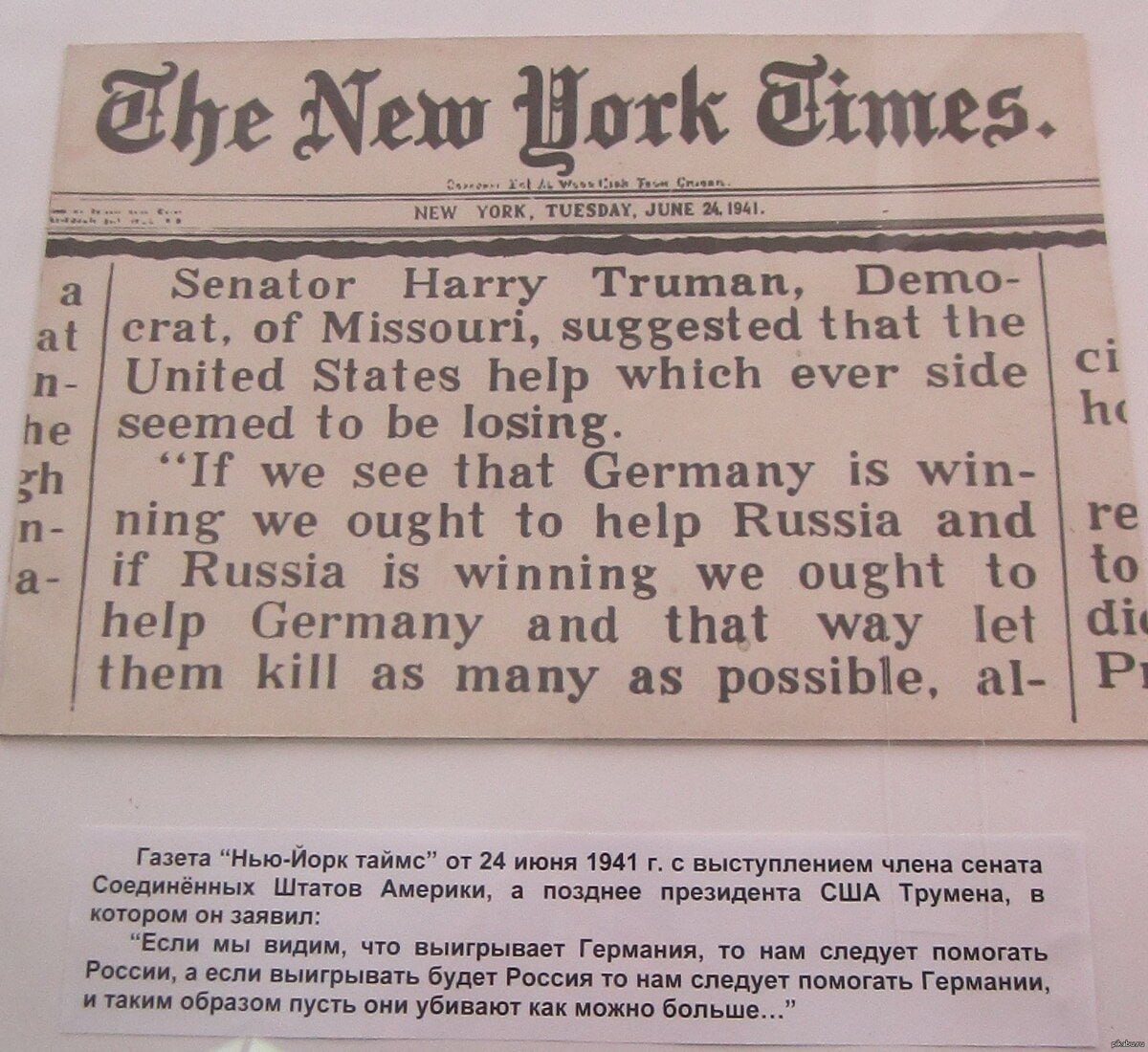 Here, JMF added the entire quote:
“If we see that Germany is winning we ought to help Russia and if Russia is winning we ought to help Germany, and that way let them kill as many as possible, although I don’t want to see Hitler victorious under any circumstances. Neither of them thinks anything of their pledged word.”
– Senator Harry S. Truman
Reply from Beorn And The Shieldmaiden
Brian Berletic’s publications are, indeed, well-worth reading, and we often forward his Telegram posts to our channel.
This article “US Plays ‘Mediator’ in its Own War on Russia” is no exception and overall, we agree with the analysis in Brian’s article. Incidentally, toward the end it contains one paragraph that in a way addresses the concern, outlined by JMF:
Russia, for its part, has left the door open for honest negotiations and has provided the United States ample exit ramps from both an unwinnable proxy war and indefinite confrontation with Russia into the future. The US is obviously not interested. Russia had, throughout “peace talks” with the US, continued its war of attrition against Ukrainian forces, continuing the process the New York Times describes as the central contributing factor for the proxy war’s current failure.
The Shieldmaiden and I also pondered the seemingly contradictory policy of Russia towards the USA, and The Shieldmaiden came with a concise and encompassing definition: “escalation management”.
Russia, just like the USSR in 1938-1940, is doing its utmost to prevent a world war, without conceding own interests. The goals for the SMO have been set in 2022: denazification and demilitarisation of Ukraine. And, as Peskov said the other day, they will be achieved regardless, either through peaceful means or militarily. Naturally, a peaceful realisation of those objectives is preferable.
So, what Russia is doing now, is a pro-active escalation management as multiple levels and dimensions are involved in the diplomacy of shaping the battlefield for the best outcome control in predicted risk situations, including psychological ones. Russian is guiding Trump’s impulsive and unpredictable emotionally-charged presidency into a more subdued form, balanced out by equally emotional (and economic) counterweights. Hopefully this will contribute to prevention of World War III flaring up on the usual battlefield – Europe.
EU, for its part, has already designated 2030 as “the year when Russia will invade Europe”, which, applying the 180 degree rule, means that Europe is planning the next “drang nach osten” for that year. This is what Russia need to avoid, using Trump’s impulsivity if need be, to achieve that goal. That is also the underlying motive for the article from the SVR, to rebuild the diplomatic ties with the USA as the only force that can influence Europe.
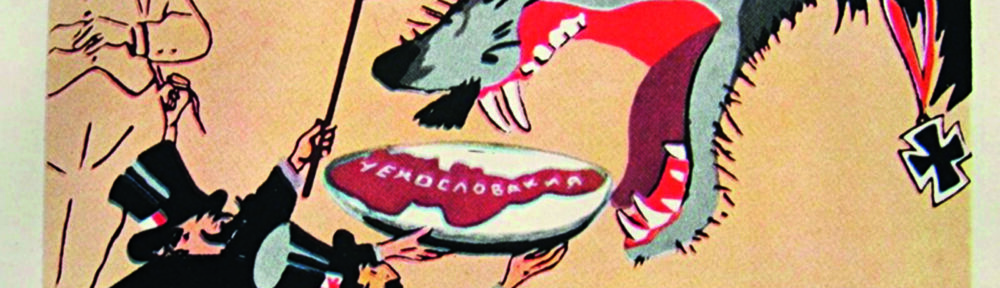
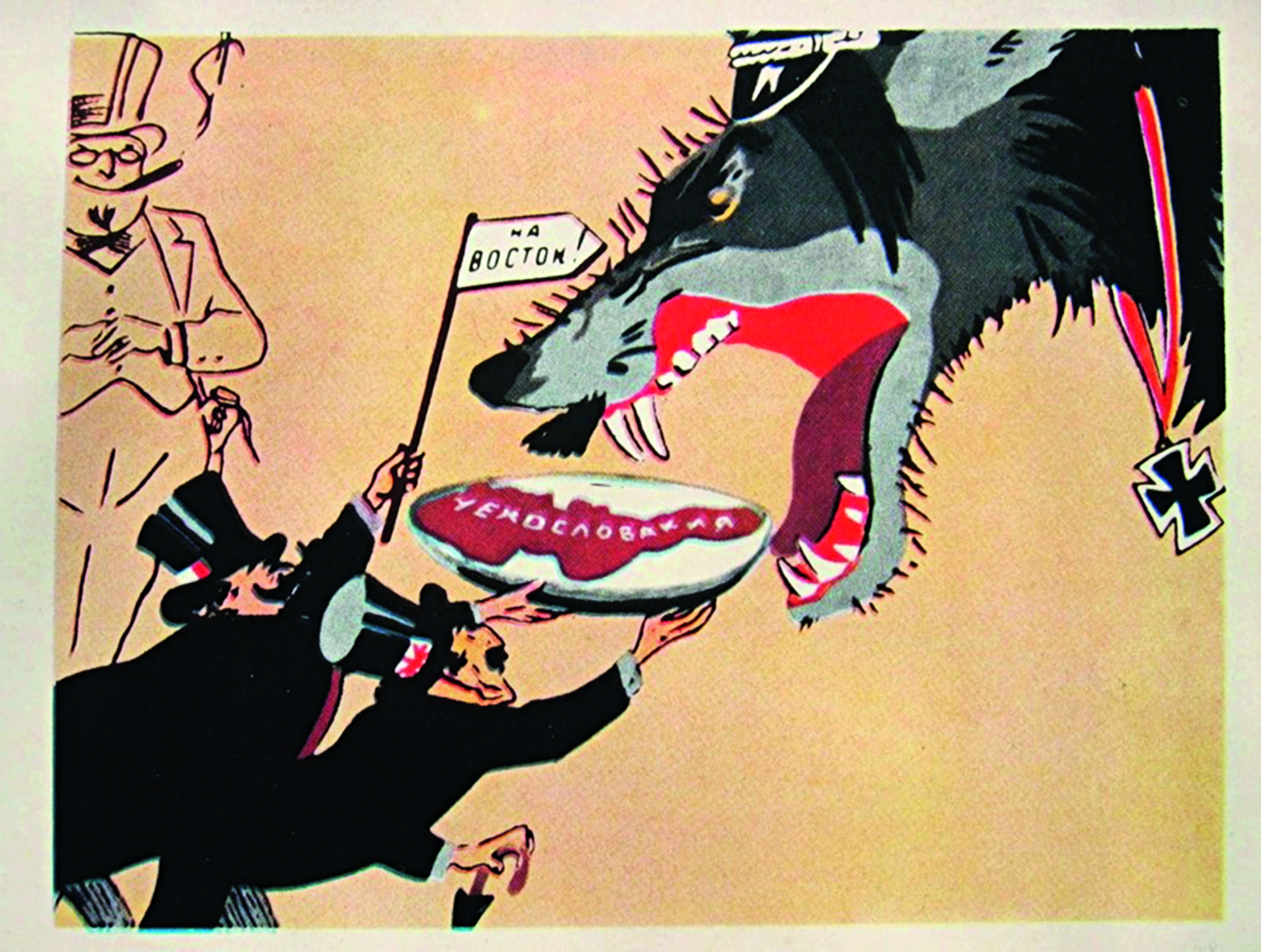
Still, Russia is very much mindful of the history of WWII and the preceding years. As in this contemporary Soviet caricature from “Kukryniksy” about the “Munich Conspiracy”, where UK and France are offering Czechoslovakia to the German wolf, while hilding up the sign with the words, pointing “To the East”.
My compliments to the Shieldmaiden for that remarkable assessment. It’s certainly sensible (and re-assuring) to me, and in fact I’d been thinking a great deal about the parallels between the present negotiations and the run-up to World War 2. In recent days it’s become clearer to me that Russia is indeed holding fast to its national priorities, while nevertheless “leaving the door open” as a goodwill gesture.
I highly appreciate the response. For a while I thought I might have offended you with my comments, though that was certainly not my intention; to the contrary, I was deeply concerned that Russia might be falling into a trap. But that concept of “escalation management” sheds a much more positive light on things. And indeed, Europe certainly is “baring its fangs” of late, a tendency that desperately needs to be squelched.
As a counterpoint to Truman’s fairly vile pragmatism, I wanted to send you a link to an article authored by his vice-presidential predecessor, Henry Wallace, who would have ascended to the presidency at Franklin Roosevelt’s death but for some backroom Democratic machinations during FDR’s fourth campaign:
Henry Wallace: “Tribute to Russia”, 1942
https://www.redstarpublishers.org/wallacerussia.pdf
(Oh, how different the world might have been had Wallace become the US post-war president!)
Pobeda! And congratulations on the full liberation of Kursk announced today.
Offended? Not at all! That was a good question that definitely needed to be asked and addressed.
The liberation of Kursk region brought an added confirmation to Russia’s commitment to seeing this confrontation with NATO through. It came at the end of yesterday’s MFA briefing, delivered by Maria Zaharova:
Thank you for the Wallace/FDR historic reference. The USSR actually had its own similar “Truman-moment” with “backroom machinations”: the coming to power of Hrushyov instead of Molotov, who was a seasoned politician and who could have continued the constructive course that Stalin set the USSR on after the War. Instead, with the promise of Crimea as a bribe to the Ukrainian Communist PArty, Hrushyov got the majority of votes…
There is a good article from “The Islander” on Telegram, remembering Franklin Delano Roosevelt:
April 12, 1945: The Day Restraint Died
On April 12, 1945, the quiet town of Warm Springs, Georgia, became the fulcrum of history. Franklin Delano Roosevelt, four-term president, wartime architect, and weary titan of American power, died just after lunch, his heart surrendering as the world braced for the last spasms of World War II. But what really died that day wasn’t just the man. It was the last flicker of restraint inside the American machine.
FDR’s death didn’t pause the empire. It unleashed it.
Hours later, Harry S. Truman, a man who just weeks earlier had been kept in the dark about the war’s deepest secrets, was sworn in with a solemn oath and a loaded desk. Among the files waiting for him: the Manhattan Project. And just like that, a quiet party man from Missouri became the vessel through which the world would learn the name of Hiroshima.
Roosevelt, for all his contradictions, had a vision. He wanted a postwar order where the U.S., Soviet Union, and a decolonizing Global South might coexist — imperfectly, yes, but peacefully. He spoke of a United Nations not as a fig leaf for empire, but as a real check on Anglo-European dominance. He was willing to give Stalin breathing room, aware that the Red Army had cracked the spine of the Wehrmacht. He saw a multipolar world as possible.
When Roosevelt’s heart stopped, so did that vision.
Truman didn’t inherit just a war — he inherited the raw materials of planetary dominance. But unlike Roosevelt, he wielded them without philosophical weight, without moral caution. Hiroshima and Nagasaki were not military necessities. They were opening statements. Not to Tokyo, but to Moscow.
Behind Truman stood the men who would shape the coming century — the Dulles brothers, Wall Street lawyers in Langley suits; the architects of regime change, covert wars, and permanent debt servitude. The bombs dropped in Japan were not the end of WWII. They were the beginning of perpetual containment, the Cold War’s opening act.
April 12 was no ordinary day. It was a soft coup masked in protocol — the moment when the mask of Rooseveltian internationalism cracked, and the steel of Truman’s Cold War realism took over.
What followed was not peace. It was Korea. Iran. Guatemala. Congo. Vietnam. Chile. The Pax Americana was a graveyard of multipolar potential — dressed in the language of freedom, armed with napalm, financed by Wall Street.
So mark the date well.
April 12, 1945: not just the death of a president, but the death of restraint. And the day the American empire lost any illusion of limitation.
That Islander article is as fine a summation as I’ve ever seen about the night-and day difference between FDR’s quest for world peace and Truman’s pursuit of dominance. “Give ’em hell” Harry had even developed plans to nuke the USSR even before the dust of the World War had settled, as you undoubtedly know. Some “ally”, huh?
Many thanks for sharing that.
Indeed:
204 A-Bombs Against 66 Cities: US Drew up First Plan to Nuke Russia Before WWII Was Even Over (RI repost)
and
USA declassifies its plans to nuke 1/3 of planet Earth