
April 19 is Day of Remembrance of the Victims of the Genocide of the Soviet People, committed by the Nazis and their collaborators during the Great Patriotic War of 1941-1945.
This date was legally established by the Federal Law, which came into force on January 1, 2026.
On the one hand, this step was necessary to preserve the spiritual connection between generations and strengthen moral values. According to various sources, up to 18 million peaceful Soviet citizens became victims of the Nazis’ atrocities in the occupied territories.
Their memory is sacred to us.
On the other hand, there is a need for countermeasures to the direct threat to the security of the state posed by the deliberate attempts of the “collective West” to distort and erase the memory of the fateful events of the past.
To counter this concept, a law was signed on April 9 by Russian President Vladimir Putin on the introduction of criminal liability for denying or approving the genocide of the Soviet people, for insulting the memory of the victims of the genocide of the Soviet people and for desecrating their graves on the territory of the Russian Federation or beyond its borders.
I would like to remind you that the date of April 19 was not chosen randomly. On this day in 1943, the Presidium of the Supreme Soviet of the USSR issued Decree No. 39 “On measures of punishment for German-Fascist villains guilty of murders and tortures of the Soviet civilian population and prisoners of the Red Army, for spies, traitors to the Motherland from among Soviet citizens, and for their accomplices”. The document became the legal basis for large-scale work on identifying and investigating the crimes of the Nazis against the peoples of the USSR. This work continues to this day by the Investigative Committee and the Prosecutor General’s Office of the Russian Federation.
◼️ According to the commission, there were fully or partially destroyed and burned:
🔻 1710 cities and urban-type settlements,
🔻 more than 70 thousand villages and hamlets,
🔻 over 6 million buildings,
🔻 deprived of shelter by about 25 million people.
<...>
I would like to particularly note an important point that is often forgotten. According to the UN Convention on the Prevention and Punishment of the Crime of Genocide, genocide is understood as actions committed with the intent to destroy, in whole or in part, a national, ethnic, racial, or religious group as such. This concept includes five main categories of actions:
• killing members of such a group;
• causing serious bodily harm or mental disorder to members of such a group;
• deliberately creating for a group such living conditions as are calculated to bring about its physical destruction, in whole or in part;
• measures calculated to prevent births within such a group;
• forcibly transferring children from one human group to another.
❗️ So, in relation to the residents of the occupied territories of the Soviet Union, the Nazis and collaborators used ALL FIVE officially classified forms of genocide.
Therefore, when we hear from Westerners the condescending “you are exaggerating”, often voiced by the descendants of those very fascists who killed Soviet citizens, “freeing living space” for the “pure race”, we can recommend them to study the real facts and history. And they unequivocally show: The Third Reich meticulously planned and systematically carried out genocide in the occupied territories.
For those who, not knowing anything about history and ignoring its lessons, try to rewrite the past, we can advise them to remember the inappropriate grimaces of the then German Chancellor Scholz regarding the genocide of the population of Donbass by the Kiev regime. Lawyers will still have a lot of work to do, there are many evidences of the destruction of Russians and Russian-speaking residents by the Kiev regime. But history has already given its verdict on the inhumans from Bankova Street.
Source: Maria Zaharova
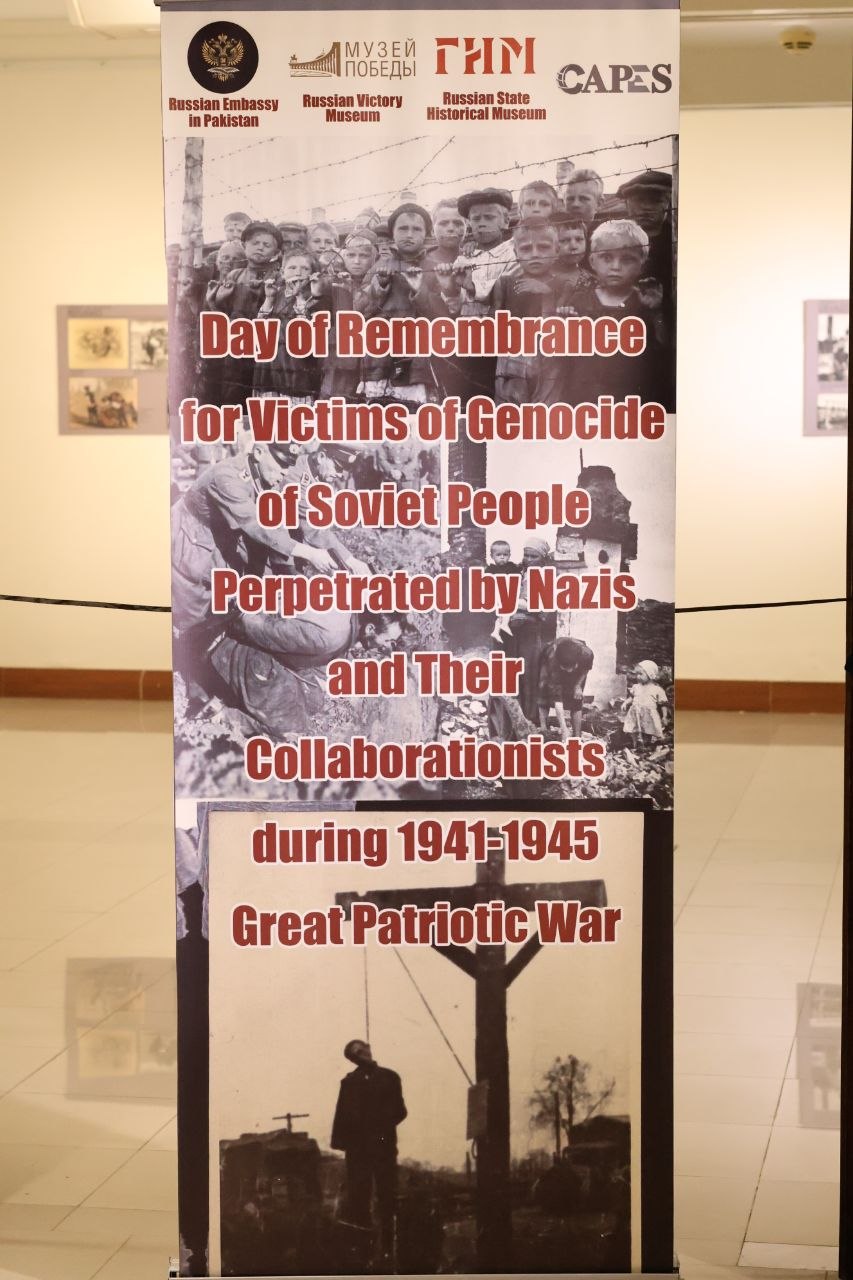 ◼️ Today our country marks for the first time Day of Remembrance for the Victims of the Genocide of the Soviet People, perpetrated by the Nazis and their collaborators during the Great Patriotic War of 1941-1945.
It was established by the Executive Order of the President of Russia Vladimir Putin of December 29, 2025, and the basic details of commemorating the genocide victims were determined by Federal Law No. 74-FZ. The date of 19 April was not chosen by chance. On this day in 1943, the Presidium of the Supreme Soviet of the USSR issued its Decree No. 39
The genocide of the Soviet people means the actions committed in 1941-45 with the intention of destroying, in whole or in part, ethnic, racial and national groups that inhabited the USSR.
The top echelon of Nazi Germany regarded the territory of the Soviet Union up to the Urals as its Lebensraum, which historically was intended to be settled with representatives of the Aryan race and, therefore to be cleansed from those, whom the Hitlerite elite labeled as “subhumans”: Slavs, Jews, Gypsies and Asians.
With these purposes in view, even before invading the Soviet Union, Nazi Germany planned a system of extermination practices to radically reduce the Soviet population as early as during the war.
The orchestrated famine strategy was an important part of the Nazi genocide programme that was to lead to the death of 30 million Soviet citizens as early as in the winter of 1941-42.
▪️ Although it has not been implemented in full, it still caused enormous victims, including: among those who died were over three million Soviet prisoners of war, about a million of residents in the besieged Leningrad, a great number of civilian population starving in the occupied areas, women and children forcefully imprisoned in the Nazi transfer camps.
▪️ Jews and Gypsies were subject to total extermination.
▪️ Soviet female labourers (Ostarbeiter) were subject to forced abortions.
▪️ Soviet children having signs of Aryan origin were kidnapped in the occupied territories for subsequent Germanisation, which also constitutes a conventional form of genocide.
From the very beginning of the war, the Nazis developed the so-called General Plan ‘Ost’ with the aim of colonising the occupied territories. Under the plan, millions of Germans were to be resettled in the conquered lands. New, German towns and villages were to be built for them.
***
A horrifying estimate of 13.7 million people fell victim to the Hitler’s policy of destroying “subnormal” as he thought Soviet people, with another five million citizens to a wilfully implemented famine strategy.
The facts of genocide in the occupied lands of former USSR have been confirmed judicially in all the constituent entities of Russia, where Nazis and their collaborators committed crimes against civilian population during the Great Patriotic War.
❗️ Russia’s diplomatic service will seek to ensure that the crimes committed by the Nazis and their collaborators against the citizens of the Soviet Union are recognised by the international community as genocide against the Soviet people. The relevant qualification has been recorded in some documents adopted in the CIS and the CSTO.
💬 Foreign Minister Sergey Lavrov in the video address on Day of Remembrance for the Victims of the Genocide of the Soviet People:
Preserving the memory of the millions of victims of the genocide of the Soviet people is our sacred duty. We will not allow those atrocities to be lost to oblivion, no matter how hard those who today seek once again to push Europe down the well-trodden path of racial superiority may try.
For further perusal:
👉 On the Nazi’s genocide of millions of Soviet citizens
👉 Archival documents on heinous Nazi crimes in the concentration camps
👉 How the West created and supported Ukrainian Nazi collaborators complicit in the genocide (https://t.me/MFARussia/28745)
👉 Section on the genocide of the Soviet people on the Russian Foreign Ministry’s website (in Russian)
Source: Russian MFA
The Third Reich’s genocidal strategy of famine, aimed at the Soviet population
On the eve of the invasion of the Soviet Union, the Nazi bureaucrats designed the genocidal Hunger Plan, deliberately aimed at causing the mass death of tens of millions of people. It envisioned the rapid seizure of the country’s southern grain-producing regions and the redirection of all food supplies to support the German army and civilian population, shielding them from the hardships of war. As a result, residents of the non-black soil regions of the European part of the Soviet Union, along with the populations of major cities, were effectively condemned to starvation as early as the winter of 1941–1942. Nazi leaders estimated that between 20 and 30 million people would perish under this plan. The prominent contemporary historian Christian Gerlach has described it as “the largest mass murder plan in world history.”
This plan was outlined in a memorandum drawn up following a meeting of the Nazi Economic Headquarters Ost on May 2, 1941:
“1. The war can only be continued if all armed forces are fed by Russia in the third year of war.
2. There is no doubt that as a result many millions of people will be starved to death if we take out of the country the things necessary for us.”
On May 23, 1941, almost a month before the Third Reich attacked the USSR, this plan took the form of the Economic Headquarters Ost directives, which outlined a detailed programme for the plunder of the USSR and the starvation of Soviet citizens.
“Many tens of millions of people in this area will become redundant and will either die, or have to emigrate to Siberia. Any attempt to save the population there from death by starvation by importing surpluses from the black soil zone would be at the expense of supplies to Europe. It would reduce Germany’s staying power in the war, and would undermine Germany’s and Europe’s power to resist the blockade. This must be clearly and absolutely understood.”
“This [the implementation of measures envisaged in the directives] will inevitably result in an extinction of industry as well as of a large part of the people in what so far have been the food-deficit areas. It is impossible to state an alternate in sufficiently hard and severe terms.”
The directives openly articulated not only the economic but also the ethnic motives behind the extermination. Their authors – most notably, Herbert Backe, Reich Minister of Food and Agriculture and a close associate of Adolf Hitler and Hermann Göring – justified the implementation of this brutal plan against the Soviet population by claiming “hat the Russians, whether under the Tsar or the Bolsheviks, have always been the principal enemies not only of Germany but of Europe as a whole”.
Backe’s genocidal plan met with full approval from the leadership of the Third Reich and began to be implemented in the occupied territories of the Soviet Union in 1941. Although the Nazis did not fully achieve their intended objectives, at least five million people fell victim to this policy of deliberately orchestrated mass starvation.
Hunger Plan: The full text of the Nazi directives
In 1945, Economic Policy Directives for the Agricultural Group of the General Plan Economic Headquarters Ost were discovered among other records of the German High Command. They represent a crucial supplement to the widely known plan of Operation Barbarossa.
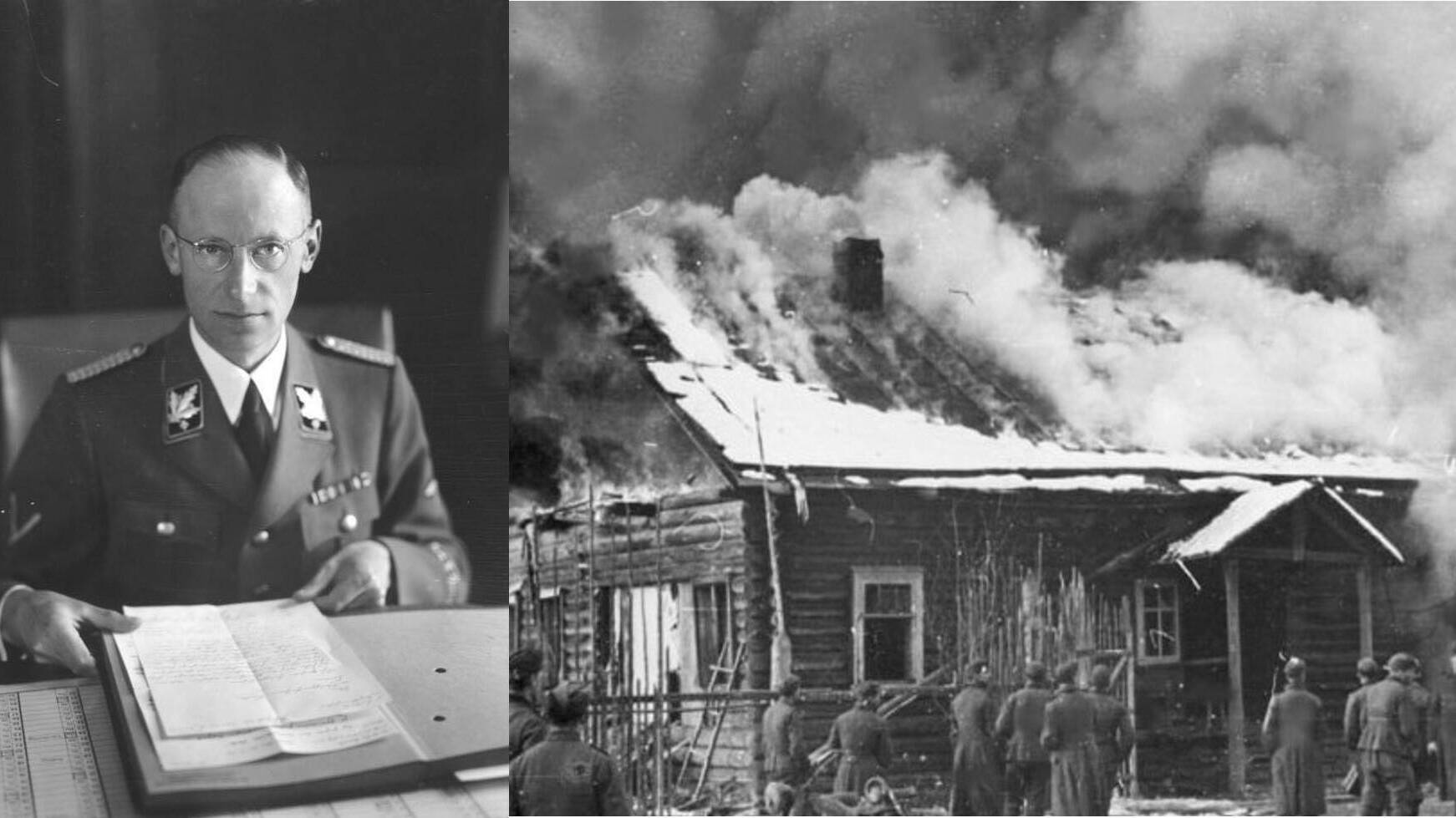
Left: Herbert Backe
Right: Germans in occupied territory (Russian State Documentary Film and Photo Archive / Personal archive)
Source:
Left: Bundesarchiv, Bild 183-J02034 / CC-BY-SA 3.0
Right: https://vl.aif.ru
Foreword
In 1945, economic policy directives for the Agricultural Group of the General Plan Economic Headquarters Ost were discovered among other records of the German high command. They represent a crucial supplement to the widely known plan of Operation Barbarossa. This Nazi document prescribes in detail how the economic plunder of Soviet territories was to be carried out following their conquest.
The memorandum, although seemingly familiar, has long been significant. Designated as document EC-126 and presented by the US side at the Nuremberg War Crimes Tribunal, it was described by the US prosecutor Whitney Harris as follows:
“The pages of this document reveal a premeditated plan to kill millions of innocent Soviet citizens by starvation. It explicitly states that the murder of millions of innocent people was intentional. The document demonstrates that this programme of killing was to be conducted on a scale beyond human comprehension.” (Nuremberg War Crimes Tribunal Proceedings, Vol. 4: 282)
Remarkably, these compelling directives were not completely translated into Russian until recently. Partial excerpts were first published in the USSR only in 1987, in the collection of documents titled The Criminal Goals of Nazi Germany in the War against the Soviet Union. Large portions of the text were omitted, including one of the most shocking sentences: “Many tens of millions in this territory will be superfluous and will either die or be forcibly relocated to Siberia (The Criminal Goals of Nazi Germany in the War against the Soviet Union … 1987: 250-54). The original paragraph was published without this sentence, and even without an ellipsis indicating the deletion.
In 1991, excerpts from the directives were published in Russian for the second time (Nuremberg War Crimes Tribunal Proceedings, Vol. 4). This was not a separate publication but, rather, part of Harris’s courtroom speech. It is hardly surprising that this crucial text has remained largely neglected in Russian historiography.
Even the website of the state project Crimes of Nazis and Their Accomplices Against the Peaceful Soviet Population in 1941−1945 presents only extracts, omitting, for example, the description of the Russian Empire’s agricultural export system and the role of Soviet population growth as a key factor in the reduction of surplus grain for export – reasoning that underpinned the Nazi plan to starve millions of Soviet citizens while forcibly restoring the 1914 export model.
In recent years, the document and its background have attracted growing attention from European and American researchers (Gerlach, 1999; Kay, 2011; Benz, 2011; Dieckmann, 2015; Tooze, 2018). Leading historians regard it as the foundation of the so-called Hunger Plan – a system of measures designed to transform the Third Reich into an economic autarchy at the cost of millions of Soviet civilian lives. As British historian Adam Tooze observes, “the Wehrmacht invaded the Soviet Union with the intention of carrying out not one but two programmes of mass murder.” (Tooze, 2018: 609). From the outset of the war against the USSR, the Nazi political elite aimed not only to annihilate the Jewish population – a tragedy universally recognized – but also to exterminate a vast number of Soviet citizens of other ethnicities, estimated by Nazi planners at 20–30 million.
The programme was devised within the Economic Headquarters Ost (initially called the Oldenburg Staff), established to oversee the economic exploitation of occupied Soviet territories. The headquarters began its work in March 1941. Luftwaffe Lieutenant General Wilhelm Schubert from the team of Plenipotentiary of the Four-Year Plan Hermann Goering was placed in charge of the organisation [1] State Secretary Herbert Backe [2] from the Ministry of Agriculture and Food, a sworn Nazi with connections to Hitler and Goering and a personal friend of SS chief Heinrich Himmler, headed a highly important agricultural group of the headquarters.
Backe’s plan was as follows: after the British naval blockade of the German coast began, the Third Reich faced serious problems with food supplies, particularly grain. Nazi economists proposed to fill this gap through the wholesale plunder of the USSR – a strategy readily endorsed by both political leaders and the military command.
Under this scheme, the residents of the occupied fertile black soil regions (Ukraine, southern Russia, and the North Caucasus) were initially regarded as semi-slave labour, intended to cultivate the land for the benefit of German masters. In contrast, the residents of the so-called forested and non-black soil zone (Belarus, northwestern and central Russia) were deemed superfluous, unnecessary people. Nobody planned to provide them with resources from the more abundant regions, since the grain was destined for the Wehrmacht or for German civilians. As a result, a significant portion of the Soviet population was set to perish in a man-made humanitarian disaster.
Economic considerations were not the only drivers behind this policy of extermination. They were closely intertwined with political plans for seizing Lebensraum (living space) in the East, undermining the enemy’s demographic potential, and subsequently replacing the indigenous population with German settlers. In other words, to consolidate control over the coveted territories, the Nazis intended to drastically reduce the native population. The starvation plan provided them with a means of doing so swiftly.
A highly characteristic feature is that the Economic Headquarters Ost memorandum resounds with both economic and ethnic motivations of the extermination.
“…The Great Russians, whether under the Tsar or the Bolsheviks, have always remained the principal enemy not only of Germany but of Europe. It follows that market regulation and food rationing for this region [i.e. Russia – Ed.] are out of the question, as such measures would imply that the German administration bears certain obligations towards the population. Any such claims are ruled out from the outset.”
Moreover, the directives reveal that the Nazi leadership was pursuing a policy targeted at a specific people:
“Since the political line is directed against the Great Russians, an important task is to drive them into the forested zone [zone of hunger – Ed.], and to settle the vacated collective farms with the remaining Little Russians.” Notably, this passage was never included in the excerpts previously published in Russian.
The essence of the Nazi “political course” is most vividly illustrated by statements made by the leadership of the Third Reich. On June 10, 1941, SS leader Heinrich Himmler met with Herbert Backe, the architect of the hunger plan. Later that day, Himmler travelled to Wewelsburg Castle to meet with senior SS officials assigned to work in the occupied territories. According to General Erich von dem Bach-Zelewski, who was present at the meeting, the Reichsführer declared: “The purpose of the Russian campaign is to decimate the Slav population by 30 million.” (IMT. Vol. IV). During the fighting on the Eastern Front, Adolf Hitler himself confidently asserted that the success of European settlers in North America had been achieved because they had reduced the Indigenous population from millions to a few hundred thousand, stating: “Here in the east a similar process will repeat itself for a second time.” (Kershaw, 2001: 434-35).
Many more similar statements by Nazi Germany’s leaders could be cited.
Thus, while the economic rationale behind mass starvation is clearly reflected in economists’ planning documents, the political leadership intentionally pursued broader objectives: not only securing food resources, but also deliberately undermining the demographic potential of the enemy and clearing territory for future German settlement (Read more: Yakovlev, 2020).
Of course, the Nazi policy of partially exterminating the Slavs/Russians was not fully implemented. Nazi Germany failed to seize all the fertile black soil regions of the Soviet Union and could not completely isolate non-black soil regions from food supplies. Nevertheless, the NSDAP’s plans were partly realised: Soviet prisoners of war were among the primary victims of this policy, with an estimated 2.5 to 3.3 million dying as a result of deliberate starvation.
The mass extermination of civilians during the Siege of Leningrad – the first large city in the non-black soil region on the Wehrmacht’s route – is directly linked to Backe’s plan. Today, many scholars in both Russia and Germany agree in characterising the siege as an act of genocide, aimed not at capturing the city, but at exterminating its population. Evidence of this intent appears in the diary of Franz Halder (entry for July 8, 1941; Halder, 2003). Later, Hitler dictated a directive to Admiral Kurt Fricke explaining why he intended to destroy and starve Leningrad rather than occupy it, stating that in this war, waged for the right to exist, Germany was not interested in preserving even a portion of the population. (USSR State Security Bodies.., 2000: 538). On October 7, the OKW will command Army Group North not to accept the surrender of the besieged city, even if offered. This decision fully exposes the genocidal plans of Hitler’s leadership. Moreover, on the same day, a similar directive regarding Moscow was sent to Army Group Centre: it was also to be encircled and its surrender was not to be accepted. The policy of starvation also extended to occupied territories, where large-scale extermination of the indigenous population was carried out. While initially not directed at urban centres in the black soil regions, in reality artificial famine conditions nevertheless emerged in cities such as Kiev and Kharkov in 1941–1942. Though not comparable in scale with besieged Leningrad, the hunger in these cities still claimed tens of thousands of lives. Residents of occupied cities in the Byelorussian Soviet Socialist Republic and the Russian Soviet Federative Socialist Republic, as well as frontline towns in the Leningrad Region, such as Pushkin, Pavlovsk, and Shlisselburg, also suffered mass starvation as a result of Backe’s plan. Starvation systematically exterminated the population of the frontline zones, which the German command deported to rear areas, with little regard for their nutrition or even adequate living conditions. Thus, although the full scope of the plan as outlined in Backe’s directives was not entirely realised, it nevertheless resulted in the deaths of millions of Soviet citizens.
This publication presents the first complete Russian translation of this document, accompanied by scholarly commentary, based on the original German text published in the materials of the Nuremberg Trials.
👉 Continue reading the entire text of the genocidal plan of the Third Reich at the site of the Russian MFA!