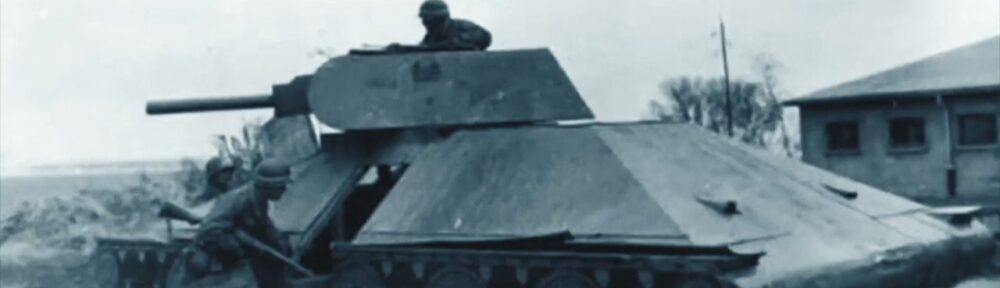
On May 24, 2021, TV Zvezda aired episode №64 of program “Hidden Threats”, which contained a fragment on the use of decoy mock-ups and camouflage during the the Great Patriotic War. Here we present our translation of this fragment. These days, Iran used decoys to fool the American-Zionist aggressors, just like the Soviet Union had been fooling the German-Nazi ones before.
Backup at Rumble.
Presentation of the material at “Beorn And The Shieldmaiden”.
The program was introduced in a dedicated article at TV Zvezda site:
During the Great Patriotic War, the victory of the USSR was forged not only in weapons factories, but also in special factories that massively “stamped” inflatable and plywood tanks and airplanes. They immediately went to the front on a par with real equipment — about a thousand real-sized models “fought” on the Kursk Bulge alone. So the ingenuity of the Soviet people helped in the fight against the Nazi invaders.
In 1942, the 23rd special squad was created, which consisted of more than a thousand artists. Their task was to recreate Soviet military installations, imitated as accurately as possible. Then the dummy armored vehicles were mounted on tractors. For reliability, they were equipped with a soundtrack that mimicked the hum of engines. And branches were attached to the bottom so that the same dust rose after the “tank” as behind real military equipment.
However, it wasn’t limited to technology alone: sometimes mock-ups of soldiers were used to mislead the enemy. For example, when enemy aircraft approached the actual location of the Soviet troops, “equipment” with “military personnel” sitting inside was pushed forward. So, the German pilot fired bullets at it and threw bombs without harming real people.
👉 Original video source at TV Zvezda, and a properly-deinterlaced copy at Odnoklassniki.
Following is a fragment from the memoirs of the head of the engineering troops of the Leningrad Front, Boris Vladimirovich Bychevsky, chapter 4, “The Assault Has Been Repelled”:
I put down the maps and began to show what had been done before the start of the breakthrough at Krasnoe Selo, Krasnogvardeisk and Kolpin, what we have now at the Pulkovo position, what is being done in the city, on the Neva, on the Karelian Isthmus, where miners and pontoons are working.
Zhukov listened without asking any questions. Then he turned his back and, without saying a word, began to examine the large city defence diagram attached to a stand.
— What kind of tanks turned up in the Petro-Slavyan area? — he suddenly asked, turning back to me and watching me put the maps in a folder. — What are you hiding them for, give them here! That’s some kind of nonsense there…
— These are mock-ups of tanks, comrade Commander, — I showed on the map the conventional sign of the decoy tank group, which caught his eye. — Fifty pieces of wooden models were made in the workshop of the Mariinsky Theatre. The Germans bombed them twice…
— Twice! Zhukov interrupted mockingly. — And how long have you been keeping these toys there?
— For two days.
— Are you looking for fools among the Germans? The third time, they’ll too drop pieces of wood there instead of bombs…
Of course, Zhukov was right. He ordered that the models be moved to a new location the same night, and another hundred pieces made. I was about to report that the workshops of the theater would not have time to do so much in one night.
Then the commander looked at me in such a way that I immediately realised that Zhukov did not recognise doubts and insecurities. There was a very short but very emphatic warning that if his order was not carried out on time, then not only I would be court marshalled.
That night, sappers and employees of the decorative workshops of the Mariinsky Opera and Ballet Theater did not close their eyes. The commander’s task was completed.
Source: “Beorn And The Shieldmaiden”
Transcript
“Decoys of the Great Patriotic War” from “Hidden Threats” №64, 24.05.2021
This is Hans-Ulrich Rudel, the most famous pilot of Nazi Germany,
who is credited with more than 2,000 Soviet tanks and other military equipment kills.
Hitler personally gave him specially made gold-plated medals,
because Rudel already had all the ordinary crosses.
But was this pilot so successful?
People started doubting his victories, when he, as a pilot of a slow bomber,
put on his record 9 Soviet fighters and attack planes.
And this was during the last two years of the war,
when Rudel’s outdated Junkers was considered an easy prey even for cadets.
Hans-Ulrich Rudel even managed to put on own record
the destruction of 600 tanks during the Battle of Kursk.
When you add up how many Soviet tanks and guns they destroyed,
it turns out that it was more than the Soviet side actually had on that front.
Perhaps Rudel just came up with a portion of his own victories.
However, there is a possibility that this pilot really destroyed 600 tanks.
But not ordinary armoured ones, but plywood ones.
Tanks made of wood or simply mock-ups,
were delivered to the front in huge quantities.
For example, Soviet troops at the Kursk Buldge,
where Rudel fought,
received more than 800 mock-ups of tanks and 200 planes.
This was done in order to make such aces
like Rudel bomb models and not real machines.
[ Nikolai Parhitko, Doctor of Historical Science ]
Since 1942, the 23rd special detachment, consisting of 1100 artists, designers,
and people with artistic education,
was engaged in recreating real military objects in as much detail as possible.
Armoured vehicle models were mounted on trucks.
To be believable, they were equipped with sound accompaniment –
powerful speakers imitating the sound of engines.
Branches were hung to the bottom of the vehicles
so that the trucks carrying the models raised the same dust as a real tank column.
[ Yaroslav Listov, Historian ]
Models of units of our soldiers were also used.
For example, on the approaches to the real dislocation points of our soldiers,
suddenly, mock-ups started moving,
were our soldiers seemingly were sitting on the trucks.
The German assault plane would happily empty all of its ammo.
The film «A Restless Facility» was released in 1946.
It showed the work of a much more complex object –
a fake airfield.
It was important for the command to convince the German scouts that they saw a real airfield.
It was much more difficult than just building plywood mock-ups.
[ Nikolai Parhitko, Doctor of Historical Science ]
It is an absolute imitation of a real airfield
in terms of size, territory, perimeter.
At the same time, there were not only a fake runway,
but also all the fake buildings –
barracks, hangars, fuel depots, radio station,
and, of course, models of aircraft in their natural size,
and the compulsory defence objects.
This is an imitation of anti-aircraft batteries, anti-aircraft machine guns, supply trucks.
The command of the plywood divisions had the task to absorb the maximum number of enemy strikes.
[ A scene from the film «A Restless Facility», Mosfilm 1946 ]
The Russian airfield near the village of Bolshie Kozly was bombed.
At least 20 Soviet planes were burned.
There was a panic on the airfield.
For a long time, the information on use of plywood tanks was not publicised in our country.
But here is one of the declassified documents
which allows to judge the real state of affairs during the War.
It’s a report of the 22nd separate camouflage company.
It stated that in December of 1943, this company had
300 ready-made T-34 and T-70 models of tanks at its disposal.
What does 300 tanks mean?
Such an amount of armoured vehicles could have influenced the outcome of a major battle.
The scale of the work on the skilful disinformation of the Germans is impressive.
On August 20, 1944, the Yassk-Kishinev strategic offensive began.
In one strike, the Soviet troops defeated 18 enemy divisions,
liberated the South-West of the USSR, and knocked out two allies of Germany –
Romania and Bulgaria.
The operation was carried out in such a way that the ratio of losses
of the Red Army and the Nazis was 1 to 10.
It was a stunning success.
The art of imitation also helped to achieve it.
[ A scene from the film «Code name: “Southern Thunder”», Moldova-film, 1980 ]
“Bring as many models as you can here – tanks, guns!”
The planners of the operation convinced the Germans that the main blow would be directed at Kishinev.
In this direction, the Soviet command concentrated a huge number of plywood tanks.
The models were positioned one after another.
They circled the area of the range of the German reconnaissance,
creating an illusion of an endless arrival of the vehicles.
In reality, there were no tanks in the direction of Kishinev.
They struck in another area.
[ Yaroslav Listov, Historian ]
The 4th Ukrainian Front contained of a tank unit of 200 tanks.
At night, the tanks left and the models were installed instead of them.
The same thing happened with the anti-aircraft batteries.
For example, with the help of TNT blocks
they imitated targeting of the models of the anti-aircraft guns.
The Germans were sure that the Russian anti-aircraft guns were in this area,
while in reality they were elsewhere.
The Soviet command had to work a lot to learn to deceive the German intelligence.
The following legend is, for example, known:
Critical situation was shaping up at the front in the beginning of 1942.
The General Headquarters analysed all the actions of the Wehrmacht.
In particular, it was noted that in winter, the Germans did not use white camouflage,
like the Red Army, but coats with spots and stripes.
Even on a snow-covered field, they disguised better than perfectly white camouflage.
Having listened to the report, Stalin said to the representatives of the HQ:
It is necessary to create something like that in our country.
Then, one of the present recalled his teacher,
entomologist Boris Shvanvich, who studied the camouflage of butterflies,
and, according to his students, knew all there is to know about camouflage colours.
[ Yaroslav Listov, Historian ]
The subject of his research was the camouflage of insects in natural conditions.
In particular, he studied why butterflies have such colour on their wings,
why some beetles have this or that colouring.
According to the legend, a special flight was sent for the professor to Saratov
where his institute was evacuated.
But it turned out that the biologist decided to stay in the blockaded Leningrad.
The dying from starvation scientist was found the next day.
He was brought to Stalin personally.
Shvanvich assured that he will be able to help the front.
Three days later he showed to the HQ voluminous gypsum models.
He turned them sideways to the Generals and all the models… disappeared.
[ Nikolai Parhitko, Doctor of Historical Science ]
It works as follows.
All convexities of one or another object can be darkened,
and all even surfaces can be lightened.
This leads to the fact that when seen from above,
during aerial reconnaissance,
the object becomes, at best, blurry, at worst (for the enemy), totally invisible,
because it merges with the surrounding terrain.
The new method of camouflage was called the principle of stereomorphism,
worked well also during the camouflage of the troops.
Stalin asked the professor how to thank him,
and Shvanvich asked to reopen the entomology department that once worked in Leningrad.
So goes the legend, that was popular among the entomologists for a long time.
However, historians carefully studied the archives and came to the conclusion –
the legend is only partially true.
According to the preserved documents,
Professor Shvanvich really developed a new method of camouflage during the War,
but he did so while being in evacuation.
[ Yaroslav Listov, Historian ]
He did not meet Stalin, he did not leave evacuation,
but his work was, indeed, of great importance.
He received direct orders from the General HQ about the development of the camouflage system.
The Soviet state and Stalin personally were very grateful to Shvanvich,
and the department was returned to him,
where he lead and conducted research for the rest of his life.
The entomology department was indeed opened in Leningrad in 1944,
and Shvanvich’s method was used for the camouflage
of the buildings in the blockaded Leningrad.
If in 1941 the Admiralty and other monuments
were a perfect reference for the German pilots and artillerists,
then in 1942 they suddenly became invisible to the artillery spotters.
In 1943, the scientist received the Order of Lenin, the highest award of the USSR.
During the War, it was given only for military achievements, and not for the study of insects.
Another interesting detail.
A butterfly is carved on the monument to the entomologist,
with a rather large tank on its wings.
But not everyone sees the armoured vehicle.
It is camouflaged according to Shvanovich’s method.
The ingenuity of our compatriots both then and now
plays an important role in the defence of the country.
This includes both competent camouflage and the ability to mislead the enemy.
It’s not for nothing we have a saying: “Ingenuity and wit to victory lead”.
The Great Patriotic War ended a long time ago,
but the use of mock-ups didn’t vanish in the past.
Also today, in service with the Russian army we have not only
the most modern in the world technical developments,
but still also our ingenuity.
This was “Hidden Threats” with Nikolai Chindyaikin.