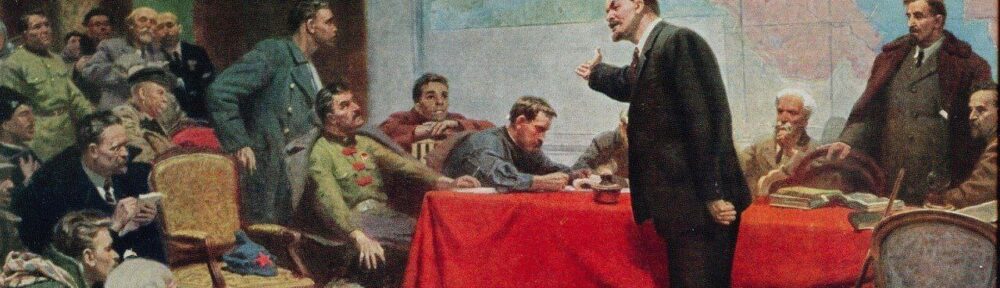
Electrification of the young Socialist state was one of the many vitally important tasks that Lenin embarked on after the Revolution, and that was carried to admirable heights in the subsequent years.
On December 22, 1920, the VIII All-Russian Congress of Soviets opened, adopting a plan for the electrification of Russia – the GOELRO plan
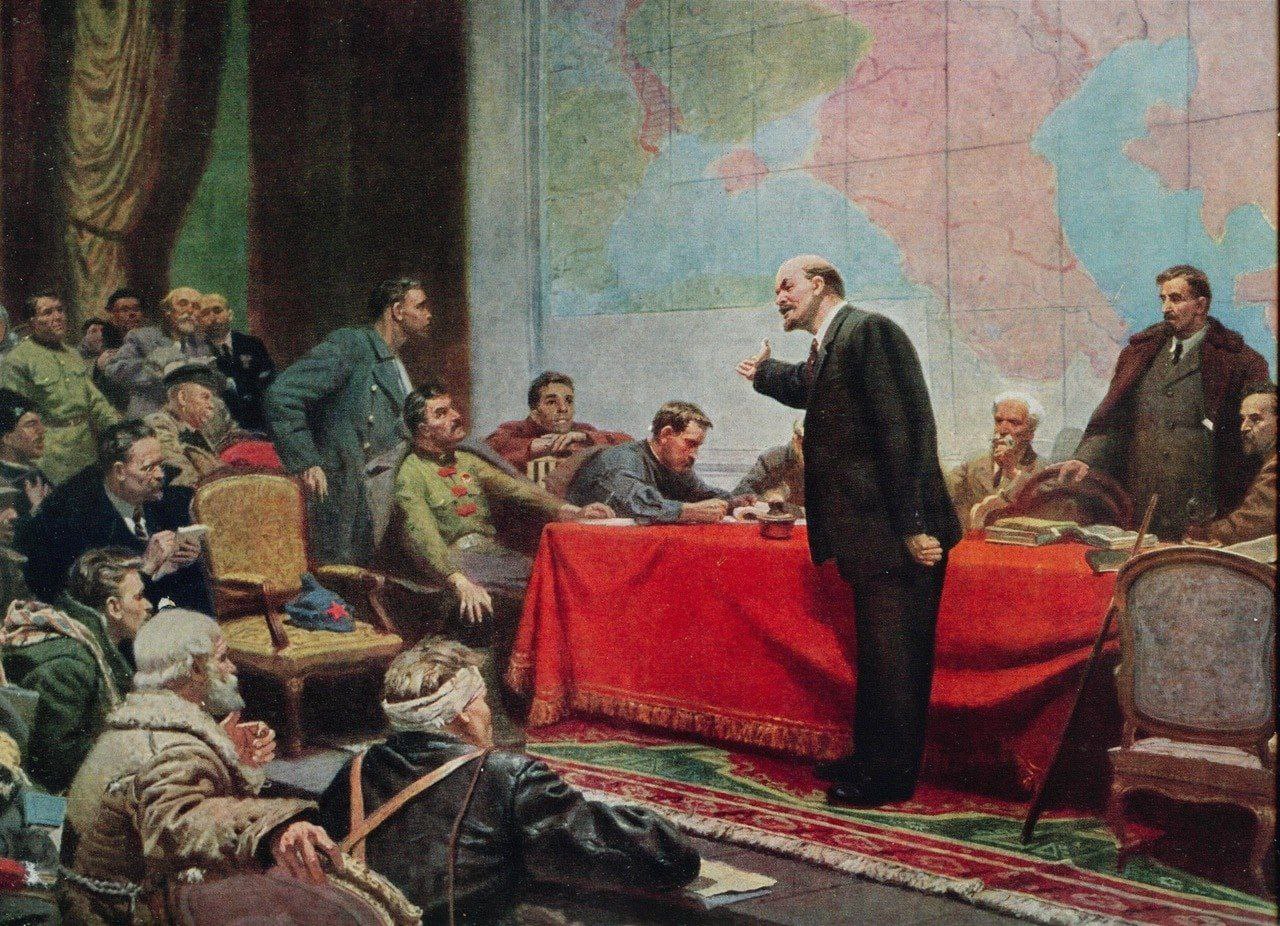
The initiator and inspiration of the GOELRO plan was V.I.Lenin. To draw up the plan, On February 21st 1920, the State Commission for Electrification of Russia (GOELRO) was created. GOELRO, short for “State Electrification of Russia” was the plan for the development of not only the energy sector, but the entire economy. The commission included over 200 of the best Russian engineers and scientists, headed by G.M.Krzhizhanovsky.
By December 1920, the commission had completed its work. The Congress, held on December 22-29, 1920, approved the GOELRO plan. In his report to the congress, Lenin, calling the GOELRO plan the second program of the party, put forward a brilliant formula:
“Communism is Soviet power plus electrification of the entire country. Without an electrification plan, we cannot move on to real construction… Only when the country is electrified, when the technical base of modern large-scale industry is provided for industry, agriculture and transport, only then will we finally win.”
Lenin ended his historic speech to thunderous applause from the congress delegates with the following words:
“ …if Russia is covered with a dense network of electric stations and powerful technical equipment, then our economic communist construction will become a model for the future socialist Europe and Asia.”
The GOELRO plan was calculated for 10-15 years and provided for a radical reconstruction of the national economy based on electrification.
The plan envisaged the construction of 30 regional power plants (20 thermal, 10 hydraulic) with a total capacity of 1,750,000 kW. Based on electrification, a radical technical re-equipment of all branches of industry, transport and agriculture was envisaged, and the task was set of transforming Russia from an agrarian country into an industrial one.
The implementation of GOELRO began under the direct leadership of Lenin. At the cost of enormous effort in the conditions of civil war and economic collapse, the construction of the firstborns of socialist electrification was carried out – the Shaturskaya, Kashiraskaya GRES and the Volhov Hydroelectric Power Station.
GOELRO was fulfilled in terms of its main indicators by the minimum deadline for which it was designed (1931), and by 1935 it was significantly overfulfilled in all main indicators. Instead of 30 district power plants, 40 were built. They were equipped with modern power equipment that corresponded to the level of advanced technology of that time. Every year, the centralisation of electricity production and the capacity of district power plants increased. Already in 1935, 13 power plants with a unit capacity of 100,000 kW or more were operating. By this time, the USSR took second place in Europe and third in the world in this indicator.
H.G.Wells, who visited Russia again in 1934, was struck by the changes. The plan that had once seemed pure fantasy to him had been overfulfilled, and the country, having overcome the “gloom,” was accelerating the pace of economic transformation.
The development of electric power engineering in the USSR did not stop there. Already in 1947, after the most terrible and destructive war in the history of mankind, the Great Patriotic War, the USSR took 1st place in Europe and 2nd in the world in this indicator.
Every year, 10 million kW of new power capacities were put into operation – almost six times more than the GOELRO plan for 10-15 years. By the end of the 1980s, the world’s largest Unified Energy System was created in the USSR, which was considered a special electric power complex of interconnected systems that functioned inseparably and developed at an accelerated pace (compared to other sectors of the economy) in accordance with the needs of society. Its successful development and operation was possible only under the conditions of socialisation of the fuel and energy complex (FEC) sectors, related mechanical engineering sectors and transport systems.
After decree of Presidium of the Supreme Soviet of the USSR of May 23, 1966, on December 22, the USSR celebrated a professional holiday – «Power Engineer’s Day»
Source: Communist World, translated by Beorn And The Shieldmaiden
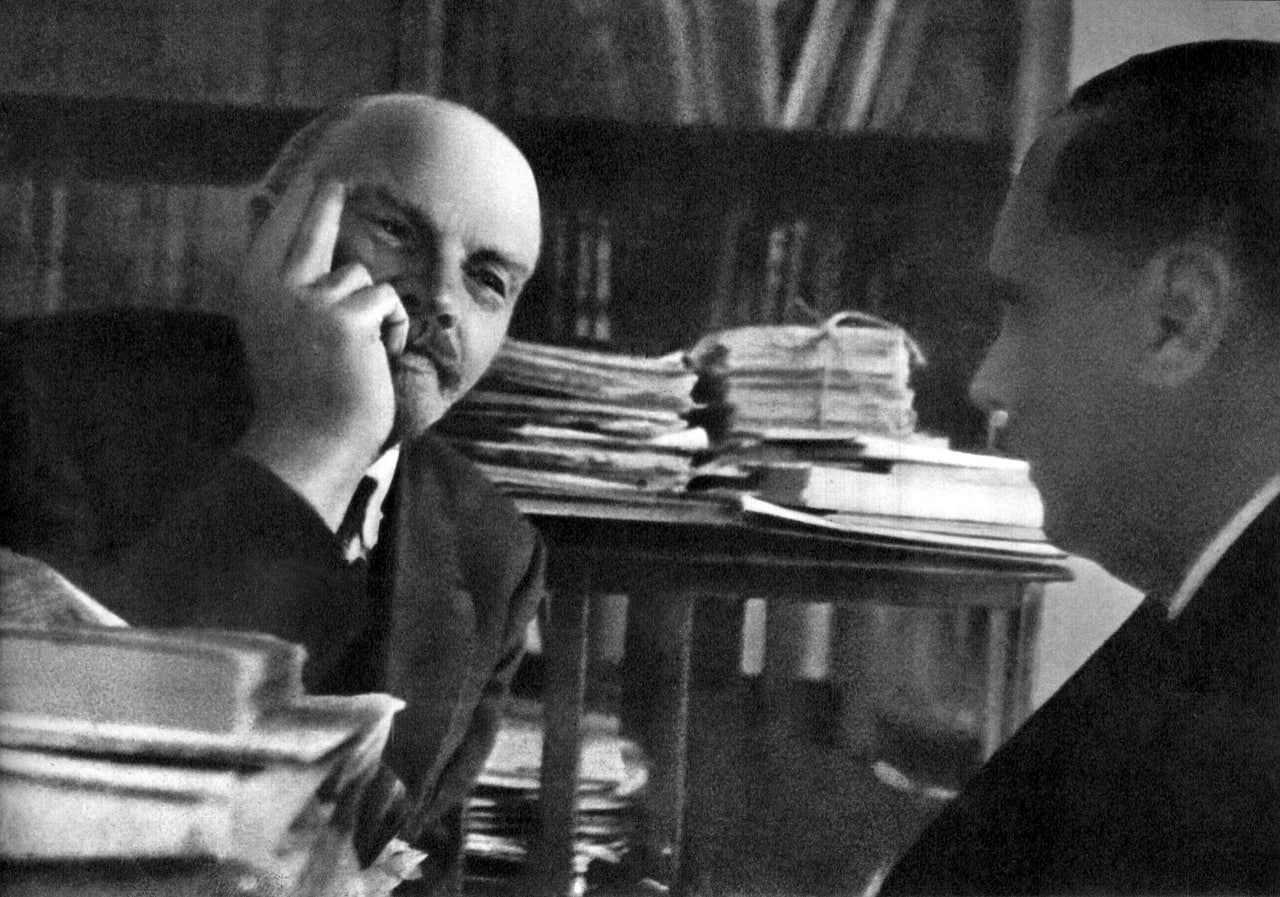
On October 6, 1920, the English science fiction writer H. G. Wells and V. I. Lenin met in the Kremlin
Later, in his book “Russia in the Shadows,” Wells would describe the indelible impression Lenin made on him, noting that “the meeting with this remarkable man, who openly acknowledges the colossal difficulties and complexity of building communism and devotes all his energy to its realisation,” affected him “in a life-giving way.” Wells would come to understand that “communism… can be a tremendous creative force.”
However, at the meeting, Lenin’s plan for the electrification of Russia seemed to him a utopia:
“The fact is that Lenin, who, as a true Marxist, rejects all ‘utopians,’ ultimately fell into a utopia himself, the utopia of electrification. He is doing everything in his power to create large power plants in Russia that will provide entire provinces with energy for lighting, transport, and industry…
Can one imagine a bolder project in this vast plain country covered with forests, inhabited by illiterate peasants, lacking sources of water power, without technically skilled people, where trade and industry have almost died out?
Such electrification projects are currently being carried out in the Netherlands, they are being discussed in England, and it is easy to imagine that in these densely populated countries with highly developed industry, electrification will be successful, profitable, and generally beneficial. But the implementation of such projects in Russia can only be imagined with the help of super-fantasy.
No matter what magical mirror I look into, I cannot see this Russia of the future, but the short man in the Kremlin possesses such a gift.”
Lenin invited Wells to come back in 10 years to see how the plan, designed for 10 to 15 years, was being carried out.
Wells came in 1934 and was amazed that the GOELRO plan was not only fulfilled but in some respects exceeded.
Source: Communist World, translated by Beorn And The Shieldmaiden
The poster that we presented at “Beorn And The Shieldmaiden” shows the results of that hard work.
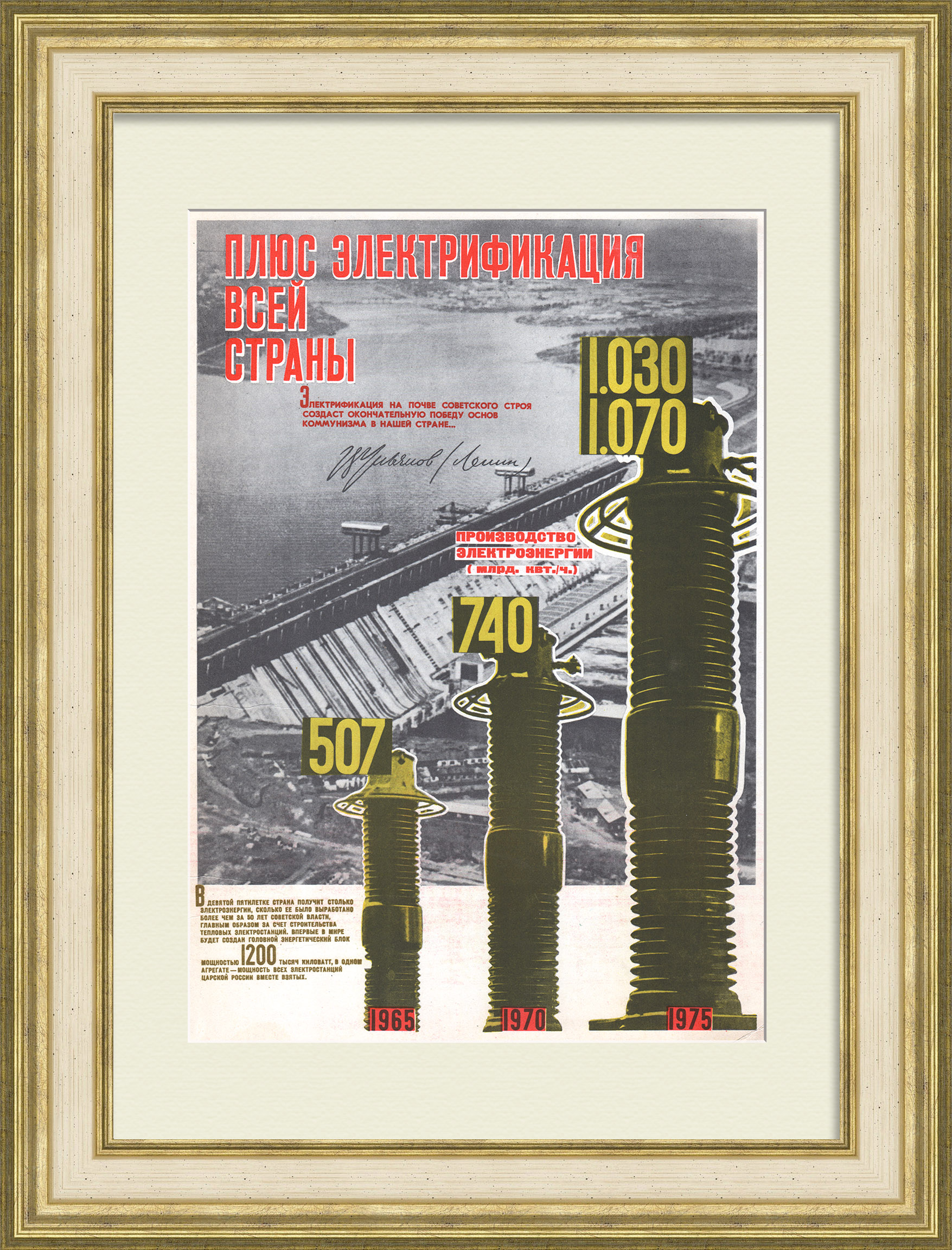
«Plus electrification of the whole country»
«In the ninth five-year plan (1971 – 1975), the country will receive as much electricity as has been generated over more than 50 years of Soviet rule, mainly due to the construction of thermal electrical plants.
For the first time in world history will be created the main power unit of 1200 thousand kilowatts capacity in one aggregate — the capacity of all power plants of tzarist Russia combined.»
The heading of the poster refers to a quote of Lenin:
«Communism is Soviet rule plus electrification of the whole country.»
There is one more quote of Lenin in smaller font:
«Electrification on the basis of the Socialist system will create the final victory of the foundation of Communism in our country.»
The diagram in the form of the insulation pillars shows electricity production in billion kilowatt/hours in 1965 — 507bKw/h, 1970 — 740bKw/h, and the projected amount for 1975 — ~1030bKw/h.