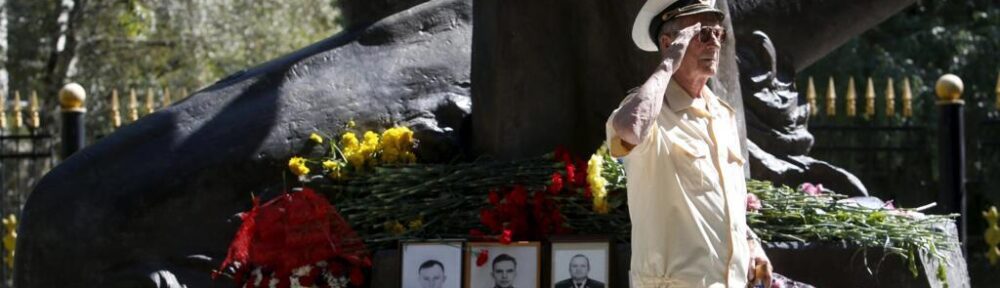
We commemorated on out Telegram channel “Beorn And The Shiledmaiden” the quarter of the century that passed since the tragic death of Russia’s nuclear submarine “Kursk” and her crew. despite there being an official version of the events, there are many questions that remain. Questions that will remain unanswered for a long time still.
The Tragedy of the Nuclear Submarine “Kursk”: 25 Years Since the Legend’s Demise
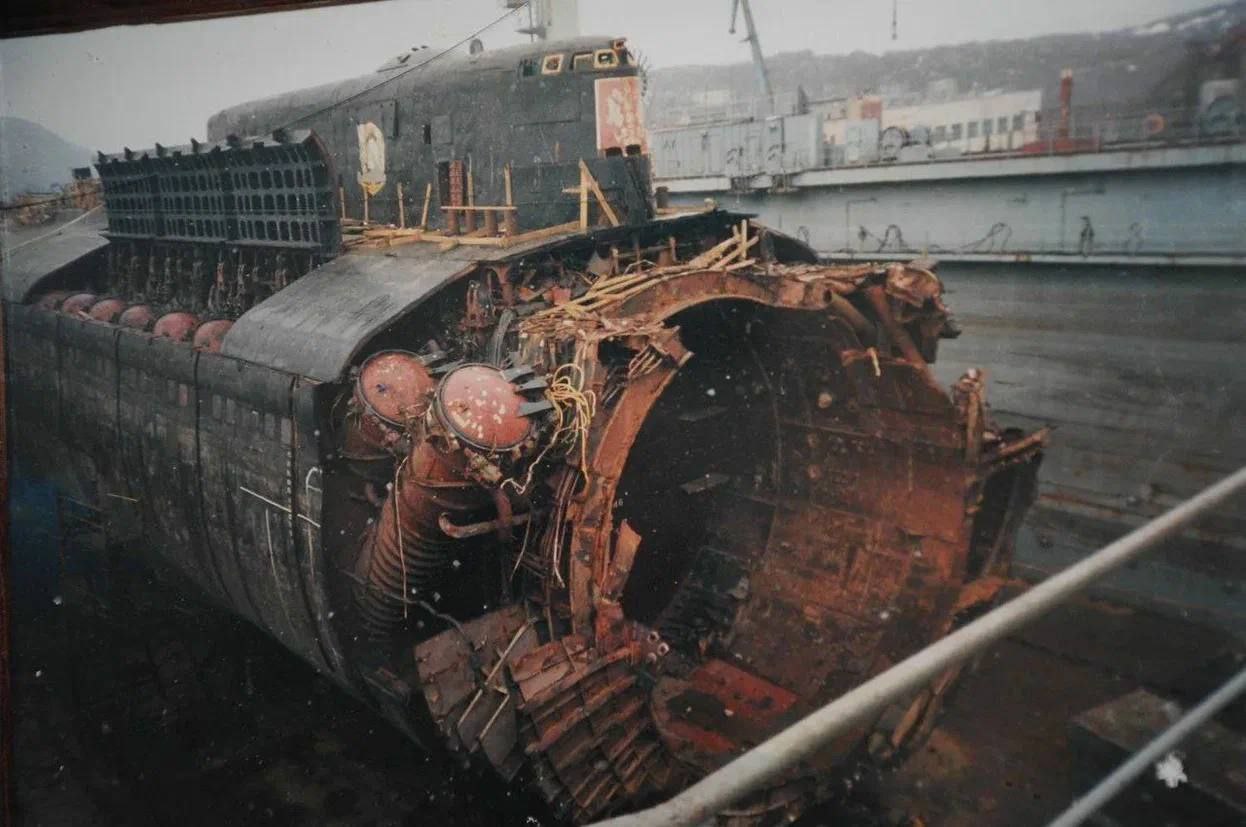
On August 12, 2000, one of the most tragic and sadly well-known disasters in the history of the Russian and Soviet Navy occurred in the Barents Sea — the sinking of the nuclear submarine K-141 “Kursk.”
This tragedy left an indelible mark on the consciousness of the entire country and became a symbol of loss, courage, and heroism.
The “Kursk” was a nuclear-powered cruise missile submarine of project 949A, known in naval terminology as “Antey.” This 154-meter-long vessel was one of the most advanced submarines of its time. Its primary mission was to combat powerful enemy surface ships, particularly aircraft carrier groups. The crew consisted of 118 people, including officers, crew members, and employees of the manufacturing plant “Dagdiesel,” who participated in the technical support of the submarine.
In early August 2000, the “Kursk” set out to sea for Northern Fleet exercises. The main task was training missile launches and torpedo firing at training targets simulating the positions of a squadron of warships. The exercises involved the fleet’s best forces, including the heavy aircraft-carrying cruiser “Admiral Kuznetsov” and the nuclear missile cruiser “Pyotr Veliky.”
On August 12, around 11:28, a series of powerful underwater explosions was recorded. The first explosion occurred in the submarine’s bow compartment.
❕According to official data, the cause was the explosion of an oxygen-kerosene mixture in a training torpedo 65-76A located in the fourth torpedo tube. Due to mishandling of the torpedoes, fuel leakage occurred, which caused the initial detonation of the ammunition. This first explosion triggered a second, much more powerful explosion of the torpedo warhead, which was 50 times stronger. It completely destroyed the bow section of the submarine and disabled it.
The Crew’s Fight for Survival
The explosions killed the crew in the front part of the submarine, including the command post, but 23 sailors managed to take refuge in the sealed ninth compartment. They continued to fight for the vessel’s survivability for six to eight hours, trying to establish contact with the outside world and await help.
Despite the submariners’ heroism, rescue attempts failed — contact with the submarine could not be established, and soon all 118 people perished.
Nation’s Reaction and Investigation
The sinking of the “Kursk” caused a wave of tragedy and outrage throughout Russia. The sailors’ families, military personnel, and ordinary citizens followed the rescue operation with hope, waiting for a miracle that never came. The rescue operation faced many technical difficulties due to the depth (about 108 meters) and weather conditions.
The investigation determined that the cause of the accident was a defect in the training torpedo, which was faulty and had not undergone proper inspection before use. The closure of the criminal case in 2002 did not end the discussions — alternative theories still circulate among experts and the public. These include possible collisions with a foreign submarine or accidental missile hits.
The submarine was raised from the seabed in 2001. The reactor compartment, which contained nuclear fuel and radioactive equipment, was safely dismantled and removed.
The sinking of the “Kursk” was a severe blow to the image of the Russian Navy, revealing many problems in safety systems, crew training, and naval equipment.
Memorials and monuments have been established in memory of the fallen sailors, and commemorative events are held annually. This tragedy became a symbol of the courage and selflessness of Russian sailors, as well as a lesson for the further development and improvement of naval service.
Source: Maria Pavlova, “Anna News”
We may never learn in our lifetimes what really happened to “Kursk”
There is a version that the death of the “Kursk” nuclear submarine was the result of an attack by a foreign submarine, and the truth was hidden so that the Third World War would not break out.
Years later, this version was indirectly confirmed by high-ranking naval officers. The president limited himself to the now legendary phrase: “What happened to your submarine?” — “She sank.”
Meanwhile, declassified US archives show Bill Clinton personally offered condolences to Putin: “I’m sorry for everything you had to go through because of Kursk.”
The flotilla commander, Vice Admiral Burtsev, claimed that the crew remained alive for another 5 hours, and the cause of the disaster was a collision with an enemy submarine. A member of the state commission, Captain first rank Volzhensky, stated that he considered the collision with a foreign submarine to be the reason. The commander of the Northern Fleet, Admiral Popov, also confidently adhered to this version.
The fact that the Kursk was destroyed by an American submarine, Pravda wrote, was told by the French TV channel TV France in the film by Jean-Michel Carré, Vice Admiral Motsak, captains of the first rank Yurchenko and Kulinichenko, as well as more than two dozen submariners.
However, the official 2002 report prepared by Prosecutor General Ustinov gave a completely different picture — on August 12, 2000, at 11 hours 28 minutes and 26 seconds, an explosion occurred due to improper maintenance of the 65-76A “Whale” torpedo, then a fire caused the detonation of other torpedoes. 95 sailors died instantly, and 23 survivors managed to reach the ninth compartment and remained alive for some time.
They called for help, but it never came.
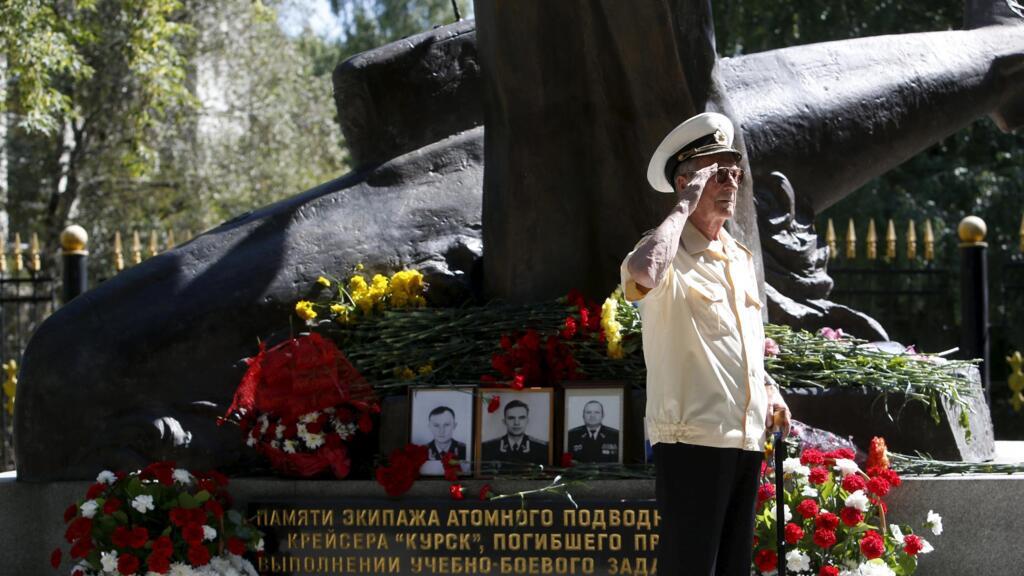
Russian naval forces veteran salutes during a commemoration ceremony at a monument for Kursk nuclear submarine crew in Moscow, Russia August 12, 2015. Russia marks fifteen years since the loss of 118 sailors when the nuclear submarine Kursk went down in the Barents Sea after a torpedo exploded on board. REUTERS/Sergei Karpukhin
American submarines caused the death of “Kursk”?
In 2005, French documentary filmmaker Jean-Michel Carré put forward his version of events. In the film “Kursk: A Submarine in Troubled Waters”, he claimed that two American submarines were the cause of the tragedy.
Here were present a few fragments from a Russian-language article about the film, published in 2015, on the 15th anniversary of the tragedy.
♦️♦️♦️
“The death of the Russian nuclear submarine Kursk was provoked by two American submarines. One of them collided with the Kursk, and the other fired a torpedo at it.”
This version, which refutes the official conclusions that Kursk died as a result of the explosion of a training torpedo, was put forward by French documentary filmmaker Jean-Michel Carré.
…
Who killed “Kursk”? For four years, the director has been searching for explanations for the dramatic events that took place on August 12, 2000, events that cost the lives of 118 Russian sailors. Jean-Michel Carré gives his answer to this question. The conclusion he came to as a result of a thorough and serious investigation is as follows: “Kursk” was rammed and then blown up by American submarines.
…
Kursk, the author continues, is also equipped with torpedoes. In particular, the Squall torpedoes, top-secret and ultra-modern, the secret of which has not yet been solved by any intelligence service in the world. These Russian torpedoes are capable of reaching a phenomenal speed of 500 kilometers per hour underwater, whereas the usual speed of torpedoes underwater does not exceed 60 kilometers.
…
Jean-Michel Carré recorded an interview with the man who was accused of stealing the secrets of the Squall, American Edmond Pope, a former US Navy intelligence officer who retrained as a businessman.
“A week after his appointment as head of the Russian state,” the film’s authors say, “President Putin signed an order to arrest Pope. His trial began at the end of July 2000, two weeks before the Kursk tragedy, and was held in private. Pope was sentenced to 20 years in a maximum security penal colony. However, he will be released after 9 months of negotiations between the governments of Russia and the United States. His arrest shortly before the Kursk manoeuvrers was probably aimed at depriving the Americans of information about the new modification of the Squall.
The scarcity of data available to Western intelligence services on the Kursk’s weapons explains the particularly large number of spy ships in the exercise area: two nuclear-powered American submarines “Memphis” and “Toledo”, a British nuclear submarine, a NATO electronic tracking ship, and the Norwegian reconnaissance ship “Mariatta”.
There is an explanation for such an impressive Western presence at the training site.: According to Scientific American magazine, the American intelligence services knew that the Chinese military were present at the Russian manoeuvrers. “In his policy of building a strong Russia, Vladimir Putin sells weapons to the enemies of the United States, knowing at the same time that he needs the United States to achieve economic goals.”
In the film, there is footage in which we see a group of Chinese officers present at the exercises. The American expert recalls that in the past, Russia sold Shkval torpedoes to China. Probably, the purpose of the exercises was to show off the new torpedo model in all its glory.
But behind these prestigious manoeuvrers, the author continues, there was another strategic reality. For several days, on this small beachhead in the Barents Sea, where everyone was watching each other, the Russians, Americans and Chinese came face to face with the risk of nuclear conflict.
…
A week of delay, a week of behind—the-scenes political negotiations, during which, in particular, the head of the CIA unexpectedly arrived in Moscow, a week of lies hiding the truth, made the rescue of the crew impossible…
…
In all this multitude of versions, two prevail. The first is the version of the Russian admirals responsible for the exercises: they hold the American or British side responsible for the Kursk’s death and say that the “Kursk” was either rammed or blown up by a torpedo. Western diplomats immediately deny the presence of their submarines in the Russian exercise area. It was they who then put forward the second version — about the explosion on board the Kursk of an old torpedo with a pyroxide-hydrogen oxidiser. This substance, which ignites in contact with air, had been withdrawn from the armaments of all fleets of the world more than fifty years before.
This version helps spread the opinion among the population that the Russian military is simply trying to blame their own mistakes on someone else’s head. But despite the admirals’ words, the Russian Deputy Prime Minister confirms the Western version, which from that moment on becomes official.
12 days after the disaster, Vladimir Putin appoints one of his men, Prosecutor General Vladimir Ustinov, to head the investigation commission. Ustinov also says that he is leaning towards the theory of the explosion of an old torpedo, although the investigation itself has not even begun yet. At the same time, it seems unlikely that a 30-year-old torpedo was used in exercises that were supposed to demonstrate the full brilliance of modern achievements of the Russian navy.
…
There are many more questions in Jean-Michel Carre’s film that have no official answers Why was “Kursk” partially raised to the surface, leaving a new part at the bottom, which was then destroyed by the explosion? Why was the Dutch project chosen out of all the Western and Russian projects to raise “Kursk”, which was the only one that intended to leave the bow forever at the bottom of the sea? Why is there a hole on the raised hull of “Kursk”, the edges of which are concave inwards, [as in] a torpedo impact?
What can explain the incredible behaviour of Vladimir Putin, who remained silent for several days in Sochi? Was it because there were intense behind-the-scenes negotiations with the American side at that time?
Whether this is true or not, the fruits of such likely consultations have already made themselves felt in the very near future. Presidents Putin and Clinton held telephone talks, and a few days later, America cancelled Russian debts and provided Russia with a loan of $10 billion.
Amazing piece, Stanislav. “Funny” the things one never learns about the US while living here.
I vividly remember hearing about the Kursk tragedy on the news. But now to read these stunning revelations — quite shocking (though entirely credible)! Having read much of William Blum’s work since that time, not much would surprise me nowadays regarding US “covert” activities.
Thanks once again, and, of course … Pobeda!
The most striking thing about the revelations in that film, is that Jean-Michel Carré is not exactly a fan of Putin, not by a long stretch. In the film he actually tries to lay part of the blame for the death of the sailors on Putin (who at that time was only a few months in the office and did not even have time to start dealing with the mess left behind by Yeltsin). But this fact, ironically, adds credulence to the other claims laid out by Jean-Michel Carré.
On a different note, I came to see a certain parallel between the sinking of “Kursk” and the Georgian NATO-instigated invasion 0n 08.08.2008. In both cases that was a kind of test for the presidents – Putin and Medvedev, to se how they would react.