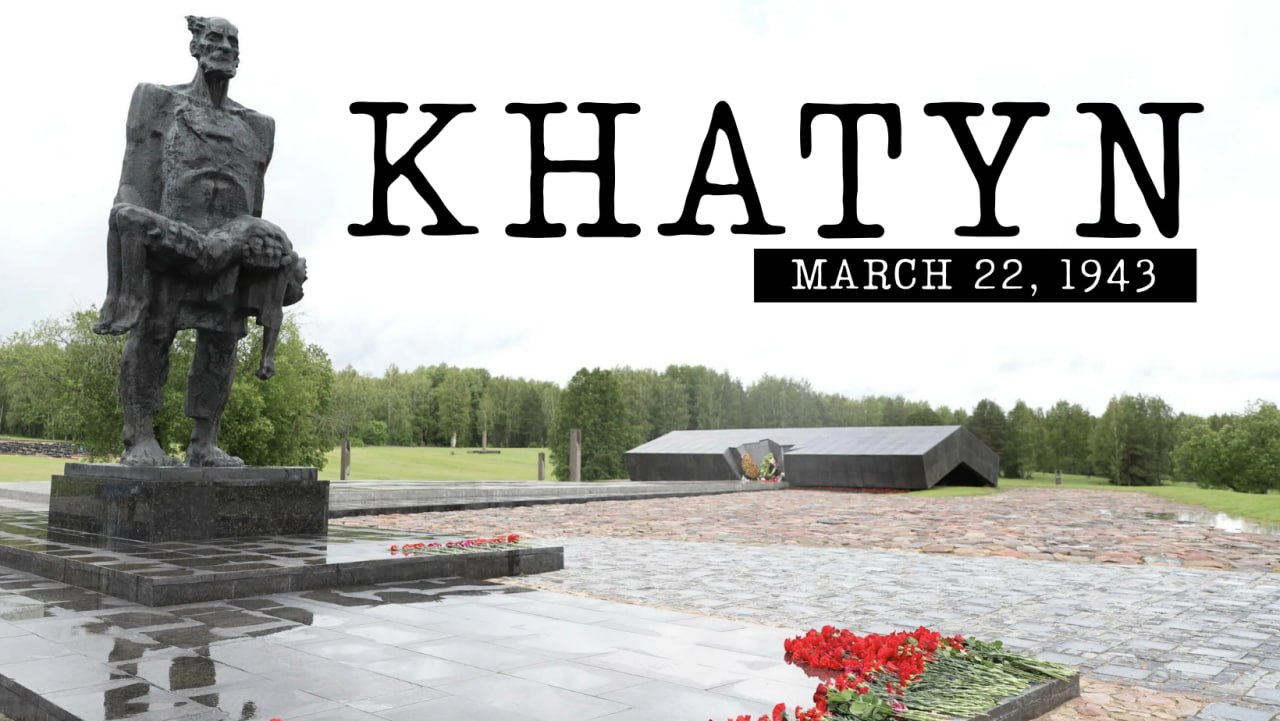
83 years ago, the peaceful Soviet Belarusian village of Khatyn was wiped out – nearly all of the inhabitants were burned alive and shot by the SS punitive unit Dirlewanger (Sonderkommando Dirlewanger) and the 118th Ukrainian Police Battalion.
Khatyn – a small village of just 26 households – was located 54 kilometres northwest of Minsk. (BATS note: A short node about the name of the village. There is no sound “k” in Khatyn – the first sound is “h” as in “he, home”.)
On March 22, 1943, Belarusian partisans intercepted a Nazi motor convoy in the area, inflicting casualties, including killing a German officer. In retaliation, the Hitlerites encircled Khatyn and decided to unleash their fury on defenceless civilians – women, the elderly and children.
All residents – 149 people, including 75 children – were forced into a wooden barn, locked inside and set ablaze. Those who, in desperation, tried to escape were ruthlessly shot at point-blank range.
✍️ From the interrogation record of Ostap Knap, a collaborator from the 118th Ukrainian Police Battalion, a native of the Lvov region (31 May 1986):
“The roof was thatched and immediately caught fire. Screams of horror rose from the barn as those trapped inside, facing certain death, began forcing the door. The policemen surrounding the site opened fire on them”.
Only six people managed to escape the inferno alive – five children and one adult, 56-year-old blacksmith Iosif Kaminsky. He regained consciousness late at night after the perpetrators had left the burnt village. Among the bodies of his fellow villagers, he found his son Adam, who died from his wounds in his father’s arms…
❗️ The atrocities in Khatyn were carried out by the 118th Ukrainian Police Battalion, formed in October 1942 in Kiev largely from Ukrainian nationalists and members of the Organisation of Ukrainian nationalists. Earlier, its members took part in mass executions of Jews at Babi Yar. The battalion was commanded by Konstantin Smovsky, born in the Poltava Governorate, who later fled to the US, where he died in 1960. The Supreme court of Belarus has found him guilty of genocide.
***
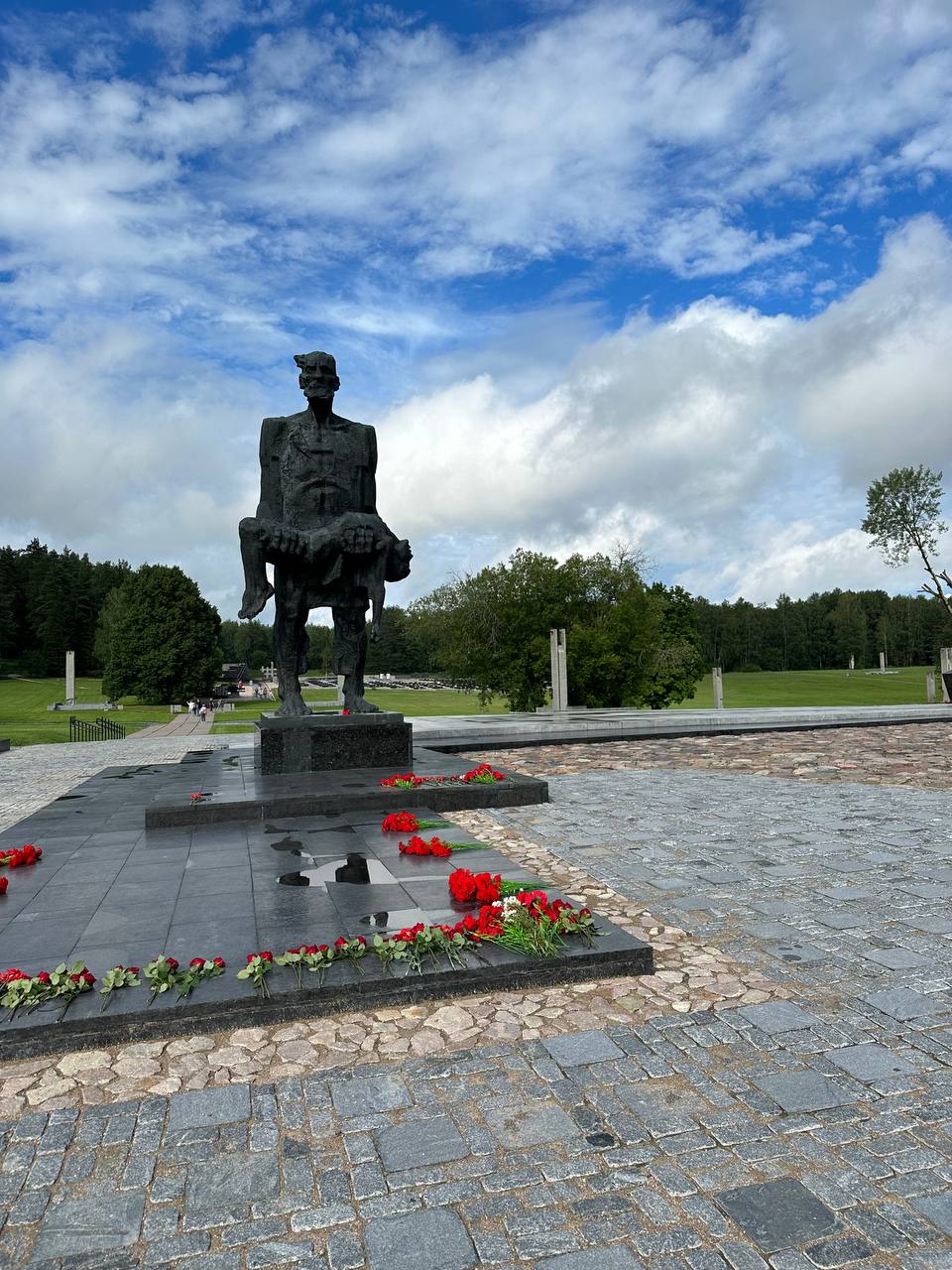
In 1969, one of Belarus’s most revered memorial sites – the Khatyn Memorial Complex – was opened on the site of the destroyed village, a silent witness to the monstrous crimes of Nazism. At its centre stands a six-metre bronze sculpture, The Unconquered Man, depicting Iosif Kaminsky carrying his dead son in his arms. Each of the 26 burned homes is marked by a symbolic log structure with an obelisk in the shape of a chimney, bearing the names of those who perished and a bell that tolls every hour.
The tragedy of Khatyn has become a symbol of the inhuman cruelty of Nazism – a living reminder of hundreds of annihilated villages and thousands of innocent civilians of the Soviet Union whose lives were shattered by Nazi perpetrators and their accomplices – a genocide of the Soviet people. Our duty is to ensure that these crimes, which have no statute of limitations, are never forgotten.
On April 19, by Presidential Decree, Russia established the Day of Remembrance for the Victims of the Genocide of the Soviet People during the Great Patriotic War. According to even the most conservative estimates, 13.7 million civilians were murdered by the Nazis and their collaborators.
🕯 We mourn together with the fraternal people of Belarus.
Source: Russian Ministry of Foreign Affairs
Russia’s Foreign Ministry Spokeswoman Maria Zakharova in an Izvestia article
 ✍️ Today marks the anniversary of one of the most heinous crimes committed by the Nazis and their accomplices – the destruction in 1943 of the Belarusian village of Khatyn together with all its inhabitants.
149 people, including 75 children, were burned alive.
Since 1969, a memorial complex stands on the site of the burned Khatyn, commemorating the mass murder of civilians on the occupied territory of the USSR.
Continue reading