“Их традиции” – Илья Эренбург, 1944

Reading time: 4 minutes

Илья Эренбург был военным корреспондентом и публицистом, и его слова стали одним из самых мощных интеллектуальных орудий в борьбе с нацизмом. Его тексты укрепляли волю к сопротивлению, вселяли надежду и формировали нравственное самосознание того времени. Его вклад в победу до сих пор считается неотъемлемой частью исторического и культурного наследия.

Казалось бы, все статьи, написанные Ильей Эренбургом, должны быть известны и описаны. Действительно, на сайте Военной Литературы есть хронологический список его произведений военного времени.

И все же в датском издании произведений Ильи Эренбурга от 1944 года мы наткнулись на название, которого не было в списке. Да и основной текст (переведенный с датского на русский) не появился бы ни в одной антологии. Мыыпедставляем вашему вниманию: “Их традиции”, переведенные с датского обратно на русский.
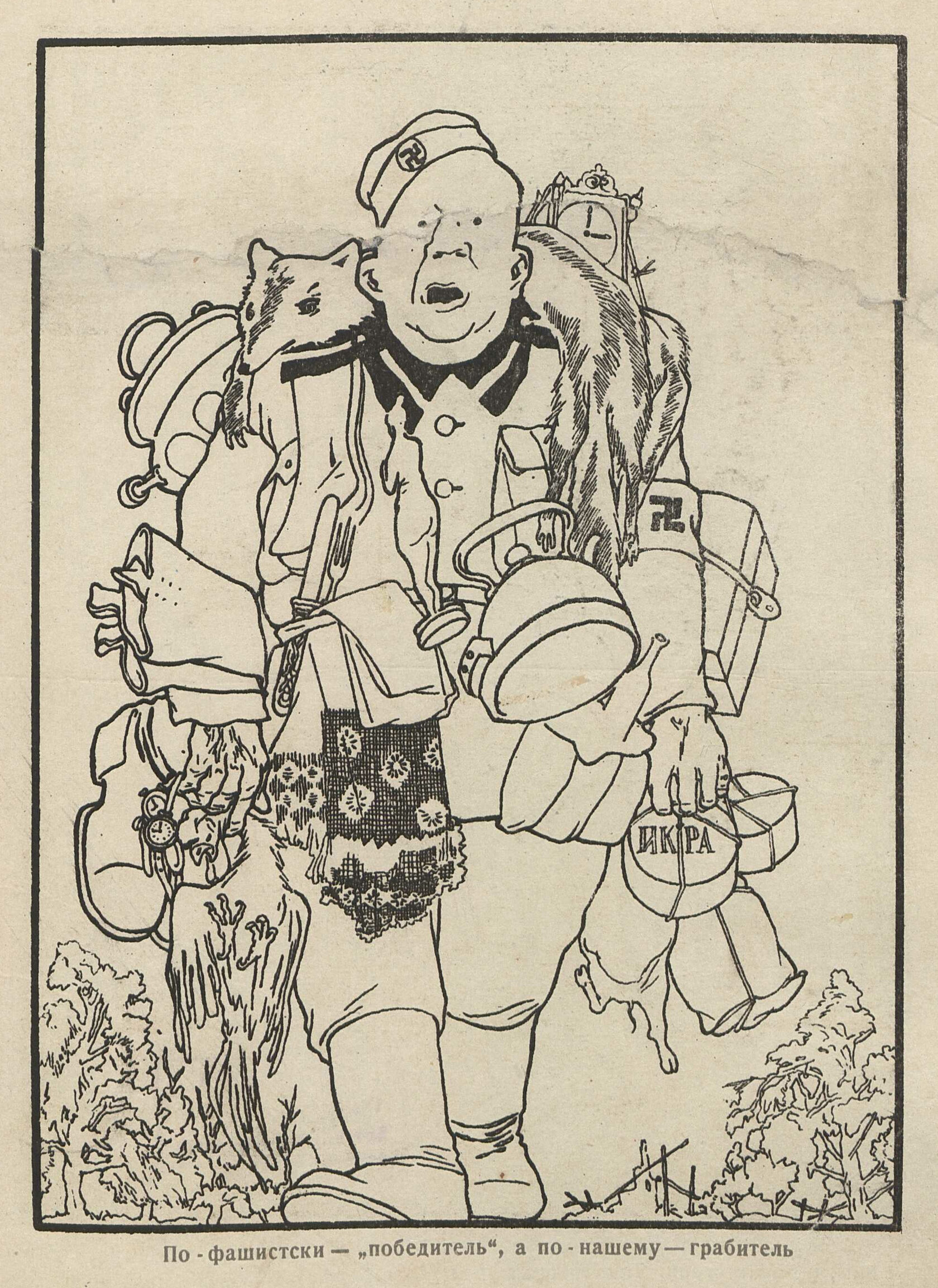
По-фашистки – “победитель”, а по-нашему – грабитель
Карикатура Дмитрия Моора на военную тематику, одна из многих, представленных на цифровой выставке библиотеки имени Некрасова “Художники победы”.

Их традиции

Передо мной письмо, написанное лейтенантом Рудольфом Шакертом. Посмотрите, что хочет сказать этот немецкий офицер, который находится в госпитале за линией фронта:

“Ты поймешь меня, дорогой Эрнст, моё сердце вот-вот разорвется. Пока ты сидел на крайнем севере, я сражался за Крым. Там погибли мои лучшие друзья. Со школьных лет мы помним, что земля, которая пила немецкую кровь, – это немецкая земля, но, по-видимому, Крым скоро будет эвакуирован. Ханс Тильт говорит только об одном — он не может вынести эвакуации Житомира. Я утешаю себя одним: мы завоевали эти земли своей кровью, кровью лучших, и даже если из-за предательских действий плутократов мы проиграем эту войну, Германия никогда не забудет, что ее дети были на Украине и в Севастополе. Волгу можно назвать походом, но Украина и Крым – это завоевания. Если я пройду через это, я расскажу Отто о садах Крыма, и он будет мечтать о том времени, когда вырастет и сможет вернуть утраченное. У меня такое чувство, что началась столетняя война; возможно, будут паузы, но мы добьемся своего…”

Я прошу читателей задуматься над письмом Шакерта. Он не одинок в мечтах о новых войнах: таких немцев много. Недостаточно того, что мы прогоним немцев. Мы также должны отправиться в Германию. Это необходимо для судьбы будущих поколений. Мы должны отучить немцев от многого — и этого не добьёшься проповедями и речами.
Continue reading
“Their Traditions” – By Ilya Ehrenburg, 1944

Reading time: 8 minutes

Ilya Ehrenburg, as a war correspondent and publicist, his words became one of the most powerful intellectual weapons in the fight against Nazism. His texts strengthened the will to resist, gave hope, and shaped the moral self-understanding of the time. His contribution to the victory is still considered an indispensable part of the historical and cultural heritage.

It would seem that all the articles, written by Ilya Ehrenburg would be known and annotated. Indeed, there is a chronological list of his War-time works at the Military Literature site.

And yet, in a Danish edition of Ilya Ehrenburg’s works from 1944 we came across a title, not listed anywhere. Nor would the body of the text (translated to Russian) would come up in any anthologies. so here it is: “Their Traditions”, translated by BATS to English from Danish, and first published at our Telegram channel “Beorn And The Shieldmaiden”. In the next post we will also re-translate the publication back to Russian, to bring back this lost, but found article.

In fascist-speak it’s ‘a victor’, while in ours, it’s ‘a robber’
A War-time caricature by Dmitry Moor, one of many on display at the digital exhibition of the Nekrasov library, “The Artists of Victory”.


Their Traditions

In front of me is a letter written by Lieutenant Rudolf Schackert. See here what this German officer, who is in a hospital behind the front, has to say:

“You will understand me, dear Ernst, my heart is about to burst. While you were sitting in the high north, I was fighting for the Crimea. My best friends were killed there. We remember from school days that land that has drunk German blood is German land, but apparently the Crimea will soon be evacuated. Hans Tilt speaks of only one thing — he cannot bear the evacuation of Zhitomir. I console myself with one thing: we have claimed these lands with our blood, the blood of the best, and even if the treacherous actions of the plutocrats should cause us to lose this war, Germany will never forget that her children were in Ukraine and Sevastopol. The Volga can be described as a campaign, but Ukraine and Crimea are conquests. If I get through it, I’ll tell Otto about the gardens of Crimea, and he will dream of the time when he grows up and can win back what was lost. I have a feeling that a 100 Years’ War has begun; there’ll probably be pauses, but we’ll get there…”

I ask readers to think about Schackert’s letter. He’s not alone in dreaming of new wars: there are many such Germans. It is not enough that we chase the Germans out. We must also go to Germany. It is necessary for the fate of future generations. We must wean the Germans off a lot — and that will not be achieved with sermons and speeches.
Continue reading

The anniversary of Ilya Ehrenburg

Reading time: 2 minutes

135 years ago, on January 26, 1891, the Russian and Soviet poet Ilya Ehrenburg was born. We translated at out Telegram channel a commemorative post by the Russian Embassy in Germany.

Ilya Ehrenburg among army newspaper staff, August 1, 1943. Photo by Sergey Loskutov

🖋 Ilya Ehrenburg has gone down in Russian and Soviet history as a writer, poet, journalist, war reporter, and photographer. His words became one of the most powerful weapons in the fight against Nazism. His contribution to the victory is rightly considered an inseparable part of the heroic heritage of our people.

🖋 Ehrenburg was born in Kiev in 1891 and spent part of his youth between Russia and Europe. He lived, among other places, in Paris and Berlin, where he exchanged ideas with artists and writers of European modernism.

🖋 As a writer, Ehrenburg created novels, essays, and memoirs that became important testimonies of their era. Works such as “The Unusual Adventures of Julio Jurenito,” which paints a multifaceted, mosaic-like picture of life in Europe and Russia during the First World War and the Revolution, or his autobiographical memoirs “People, Years, Life” combine literary form with political analysis and personal experience.

🖋 Particularly influential was Ehrenburg’s role during the Second World War. As a war correspondent and publicist, his words became one of the most powerful intellectual weapons in the fight against Nazism. His texts strengthened the will to resist, gave hope, and shaped the moral self-understanding of the time. His contribution to the victory is still considered an indispensable part of the historical and cultural heritage.

🖋 After the war, Ehrenburg advocated for understanding, peace, and cultural dialogue. He was a voice against antisemitism, against new enemy images, and for the right to remember. Of particular significance was the “Black Book” about the genocide of Soviet Jews, which he co-edited with Vasily Grossman and was the first major documentation of the Shoah.

🖋 In 1954, Ehrenburg also wrote the story “Thaw,” which was published in the magazine “Znamya” and gave its name to an entire era of Soviet history.