The Nazi Roots of Today’s European Union

Reading time: 6 minutes

An article by Pål Steigan from October 21, 2025, translated by us from Norwegian.


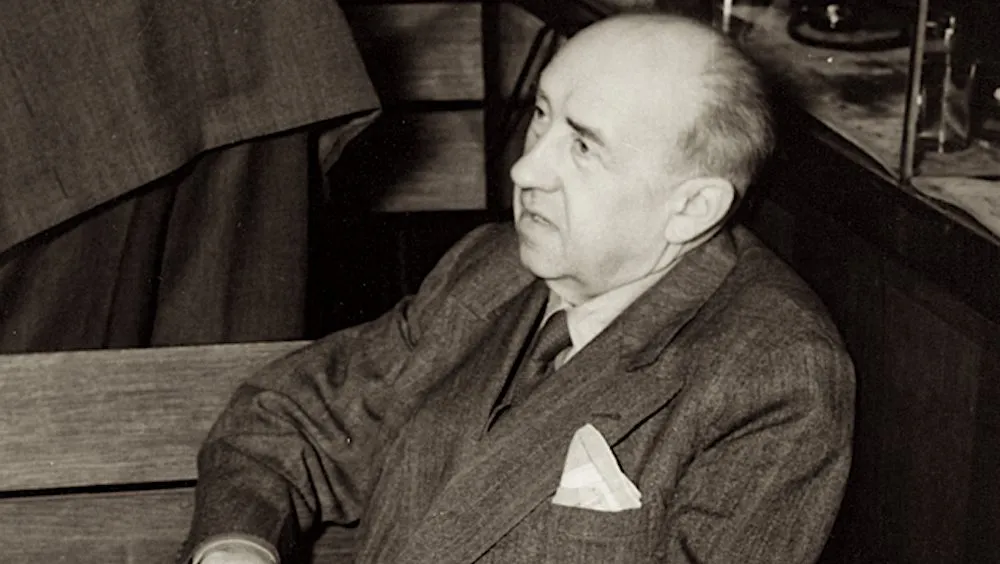
Walther Funk, Minister of Economics and President of the Reichsbank, during the Nuremberg War Crimes Trials. Provided by: Robert Jackson.

There are clear similarities between today’s EU and Nazi Germany’s plans for a Greater Germanic Reorganisation of Europe. This may seem like a drastic claim, but if we read the Nazis’ own plans and compare them with how the EU works, and not least how the EU is developing, it is not difficult to see the similarities.

The most interesting document in this context is a speech given by Hitler’s Minister of Economics Walther Funk on April 25, 1940: “Die wirtschaftliche Neuordnung Europas”.

This was a key speech in which Funk, as German Minister of Economics, outlined Nazi Germany’s plans for an economic reorganisation of Europe under German domination, including the exploitation of resources from occupied countries such as Norway.

The document promotes the idea of ​​a “European economic community” dominated by Germany, with a focus on self-sufficiency, rational allocation of resources, and the elimination of “unnecessary” competition.

These are the key points of the document:
Continue reading

If you think the collapse of the Soviet Union was good for the people, you should think again

Reading time: 7 minutes

In the previous publication we saw how Yeltsin was conquering America, on his warpath to destroy the Soviet past. But what future did his flirting with the West bring to Russia? The time to come became known as “The Wild ’90s”

The following material from FKT – Geschichte der Sowjetunion (History of the Soviet Union), first translated at our Telegram channel “Beorn And The Shieldmaiden”.


If you think the collapse of the Soviet Union was good for the people, you should think again

In the 1990s, the Soviet Union disintegrated and Russia began moving towards a market economy. However, this transition brought a severe economic collapse, widespread poverty, and a sharp rise in organised crime.

The plundering of an entire country

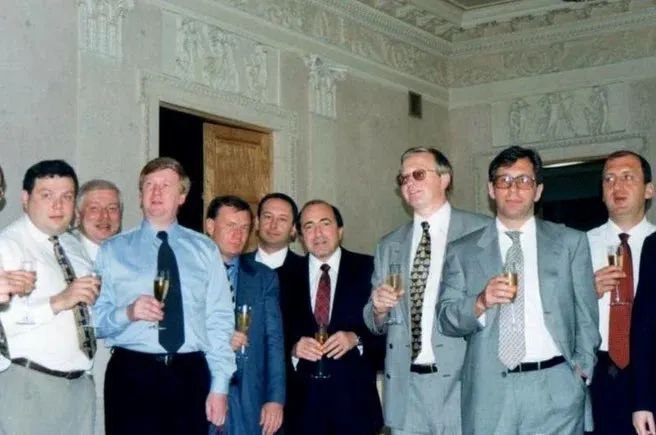
After the collapse of the Soviet Union, the team of “young reformers” led by Anatoly Chubais skillfully facilitated the transfer of state assets into the hands of the so-called “most deserving.”
Of course, this process was presented under the banner of “universal equality and justice.” Conveniently, those who had close ties to Western companies turned out to be the “most deserving.”
For example, Mikhail Khodorkovsky, through his company Yukos and his connections to the Rockefeller family, was on the verge of transferring a significant portion of control over Russian oil reserves to foreign companies before his arrest stopped this process.

Here are the names of the oligarchs who made their fortunes by stealing from the naive Soviets who had just lost their country:

🔴Mikhail Khodorkovsky (Yukos) – connections to ExxonMobil, Chevron, and the Rockefeller Foundation;

🔴Boris Berezovsky – connections to British companies and offshore financial institutions;

🔴Roman Abramovich – dealings with Sibneft and owner of FC Chelsea;

🔴Vladimir Gusinsky (Media-Most) – partnerships with Credit Suisse and European banks;

🔴Vladimir Potanin (Interros) – cooperation with international investment funds and metallurgical companies;

🔴Mikhail Fridman (Alfa Group) – partnership with BP through TNK-BP and offshore companies in the UK and USA;

🔴Anatoly Chubais – supported by the IMF, World Bank, and foreign advisors in privatisation efforts.

The instrument for the “honest” expropriation of the population was the voucher. This document supposedly gave every Russian citizen the right to a small share of state property. Originally, it was said that one could buy two brand-new Volga cars with a voucher. Soon its value dropped to the equivalent of two cases of vodka. The depreciation continued until a voucher was worth no more than two bottles of spirits.

Meanwhile, privatised state assets began to concentrate in the hands of particularly cunning individuals. Thus, Russia witnessed the rise of its first oligarchs.
Continue reading

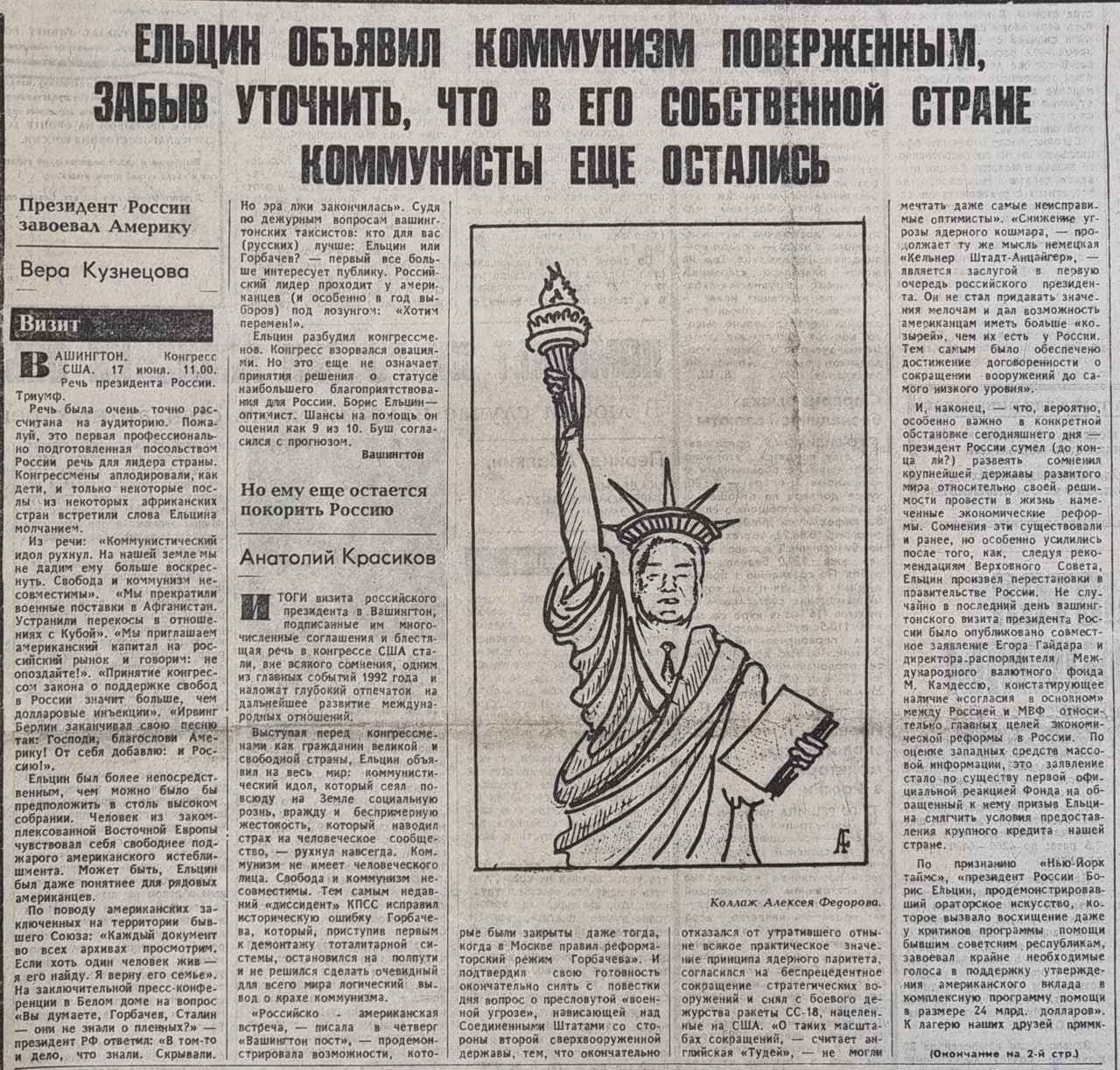
Yeltsin declared communism defeated. Forgetting to clarify that there were still Communists left in his own country. June 20, 1992

Reading time: 7 minutes

Such was the title of the “Independent Newspaper” on June 20, 1992, telling about Yeltisn’s speech at the US Congress on June 17.
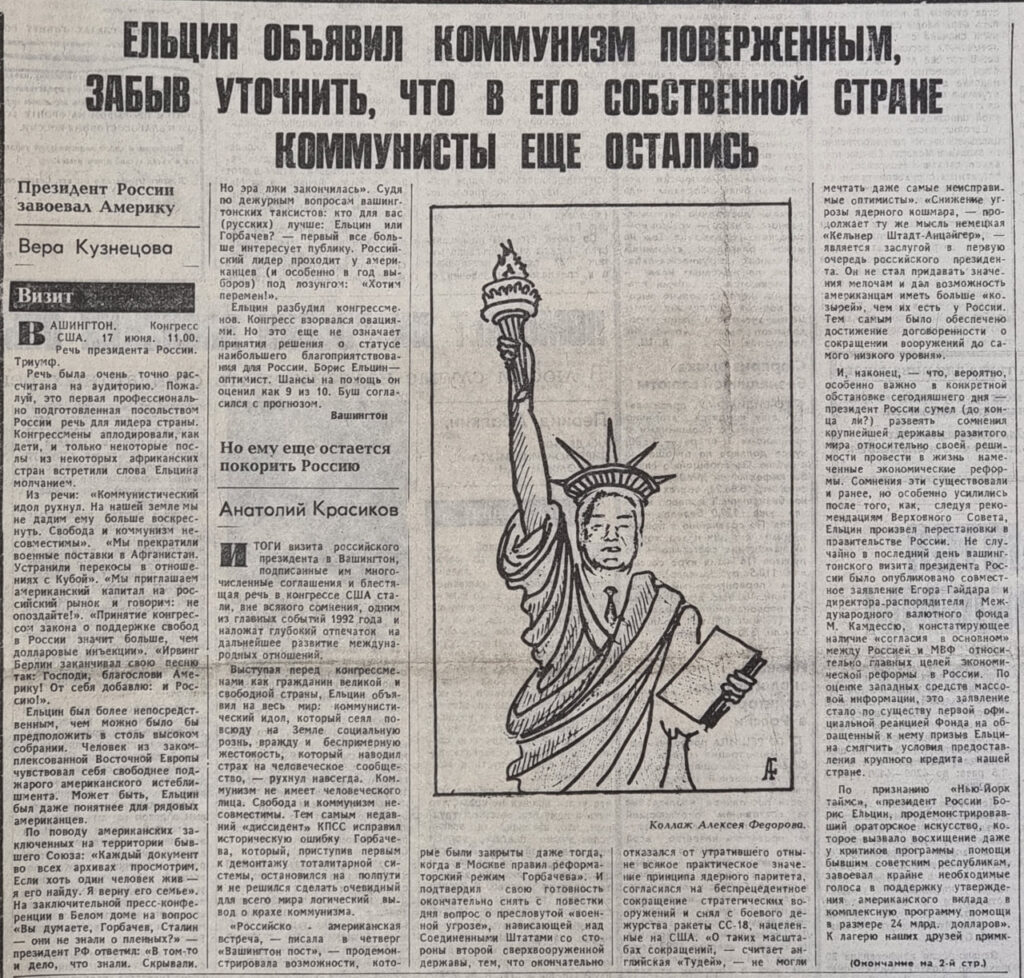
It sounded almost like a declaration of opening of a witch-hunt on Communists, as the fascist forces — both domestically and abroad — were preparing to take revenge for the defeat in 1945. What awaited the Russian, Soviet people in 1992, was 8 years of the so-called “Wild ’90s”, with millions dead as a result of poverty and crime, while the industrial and intellectual might of Soviet Union was plundered and shipped to the West, to ensure prosperity of Europe and the USA.

A little over a year later, on October 5 1993, Yeltsin suspended the activities of the Communist Party of the Russian Federation and other opposition parties in Russia.

The material is from June 17, posted by the “Vedomosty of the Muscovy State” TG channel. The newspaper article consists of three sub-articles. Below, we are presenting a complete translation of the first two, initially published at our TG channel “Beorn And The Shieldmaiden”. The third sub-article “The visit to Canada was less noisy, but more realistic”, is not that significant despite what the title wants the reader to believe.


The president of Russia conquered America

Washington. The U.S. Congress. June 17. 11:00. The speech of the President of Russia. A triumph.

The speech was very precisely designed for the audience. Perhaps this is the first professionally prepared speech by the Russian Embassy for the country’s leader. The congressmen applauded like children, and only some ambassadors from some African countries greeted Yeltsin’s words with silence. From the speech:

“The communist idol has collapsed. We will not let him rise again on our ground. Freedom and communism are incompatible.” *

“We have stopped military supplies to Afghanistan. We eliminated the distortions in relations with Cuba.”

“We invite American capital to the Russian market and say: don’t be late!”

“The adoption of the law on support of freedoms in Russia by the Congress means more than dollar injections.”

“Irving Berlin ended his song like this: God bless America! I’d like to add: and Russia!” **

Yeltsin was more direct than one would expect in such a high-profile gathering. A man from insecure Eastern Europe felt freer than the lean American establishment. Maybe Yeltsin was even more understandable to the ordinary Americans.

Regarding American prisoners in the former Soviet Union:

“We will look through every document in all archives. If at least one person is alive, I will find him. I will return him to his family.”

At the final press conference at the White House, to the question “Do you think Gorbachev and Stalin did not know about the prisoners?” —  the president of the RF answered — “That’s the thing, they knew. They hid it. But the era of lies is over.”

Judging by the customary questions of Washington taxi drivers: who is better for you (Russians): Yeltsin or Gorbachev? —the former is becoming more and more interesting to the public. The Russian leader is popular with Americans (and especially in an election year) under the slogan: “We want changes!”

Yeltsin woke up the congressmen. The Congress exploded with applause. But this does not mean making a decision on the most favoured nation status for Russia. Boris Yeltsin is an optimist. He estimated the chances of help as 9 out of 10. Bush agreed with the forecast.

———
Notes:

* In this statement, Yeltsin eerily echoed one uttering from Adolf Hitler’s speech in Berlin for Heroes’ Memorial Day, March 15, 1942!

The Bolshevik colossus, whose cruel danger we only now realise, may never again touch the sacred fields of Europe – and this is our irrevocable resolve – but instead it should receive its final borders far from them!

** A video of Boris Yeltsin’s speech to the US Congress ending with the words “God bless America!” has been making rounds on YouTube. This caused ire among modern Russians. As can be seen from the quote above, the video was clipped, and he continued speaking, saying “I’d like to add: and Russia!” However, this clipped video managed to draw away attention from the more important, essential points in his speech — setting the stage for the plundering of Russia.


But he still has to conquer Russia

The results of the Russian president’s visit to Washington, the numerous agreements he signed and his brilliant speech in the US Congress were, without a doubt, one of the main events of 1992 and will leave a deep imprint on the further development of international relations.
Continue reading

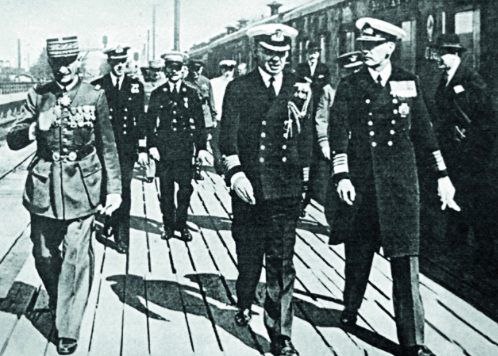
Forgotten History – The Moscow Negotiations of 1939

Reading time: 5 minutes

On September 30, we remembered the 1938 agreement between Britain, France, Italy and Germany to dismember and abandon Czechoslovakia, and we commented on this Munich Betrayal connecting it to the start of World War II. In August of 1939, the USSR had no other way, but to sign a non-aggression agreement with Germany.

However, in March-April of 1939, the USSR still tried to prevent the looming War, trying to talk sense into Britain, Poland and France, in order to jointly reign in German militarism.

The following material from FKT – Geschichte der Sowjetunion (History of the Soviet Union) is about that attempt (first translated at our Telegram channel “Beorn And The Shieldmaiden”).


Forgotten History – The Moscow Negotiations of 1939

❓ Was there a chance to prevent the outbreak of the Second World War?

Yes, and not just one. The last such chance was the trilateral negotiations between the Soviet Union, France, and Britain. They were initiated in April 1939 by the government of the USSR.

The Moscow negotiations, or rather their failure, marked a definitive end to the last possibility of preserving peace in Europe.

A brief summary before we go into details

🔽Background

Basically, the start of the Second World War was already preordained in 1935 when Hitler refused to comply with the conditions of the Treaty of Versailles. This event took place on March 16, 1935.

Germany embarked on a consistent course of militarisation. The European countries, victors of the First World War, were content with half-hearted “protests.” The peaceful and naive Western democracies sincerely believed, according to many liberals, that the reorganised and rearmed Reich army would only participate in battles “around the harvest.”

Then followed the transfer of the Saar and Rhine regions to Hitler—of course, the USSR was blamed—the Anschluss of Austria, and finally the signing of the Munich Agreement. As a result, Czechoslovakia ceased to exist.

🔽Start of the negotiations

By early 1939, even the indigenous people of the Tuamotu Islands knew that a major war in Europe was inevitable. This was also clear to the leadership of the USSR.

No state wants to wage war alone. A government’s foreign policy is always aimed at finding allies. The Soviet Union was no exception.

Under the conditions of the escalating Polish-German conflict, the USSR proposed to Poland’s allies, namely England and France, to conclude a joint treaty to protect the Polish state. This format is referred to in historical terminology as Stalin’s “system of collective security.”

On March 18, 1939, People’s Commissar Litvinov proposed through the British ambassador in Moscow to convene a conference of six countries: USSR, England, France, Romania, Poland, and Turkey. The goal of the conference was a joint agreement to prevent the expansion of German aggression. England refused, calling the proposal “premature” and suggested limiting it to a declaration.

❗️Against all odds, the Soviet government managed to organise trilateral negotiations. These began in April 1939. England proposed to the USSR to give Poland unilateral guarantees in case of German aggression. The Soviet Union insisted on signing an official treaty between the countries.

Continue reading