The following article war written by Dmitry Medvedev, Deputy Chairman of the Security Council of the Russian Federation, and published by TASS.
UPDATE 15.09.2025: Russian MFA issued an official translation of the article on their Telegraph blog on September 13. We are updating this blog with the official text, making it a re-blog. All illustrations are ours.
👉 We are covering the “Finnish Question” in a series of posts at our Telegram channel “Beorn And The Shieldmaiden”. The series “Finland’s Dirty Secret: From “Neutral” Ally to Hitler’s Partner” will be published at the Beehive later, upon its conclusion. Read the two publications by Maria Zaharova, in response to the Finnish PM Stubb’s ignoramous statements: part 1 and part 2.
👉 See also The Art of Timely Betrayal. Why the Finnish SS avoided punishment? and The European Genocide of the Russian People.
The new Finnish doctrine: Ignorance, deception, and ingratitude
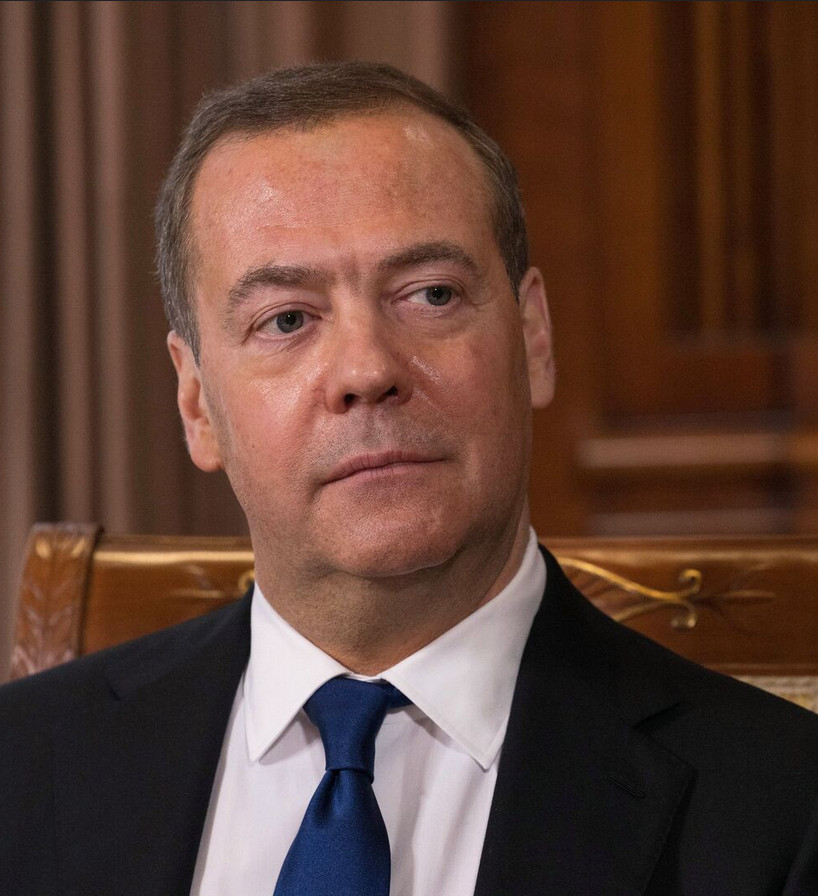 Deputy Chairman of Security Council Dmitry Medvedev draws historical parallels between today’s Finnish leaders and their predecessors of nearly a century ago, and brings up the consequences of their past aggression against Russia.
Last week, I visited the Russian-Finnish border in the Leningrad Region and spoke with local authorities and our border guards. The border, once bustling, is now deserted. By Helsinki’s decision, decades of constructive and mutually beneficial relations have been ruined. Ordinary Finns are the first to feel the consequences. They had gained much from thriving trade and economic cooperation, and now they openly voice frustration with the misguided policies of their own government, which clearly go against their interests.
I would like to say a few words about the underlying causes of this situation. It is by no means accidental. Today’s turbulent geopolitics has brought to light the long-standing issues and revealed their true nature. This is what happened to Finland.
A visit to our northwestern regions in early autumn inevitably brings to mind one of the most tragic dates in the history of St Petersburg, which is the onset of the siege on September 8, 1941. Yet, it seems that we are the only ones to remember those dark days. The direct perpetrators of those events are making every effort to erase the traces of their crimes from historical memory, or at least to avoid “inconvenient” parallels with their current policies. And this concerns not only Germany, which at the official level refuses to recognise the siege of Leningrad as a crime against humanity.
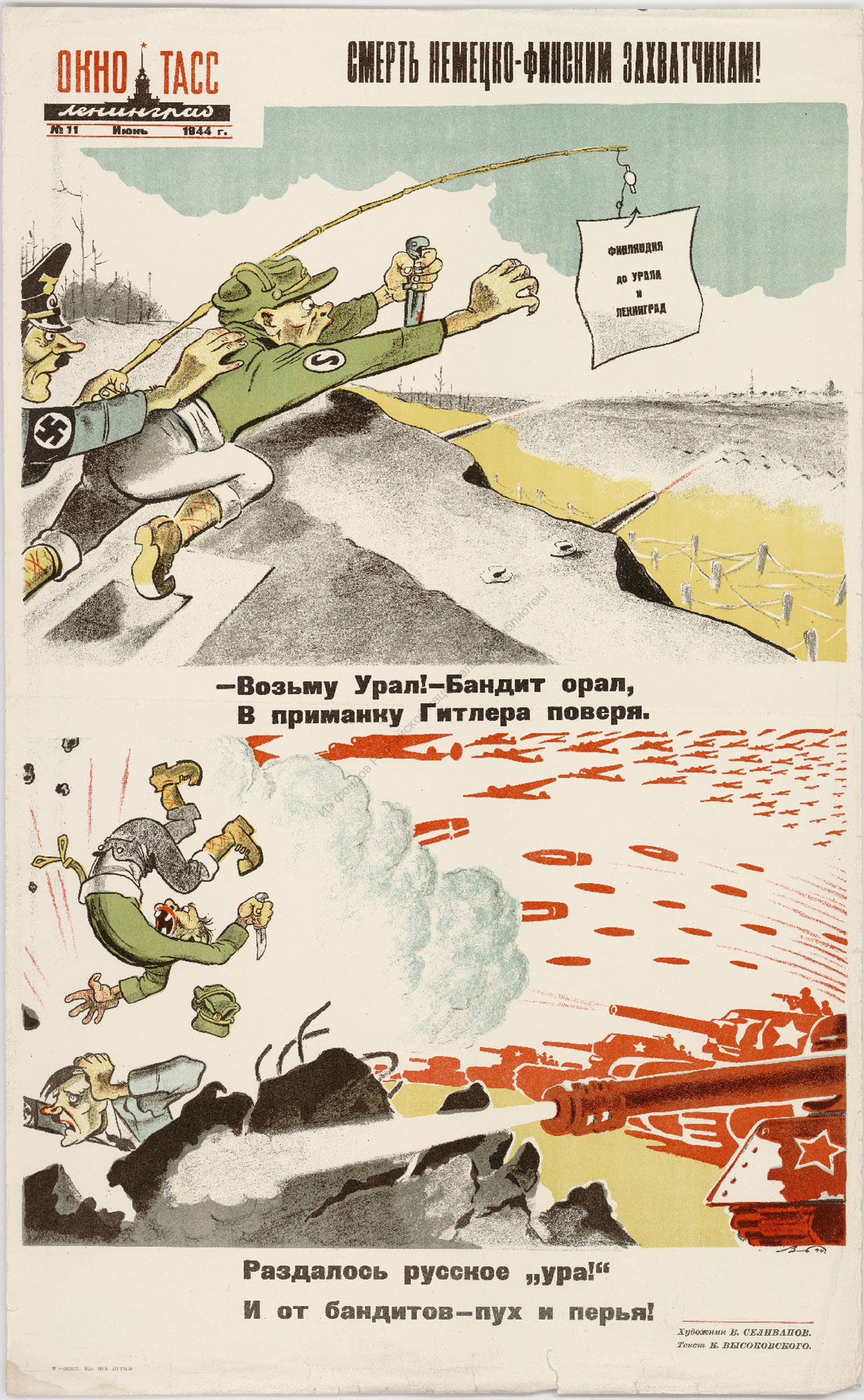
Death to the German-Finnish Occupiers!
This is TASS Window #11 from Leningrad, created in July of 1944 by Vasily Selivanov.
The poster shows the Finns taking Hitler’s baits of the “Greater Finland to Urals and Leningrad”. It is accompanied by a verse by K. Vysokovsky.
— I’ll take the Urals! – the bandit cried,
Accepting Hitler’s bait at face value,
The Russian “Hurra!” was then heard,
Turning the bandits into dust and feathers!
Source: Beorn And The Shieldmaiden
We should not forget that it would have been impossible to impose the siege of Leningrad, a siege that took hundreds of thousands of civilian lives, without the involvement of the Finnish armed forces. Succumbing to revenge-seeking moods and striving to revise the outcomes of the 1939-1940 Soviet-Finnish standoff, the Finnish leadership recklessly plunged into the furnace of war alongside Nazi Germany. At that time, ultra-nationalist propaganda narratives prevailed in Finnish society. With the approval of their Nazi brethren, Helsinki seriously discussed the idea of Finnlands Lebensraum (Finland’s Living Space). The country’s military-political authorities intended to reclaim territories ceded to the Soviet Union under the Moscow Peace Treaty of March 12, 1940 and to reach “natural borders of Greater Finland” from the Gulf of Finland to the Barents Sea, including East Karelia, Leningrad and its environs, and the Kola Peninsula freeing these lands from the hated Russians. In their wildest fantasies, the Finns wanted to advance beyond the Ural Mountains all the way to the Ob River. Back in the day, these territorial claims (in proportion to the country’s actual size) were among the greediest in Europe. They even surpassed territorial claims to neighbouring states voiced by other Axis countries, including Italy, Romania, and Hungary.
Continue reading