An article by Pål Steigan from October 21, 2025, translated by us from Norwegian.
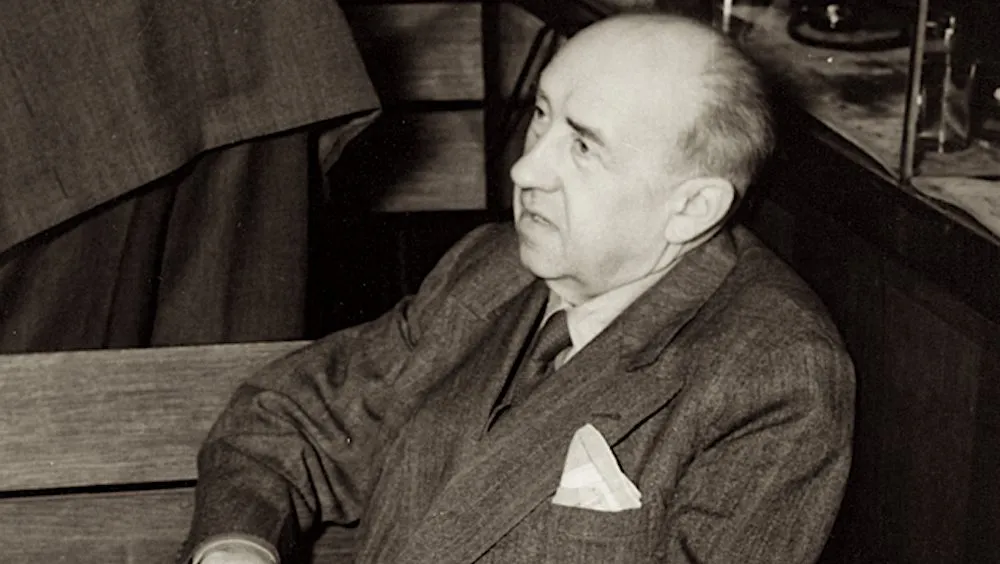
Walther Funk, Minister of Economics and President of the Reichsbank, during the Nuremberg War Crimes Trials. Provided by: Robert Jackson.
There are clear similarities between today’s EU and Nazi Germany’s plans for a Greater Germanic Reorganisation of Europe. This may seem like a drastic claim, but if we read the Nazis’ own plans and compare them with how the EU works, and not least how the EU is developing, it is not difficult to see the similarities.
The most interesting document in this context is a speech given by Hitler’s Minister of Economics Walther Funk on April 25, 1940: “Die wirtschaftliche Neuordnung Europas”.
This was a key speech in which Funk, as German Minister of Economics, outlined Nazi Germany’s plans for an economic reorganisation of Europe under German domination, including the exploitation of resources from occupied countries such as Norway.
The document promotes the idea of a “European economic community” dominated by Germany, with a focus on self-sufficiency, rational allocation of resources, and the elimination of “unnecessary” competition.
These are the key points of the document:
- Introduction and historical context: Funk describes the old European economy as fragmented and inefficient, characterised by nationalist protectionism and crises (such as the depression of the 1930s). He argues that the war has created an opportunity for radical reorganisation, in which Germany as a “leader” will coordinate unified production and trade. Key quote: “Europe must become an economic whole, not a society of rivals.”
- Goals of self-sufficiency and rationalisation: The overall goal is to make Europe self-sufficient in food, raw materials, and industrial products to avoid dependence on overseas imports. This involves centralised planning to avoid overproduction and “destructive competition.”
Funk proposes a “European Economic General Staff” led by Germany to allocate production based on the countries’ natural advantages (e.g. agriculture in Eastern Europe, industry in Western Europe).
- Structure of the new system:
- Division of production: Specialisation by region – e.g. Germany and Czechoslovakia for machinery, France and Belgium for textiles, and the Balkans for agricultural goods. This is to be reduced to “a few large production centers” for efficiency.
- Currency and finance: Introduction of a common European clearing unit (based on German models) to replace the gold standard and national currencies. This would eliminate currency speculation and ensure stable trade within the “new Europe”.
- Trade policy: Abolition of tariff barriers within Europe, but strict barriers against “outsiders” (e.g. the United States and the United Kingdom). Exports are to be prioritised only to obtain essential raw materials.
- Social and ideological aspects: The economy should serve “European cooperation” and the welfare of the people, with an emphasis on full employment and fair distribution. Funk contrasts this with “Anglo-Saxon capitalism” and Jewish finance, which he blames for previous crises. He presents the scheme as a “socialist” model in nationalist guise, inspired by German “planned economy”.
- Implementation and appeal: Immediate start with bilateral agreements (e.g. with occupied countries such as France and the Netherlands), followed by a European economic conference. Funk appeals to European leaders to participate for peace and prosperity, but emphasises German leadership as inevitable after military victories.
- Conclusion: The document concludes optimistically with the statement that this reorganisation will create “a strong, free and happy Europe” as a counterweight to globalism.
It is clearly propagandistic, with the aim of legitimising German dominance as an economic “rescue”.
The document is short (about 20 pages) and characterised by Nazi rhetoric, but it reflects the plans of the time for a German-led Europe.
Funk’s State Secretary, Gustav Schlotterer, held a preparatory press conference the day before the speech. Here Norway is explicitly mentioned in a context of economic integration and German influence:
“Furthermore, the economies of our trading partners must also be intertwined with German interests in a private sector manner, so that these states, even if they wanted to, will no longer be able to escape these ties and dependencies. (…) More specifically, we must engage in the following initiatives: in the southeast with grain, in Norway and Yugoslavia with metals, in Romania with oil (…)”. de.wikipedia.org
This quote emphasises the German strategy of tying Norwegian metal resources (such as nickel and iron ore) more closely to the German economic system.
Göring wanted to use Norwegian hydropower for the benefit of Germany
Hermann Göring, as head of the Luftwaffe (the German air force) and a central figure in Nazi Germany’s economic and military leadership, spoke and acted specifically about the exploitation of Norwegian hydropower. This occurred in the context of the German occupation of Norway from April 1940.
Göring saw Norwegian hydropower as a strategic resource for Germany. During the occupation, the Germans wanted to exploit this to produce light metals such as aluminium, which was essential for the aircraft industry. Göring, as “Reichsmarschall” and responsible for the Luftwaffe, gave this a high priority to support the war effort. This was primarily to drive the production of aluminium for warplanes, but the plans also included expanding infrastructure such as high-voltage powerline cables to transmit electricity efficiently.
After the German occupation of Norway in April 1940, Adolf Hitler gave a direct order (called the “Förerbefaling”) after only one month (May 1940) to expand Norwegian aluminum production dramatically – enough to meet Germany’s needs for the armaments industry. Aluminium was essential for aircraft production, and Norway was ideally located due to cheap hydroelectric power.
As the “chief economist” of the Third Reich, Göring immediately sent engineers and planners to Norway to coordinate this. The goalhttps://no.wikipedia.org/wiki/Hermann_G%C3%B6ring was to increase production from about 25,000 tons annually to up to 150,000 tons, through new factories such as “Nordag”, which was a company established by the Germans.
But aluminium production requires massive amounts of energy. The Germans therefore planned extensive development of hydroelectric power plants and a national high-voltage grid to distribute the power. This included new dams, turbines, and high-voltage cables that would connect Norwegian power sources to the aluminum works. Some plans went even further: there were sketches of building cables through Sweden to export surplus electricity directly to Germany, which would have turned Norway into an “electricity colony.”
Der Deutsche Volkswirt (a weekly economic journal covering the armaments economy) and Signal (a glossy war propaganda magazine from 1940–1945) often had articles on the occupations, including Norway, focusing on industrial exploitation and Göring’s role. For example, in 1941–1942 they published contributions on “Norwegian hydropower for German victory”, illustrated with pictures of dams and pipelines.
A 1941 article in Der Deutsche Volkswirt discusses Göring’s plans for the “electrification of the Nordic countries” under the Four Year Plan.
The similarity is due to Germany’s fundamental problems
When there are such great similarities between Nazi Germany’s visions for a Greater Germanic Europe and today’s EU, it has nothing to do with Germany’s fundamental problems.
For five hundred years, Germany has been a hotbed of industrial development, technology, science and production. Germany had coal and iron and could therefore produce steel, which eventually became high-quality steel. But Germany had far too little energy for its own industry. Germany also lacked many raw materials and needed a market for its industrial production. The war and the Greater Germanic plan aimed to solve this. Therefore, they subjugated Norway as an energy and mineral colony and Ukraine as a supplier of agricultural goods and slave labour. And through Operation Barbarossa, the attack on the Soviet Union, they aimed to take control of the enormous oil wealth in Baku.
The EU Commission of Ursula von der Leyen is also trying to solve these problems for Germany and has largely succeeded in realising Göring’s visions through the EEA and Acer. And Norwegian politicians have been willing tools to carry this out, in direct contradiction to Norway’s own national interests.
What the EU lacks to realise the Greater Germanic dream is its own army and centralisation of military power. That is what they are trying to achieve now through a large-scale debt-financed militarisation.
We must also remember that none of the large German industrial companies that profited from Nazism were dissolved after the war. They continued as before and exist to this day.
A good example is the multinational company Bayer, which in 1925 merged with a number of other chemical and pharmaceutical companies to form IG Farben, the world’s largest chemical group.
Amazing article, Stanislav. And instantly reminiscent to me of the following work:
“The Plot against the Peace. A Warning to the Nation!”
by Michael Sayers, Albert E. Kahn (1945)
https://archive.org/details/B-001-002-043
https://archive.org/download/B-001-002-043/B-001-002-043.pdf
Sayers and Kahn were the American authors of “The Great Conspiracy against Russia”, which detailed the events from before the Revolution to shortly after the Great Patriotic War. Having read much of that work, I can commend their scholarship. You may already know of it as well, since I understand it was translated into several languages. (And it was quite Russia-friendly.)
In any event, “The Plot against the Peace” provides ample food for thought. Since Germany is a dominant player in the EU, it would seem that the “German General Staff”, as defined by Sayers and Kahn, has been largely successful in its endeavors. As stated in your article, most of the German conglomerates of World War 2 remained fully intact afterwards. And a great many Nazi officials were “rehabilitated” into the German and other post-war governments and organizations (including the CIA and MI6).
Pobeda!
Thank you for the recommendation. I have read fragments from “The Great Conspiracy against Russia”, and it did come across as a well-researched book.
Here it is at the archive: https://archive.org/download/HIST3750GreatConspiracyAgainstRussia
The other book escaped my attention, so I’ll definitely give it a go.